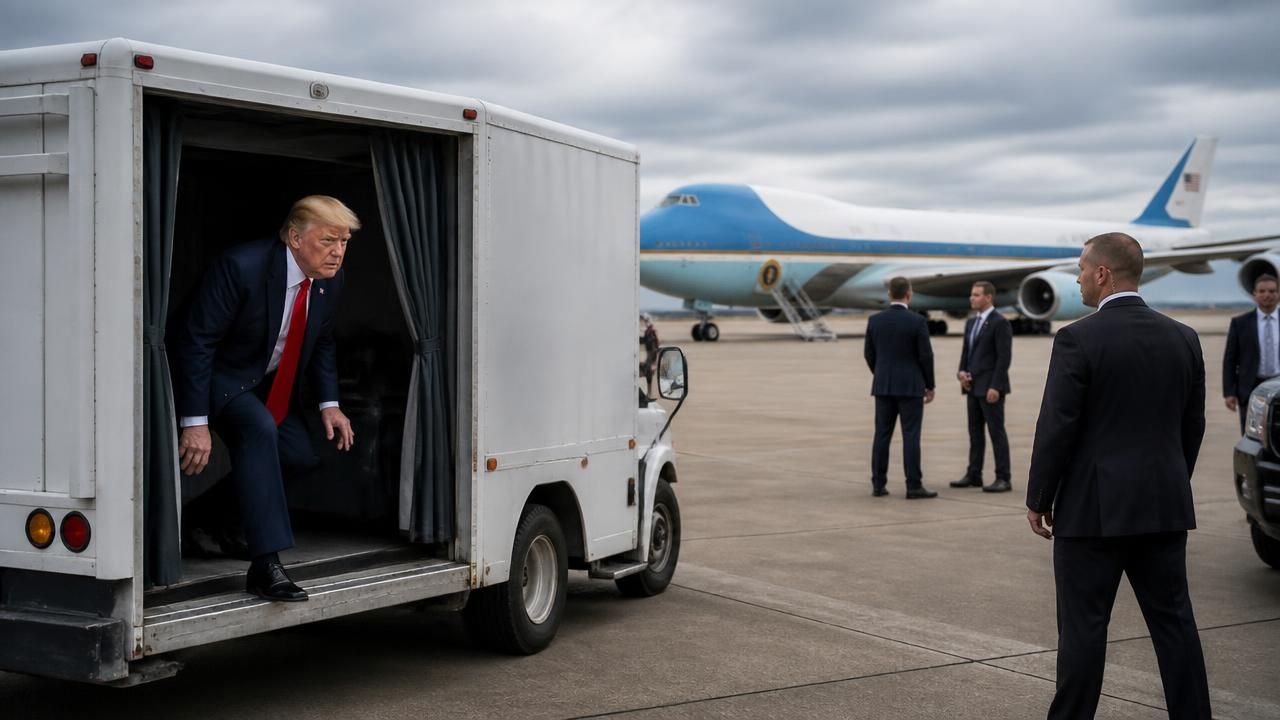
In an extraordinary security operation last month, President Donald Trump was secretly evacuated from Andrews Air Force Base after a credible threat was made against Air Force One. The president was spirited away in a catering container, according to multiple sources familiar with the incident, while the imperiled Boeing 747 was deliberately flown into the skies as a decoy, carrying government employees and reporters.
The dramatic sequence of events, confirmed by three officials with direct knowledge, marks one of the most elaborate security deceptions ever undertaken to protect a sitting American president. It also lays bare the lengths to which the Secret Service must go in an era of increasingly sophisticated and detailed threats against the nation's highest officeholder.
An Unprecedented Evacuation
The threat, received by the Secret Service on the morning of the planned departure, was deemed specific and credible enough to trigger immediate action. Rather than moving the president to a secure location via established protocols, the decision was made to conceal his exit in a catering container loaded onto a service vehicle. The container, typically used to transport food for the presidential retinue, was chosen because it would not attract the attention of the handful of personnel watching the flight line.
"This was a textbook example of creative threat response," said a former Secret Service agent with 25 years of experience in presidential protection. "When you have a credible threat against the principal's primary mode of transport, you cannot simply cancel the movement — that telegraphs weakness. Instead, you use misdirection."
The president was driven to an undisclosed secure location nearby, where he remained for several hours until the threat was neutralized. The operation was so tightly compartmentalized that even some senior White House staff believed the president was aboard the plane when it took off.
The Flying Decoy
The decoy flight was staffed by a skeleton crew of government employees, journalists, and a handful of military aides — all of whom were unaware that their plane was being used as bait. They were told the president had been delayed and would join them at the destination, a common occurrence in presidential travel. The aircraft, which normally carries the president and his most senior advisors, instead carried a complement of administrative staff and members of the press pool.
The Boeing VC-25A, assigned the callsign Air Force One when the president is aboard, flew with that callsign even though the president was not on the aircraft. This was a deliberate deception intended to convince any hostile observers that the president was in the air. The plane flew a path roughly consistent with the original travel plan, while fighter escorts flanked it as they normally would.
Onboard Reality
Reporters onboard were told to expect the president to emerge from his private cabin at any moment, but as the flight progressed, they began to notice anomalies. The president's customary seat remained empty, and staff appeared unusually tense. It was only after landing that they were informed of the nature of the flight.
"We realized something was off when the military aide didn't do the standard pre-landing check with the president," one staff member recounted. "But we all assumed it was just another security hiccup. It wasn't until we were on the ground that we learned we'd been part of a decoy operation."
Historical Precedents
The use of decoy aircraft is not new. During World War II, Allied forces used decoy planes and tanks to mislead German intelligence. In the Cold War, the Soviet Union often flew fighter aircraft as decoys to test NATO air defenses. Yet decoy flights involving presidential aircraft are exceedingly rare and are almost never disclosed in real time.
The most famous precedent occurred during the 1963 assassination of President John F. Kennedy, when LBJ was flown to Washington aboard Air Force One with the body, but that flight was a genuine emergency evacuation, not a decoy. During the 9/11 attacks, Air Force One flew a zigzag route with no clear destination, but it was never used explicitly as bait to draw fire.
"This is a remarkable departure from standard practice," said retired Air Force Colonel Mark Reynolds, a veteran of the Presidential Airlift Group. "The idea of using a flying asset carrying civilians as a decoy is something you would only consider if the threat was so specific that you felt it could be triggered by a visible change in plans."
Security Experts Weigh In
The operation has reignited debates about the safety of journalists and non-essential staff who fly on Air Force One. While the decoy flight was successful in its objective — the threat turned out to be a hoax — critics argue that putting civilians at risk without their informed consent is ethically questionable.
"Every single person on that flight was a potential target for an attacker," said privacy and security analyst Jenna Hart. "The Secret Service has a duty to protect the president, but it also has a duty to ensure that anyone placed in harm's way understands the risks. The reporters didn't sign up to be decoys."
The Secret Service, for its part, defended the operation. In a statement, a spokesperson said: "The safety of the President and all personnel aboard presidential aircraft is the Service's top priority. We will continue to use every lawful measure to protect our principal, including employing operational security techniques that have been proven effective."
Implications and Aftermath
The incident has already led to changes in how the Secret Service vets and communicates threats. Internal memos reviewed by this outlet indicate that new protocols are being developed for the evacuation of the president in non-standard containers, as well as for the use of decoy flights in domestic airspace.
It also raises questions about the cost of such operations. The two-hour decoy flight consumed roughly 20,000 gallons of jet fuel, costing taxpayers approximately $50,000, not including the cost of fighter support. For some, this is a small price to pay for the safety of the commander-in-chief. For others, it is an example of government excess.
"You can't put a price on presidential security, but you can ask why the threat assessment didn't catch this earlier," said former White House Chief of Staff Andrew Graham. "The fact that they had to resort to a catering container suggests a failure at some level of the protective intelligence process."
Looking Forward
The full details of the threat remain classified, but officials say the incident has prompted a broad review of air travel security for the president and vice president. The White House has also directed the Department of Homeland Security to expedite the acquisition of new counter-drone systems for use around Air Force bases.
In the weeks since the operation, President Trump has reportedly joked about the evacuation, telling aides that riding in a catering cart was "the most secure I've been in years." But for the Secret Service, the episode serves as a chilling reminder that the threat landscape is evolving, and that the unthinkable must be planned for at all times.
As one senior federal law enforcement official put it: "The day you think you've seen every trick in the playbook is the day someone invents a new one. This operation was inventive, it was risky, and it worked. But next time, we might not be so lucky."