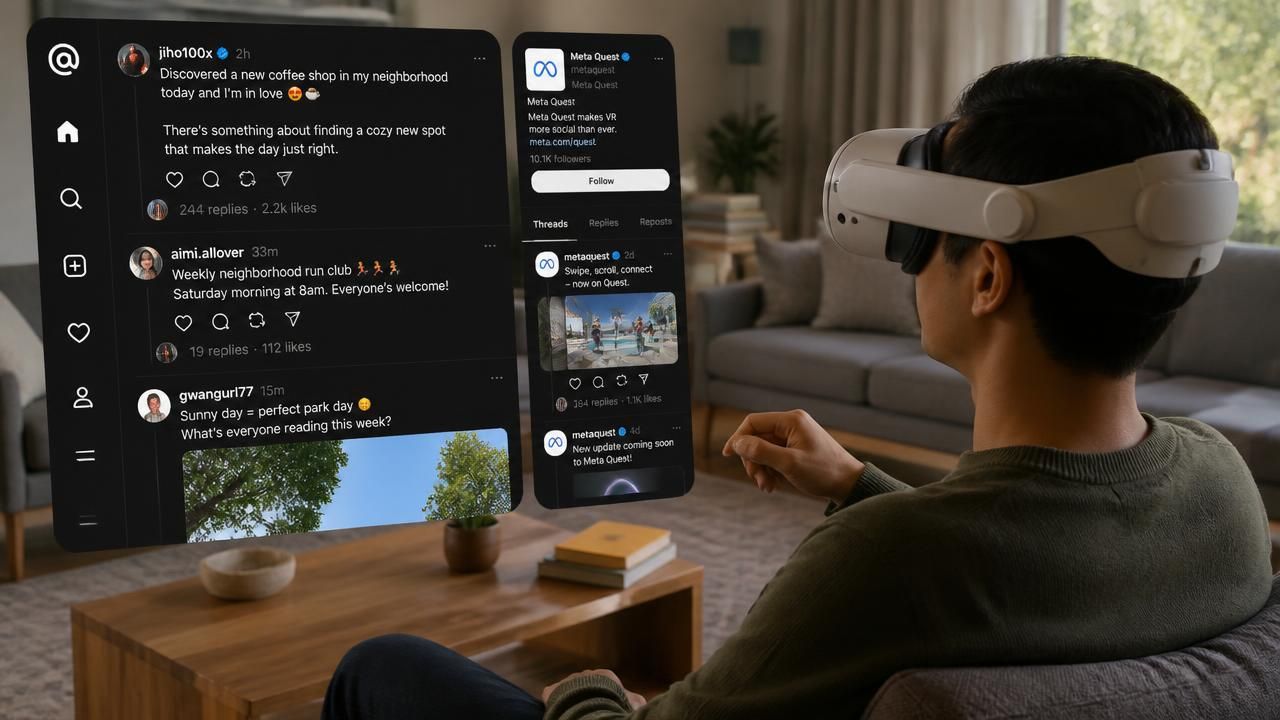
In a move that underscores Meta's ambition to make social media a fully immersive experience, the company on Tuesday launched a dedicated Threads app for its Meta Quest VR headsets. The rollout puts the X/Twitter rival directly into virtual reality for the first time, allowing users to scroll, post, and engage with their feeds without ever leaving their headset.
The launch follows Meta's recent integration of Threads into its Ray-Ban Display smart glasses and arrives as the platform celebrates a major milestone: surpassing 500 million monthly active users. The timing is no accident—Meta is betting that Threads, which had a meteoric rise and then a sharp fall before recovering, is now ready to become the cross-device social backbone of its entire hardware ecosystem.
What the Quest App Offers
According to Meta, the Threads app for Quest is not a stripped-down novelty but a full-featured experience. Users can browse their feed, create posts, like and reply to content, visit profiles, search, and watch videos—essentially all the core functionality of the mobile app, now rendered for virtual reality.
“We designed the new Threads app for Meta Quest to make using VR more social than ever,” Meta said in a blog post. “Whether you want to keep up with conversations during a game or check in with your community between experiences, Threads is now there with you.”
The Verge, which first reported the launch, noted that the app appears to be “pretty full-featured,” suggesting Meta intends for virtual reality to become a legitimate venue for social discourse rather than a novelty side-channel.
A Strategic Pivot Toward “Phone-Style” VR Apps
The Threads launch is part of a broader strategic shift at Meta. Reports indicate that the company's VR app store is about to fill up with more 2D, phone-style applications, moving beyond traditional immersive games and experiences. This could signal a new era for Quest headsets as everyday computing devices, with Threads serving as a Trojan horse for social engagement in VR.
Meta's VR ecosystem has been gaining momentum beyond Threads. The company recently introduced Hyperscape multiplayer, allowing eight-person VR hangouts, and has been steadily expanding the social capabilities of its Quest platform. Leaks of a new, more affordable headset—dubbed the Quest 3S—suggest Meta is preparing to bring these experiences to a broader consumer base.
Threads: From Hype Cycle to Recovery
Threads' journey to 500 million users has been anything but linear. When the app launched in July 2023 as Instagram's answer to Twitter, it shattered records, amassing over 100 million sign-ups in its first week. But the initial euphoria quickly faded. Within months, BBC News reported that daily active users had declined by more than half, and even CEO Mark Zuckerberg acknowledged the drop-off.
Yet the platform has mounted a remarkable recovery. By late 2024, Threads had not only regained its lost momentum but accelerated, crossing the half-billion mark. Zuckerberg has publicly floated the possibility that Threads could become Meta's next social network to reach one billion users, alongside Facebook, WhatsApp, and Instagram.
The recovery has been fueled by a mix of features, integrations, and external tailwinds. As interest in Elon Musk's X has waned amid policy controversies and advertiser pullbacks, Threads has positioned itself as a more stable alternative. PCMag noted a spike in Threads downloads during periods of X turbulence, and The Telegraph framed Meta's aggressive push as “going in for the kill” while Twitter bleeds ad dollars.
Live Chats and Desktop Apps
Meta has also been busy adding features to keep users engaged. Threads recently launched Live Chats for major cultural moments, including the NBA Playoffs and Finals, allowing users to discuss events in real-time. Meanwhile, a desktop app has begun rolling out to some users, with Android Central observing that its design increasingly mirrors Instagram—a sign that Meta is converging its properties around a unified visual language.
One Login to Rule Them All
Perhaps the most consequential development is a plan reported by PetaPixel and Innovation Village: Meta is building a single login system that spans Facebook, Instagram, and Threads. While the company already allows linked accounts, a unified identity layer would make cross-platform switching seamless and further entrench users in Meta's ecosystem—from social feeds to smart glasses to VR headsets.
This move, coupled with the Quest app launch, reveals the contours of Meta's long-term strategy: a world where your Threads feed follows you from your phone to your face to your headset, where social interaction is not confined to a screen but layered onto reality itself.
What It Means for the Future of Social VR
Industry observers are split on whether virtual reality can truly become a daily social destination. A recent WBUR Endless Thread episode questioned if VR will ever shed its niche status. But Meta is clearly betting that the answer is yes, and Threads is its sharpest weapon yet.
By making Threads a native part of Quest, Meta is testing whether users will spend their VR sessions not just gaming, but also participating in text-based social networking. The company's broader push to fill the Quest store with 2D apps suggests it sees the headset as a general-purpose computing platform—one where social media is as essential as games.
The stakes are high. Meta has invested tens of billions of dollars into the “metaverse” concept, and while it has reversed course on some of its most ambitious VR plans—admitting that the metaverse will not be entirely virtual—it remains committed to making headsets a mainstream consumer product. Threads on Quest is a step toward that goal, offering a familiar, low-friction entry point for the billions of people who already use Meta's social apps.
As Zuckerberg sees it, Threads could be the glue that binds Meta's hardware and software into a cohesive whole. If the app's momentum continues and VR adoption ticks upward, the company may finally have the killer use case it has been searching for.
For now, users with a Quest headset can download Threads and start posting from inside virtual worlds. Whether that proves to be a gimmick or a glimpse of the future will depend on whether Meta can make social VR feel as seamless and compelling as the 2D web it aims to replace.