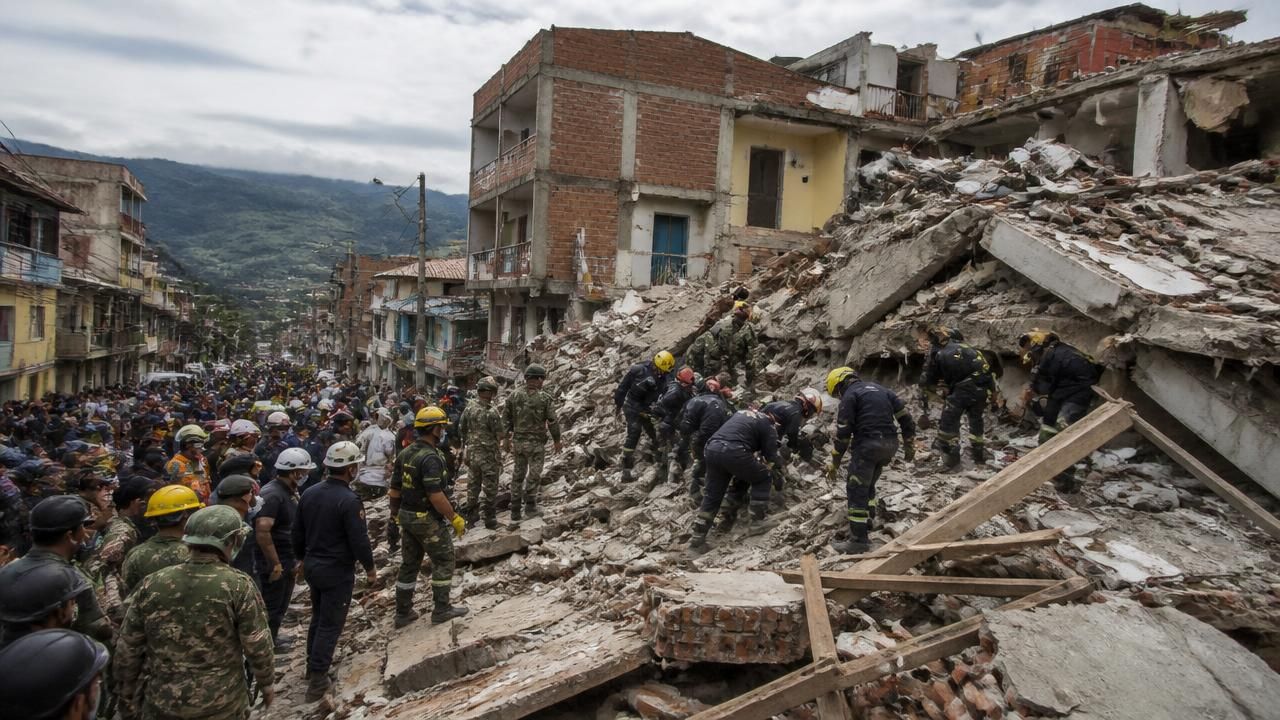
A powerful 7.4-magnitude earthquake struck western Colombia on Monday, killing more than 130 people and injuring over 570, according to local officials. The quake, which the president described as the strongest to hit the region this century, sent tremors through major cities including Bogotá, Cali and Medellín, collapsing buildings, crumbling a historic church and forcing rescue teams to dig through rubble in a race against time.
A Historic 7.4-Magnitude Earthquake Strikes Western Colombia
The earthquake struck at approximately 8:15 a.m. local time, centered near the Pacific coast in the department of Chocó, about 30 miles from the town of San Juan. Its shallow depth of roughly 15 kilometers amplified the shaking, causing widespread damage across a heavily populated region. Initial reports from local authorities cited at least 22 deaths, while other outlets reported 26; within hours, the toll had climbed past 100, and by Monday evening, President of Colombia confirmed 130 fatalities and more than 570 injured in a televised address.
The death toll appeared likely to rise as rescuers searched damaged buildings, the president said.
Rescue and Emergency Response
President declared a state of emergency and mobilized the military to support rescue operations, which are being complicated by damaged roads, power outages, and repeated aftershocks. In the worst-affected cities, including Pereira, Armenia, and Manizales, emergency workers and civilian volunteers have been working around the clock, using cranes, shovels, and even bare hands to free survivors trapped under tons of concrete.
Bloomberg reported that Colombian civilians have been a critical force in the rescue effort, forming impromptu brigades to clear debris and provide first aid before official teams arrived. "People are coming from all over with shovels and water and food," one volunteer told local media. Meanwhile, hospitals are overwhelmed, with reports of patients being treated in hallways and parking lots as medical teams struggle to cope with the influx of the injured.
Key Data on Casualties and Damage
- At least 130 people dead and 570+ injured, according to the president.
- 61 buildings collapsed, including a nearly 100-year-old church in Pereira.
- 10 major cities reported structural damage, including Bogotá, Cali, and Medellín.
- Military and emergency teams are deployed to 12 affected municipalities.
Damage and Destruction: A Nation in Shock
Among the most haunting images of the disaster was the collapse of a historic church in Pereira, where surveillance footage showed the century-old building's bell tower and facade crumbling into dust within seconds. The church, a beloved landmark, had stood for 98 years and was packed with parishioners for a morning mass; according to the New York Post, at least 11 people inside died. The loss of the church encapsulates the cultural and emotional toll of the quake, striking at the heart of the community.
Beyond the historic heartbreak, modern infrastructure also failed. High-rise apartment blocks in Cali swayed violently, cracking at load-bearing joints and leaving hundreds homeless. In Bogotá, the city's metro system was briefly suspended as structural inspections were carried out, and hundreds of aftershocks have kept residents on edge, many spending the night in parks and open squares for fear of further collapses.
Seismic Context: Why Colombia Quakes
Colombia lies along the Pacific Ring of Fire, where the Nazca Plate is subducting beneath the South American Plate. This tectonic collision creates a constant buildup of stress, released periodically in earthquakes. Monday's event, however, was exceptional even for this seismically active region, ranking as the strongest tremor to strike western Colombia in over a century. According to the United States Geological Survey, at least five aftershocks of magnitude 5.0 or greater have already been recorded.
Seismologists note that the region's vulnerability is compounded by lax enforcement of building codes, especially in smaller towns and rural areas. "We are facing a construction legacy that predates modern seismic standards," said Dr. Martina Vélez, a geophysicist at the National University of Colombia. "The destruction is concentrated in older and unengineered structures, which is why in these neighborhoods we see complete pancake collapses."
Media Framing Across Global Outlets
International coverage of the tragedy has varied widely, reflecting different editorial priorities and informational angles. Reuters and The New York Times focused on the scale, with Reuters declaring it the "strongest quake this century" to hit western Colombia. Forbes adopted a humanitarian lens, highlighting the vulnerability of children in the aftermath, warning that "Children At Risk After Major Earthquake Strikes Colombia." The New York Post zeroed in on the crumbling church, crafting a narrative around heritage and loss, while Bloomberg emphasized the role of ordinary citizens in rescue efforts. Meanwhile, The Guardian provided live updates, capturing the unfolding crisis hour by hour, and CBS and BBC initially reported lower death tolls before revising upward as official numbers became clearer.
This disparity in early reporting highlights the challenge of accurate crisis journalism in the digital age, where unverified claims can circulate rapidly alongside confirmed facts. As the event continues to unfold, outlets have attempted to balance emotional impact with forensic data, offering readers both the heartbreak of individual stories and the context of tectonic science.
Recovery and Future Implications
The road to recovery will be long and costly. Experts estimate that rebuilding the affected areas could take years and require billions of dollars. The Colombian government has promised swift aid, but international support will be vital. Humanitarian organizations such as UNICEF and the Red Cross have already launched emergency appeals, with a focus on providing shelter, clean water, and psychological support for the most vulnerable survivors, especially children.
This earthquake is a stark reminder that while tectonic forces cannot be prevented, their toll can be mitigated. The disaster has reignited debates about stricter building codes, seismic retrofitting, and the implementation of early-warning systems that could give residents precious seconds to evacuate. For now, the nation mourns, but from the rubble arises a determination to build back stronger and more resilient than before.