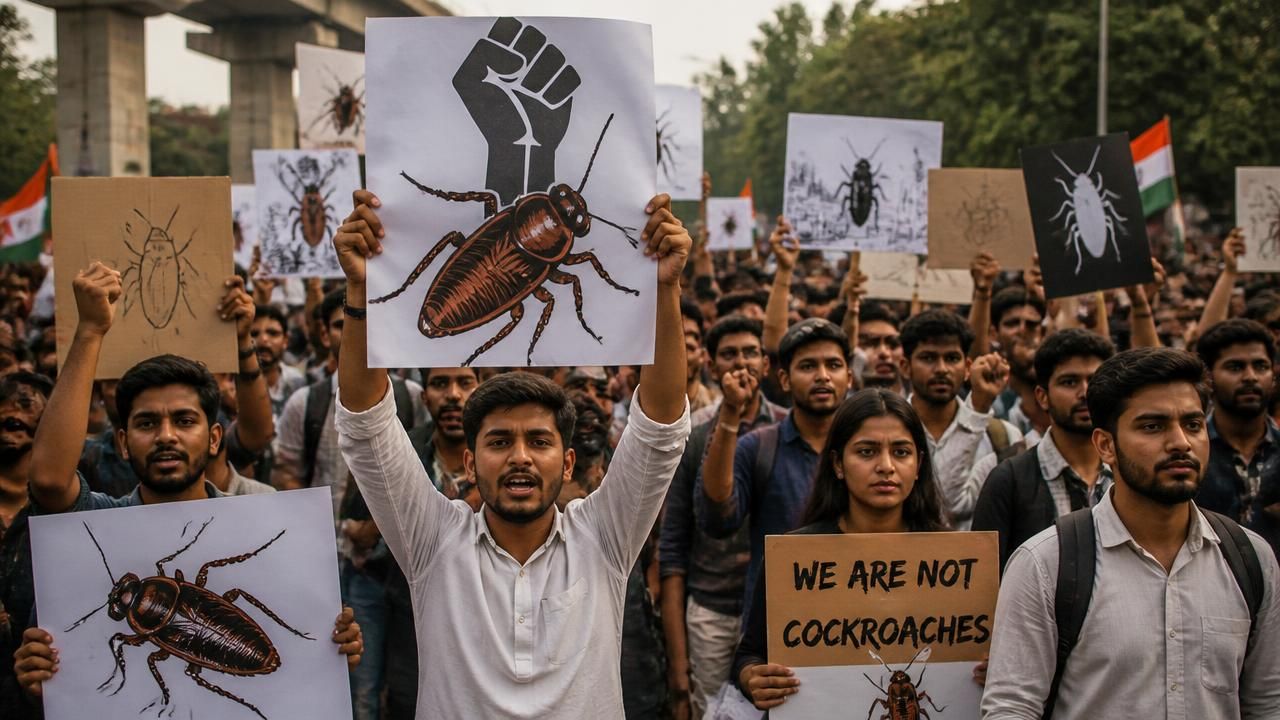
In a country not short of political drama, it is perhaps fitting that India's most talked-about political movement in recent weeks has been named after an insect. The Cockroach Janta Party (CJP) — a satirical collective born from a top judge's dismissive remark about unemployed youth — has grown into a nationwide Gen Z protest movement, forcing a cabinet minister's resignation and confronting one of the country's most powerful leaders, Prime Minister Narendra Modi.
What began as a mock online party now claims the backing of millions of young Indians, and its leaders are carefully navigating a path between street protest and institutionalized pressure group. In a nation where establishment politics often feels impenetrable to the young, the CJP has achieved what many traditional opposition parties have not: a rare victory, and a seat at the bargaining table.
How It Started: A Chief Justice's Unfortunate Phrase
The genesis of the movement lies in a remark attributed to India's Chief Justice, D.Y. Chandrachud, during a court hearing in early 2025. Frustrated with the scale of petition filings, he reportedly compared such litigants to cockroaches — a comment that, when reported, was widely interpreted as a slur against the nation's struggling youth. The remark triggered instant outrage across social media platforms, where unemployment and exam paper leaks have already generated deep frustration.
For many young Indians, the metaphor struck a nerve. As DW News noted on Facebook, "Young Indians are joining a satirical political party, the Cockroach Janta Party, amid outrage over India's chief justice likening unemployed youths to cockroaches." The response was both humorous and defiant: if the establishment saw them as cockroaches, they would embrace the label.
From Memes to Mass Protests
What began as a hashtag quickly coalesced into something more structured. Abhijeet Dipke, a 23-year-old activist, founded the CJP as a parody, but the movement soon took on a life of its own. Within weeks, platforms like Telegram and GitHub were hosting decentralized organizational tools, allowing coordinators across cities to plan protests that were nearly impossible to censor — a phenomenon one analysis described as "how decentralised tech defeated state censorship in India."
The movement's demands were concrete and resonant: cancellation of repeated exam paper leaks, a transparent recruitment process for government jobs, and accountability for the country's chronically high youth unemployment rate. Protests spread from university campuses in Delhi and Mumbai to smaller cities. As the Manhattan Mercury reported, "Mock political party for India's young 'cockroaches' holds first street protest."
The online satire quickly translated into physical street presence. Demonstrators brandished signs with witty anti-establishment slogans, and memes became their most powerful ammunition. According to KFOR, the protests took on Modi "with unlikely weapons: sharp, irreverent humor and memes."
Victory: An Education Minister Steps Down
The movement's first major scalp came on [date], when Education Minister Dharmendra Pradhan resigned amid the escalating protests over exam leaks. CNN reported that the resignation came "after days of 'Cockroach' youth protests over exam paper leaks." The New York Times described it as a "rare victory" for protesters, while The Economist ran a headline that summed up the mood: "Cockroaches 1, Modi 0."
For the CJP's leaders, the resignation was a validation but not the endpoint. "We are standing with the youth of this country," spokesperson Ashutosh Ranka told Bloomberg Markets, emphasizing that the movement would continue to raise youth issues "regardless of who is in power." Ranka signaled political neutrality, stating that the CJP is not aligned with any opposition party and would hold any government accountable.
Prime Minister Modi, who had remained publicly silent for days, eventually broke his silence to address the Gen Z movement — a response widely seen as a defensive acknowledgment of the protests' growing clout. Opposition parties sought to capitalize on the momentum, with several backing the CJP's demands in parliament.
A New Kind of Political Animal
The CJP differs from traditional political formations in both form and ambition. Its founders insist it is not a political party, but a "public pressure group." In an interview with ANI, Abhijeet Dipke said, "CJP will work as pressure group," adding that the organization is focused on restoring accountability and neutrality in institutions. On Thursday, The Logical Indian quoted Dipke as saying, "Citizens don't need elections to demand rights," ruling out any immediate foray into electoral politics.
That stance has earned the movement a degree of trust among young people weary of India's partisan divisions. As the Times of India observed, the movement's growth has spawned countless theories, but its appeal lies in its very absence of a conventional power structure. There are no permanent leaders, no ideological purity tests — just a shared frustration with a system that often feels broken.
Forbes asked, "What made India's Cockroach Movement impossible to ignore?" The answer appears to lie in its decentralized, meme-driven nature, which blurs the line between joke and genuine resistance. In a country where authority is often treated with reverence, a political party that calls itself cockroach and mocks its own leaders with impunity is both refreshing and subversive.
Controversies and Questions
But the movement is not without its detractors. The Federal raised questions about founder Abhijeet Dipke's past ties to the Aam Aadmi Party (AAP), suggesting the CJP might be a covert political project. Dipke has denied these claims, and the movement's insistence on neutrality has largely held. In a telling parody, a viral "Oggy Janata Party" emerged, mocking the CJP as a "soft target" for political manipulation. The episode underscores the deep skepticism surrounding any new youth movement in India's hyper-partisan landscape.
Even the movement's own success has raised concerns. As one Federal article put it, "Message vs messenger: Can CJP stay issue-focused amid youth rage?" The challenge for Dipke and his associates will be maintaining cohesion as the movement transitions from street protests to longer-term engagement.
What Lies Ahead
On Thursday, the CJP announced it is officially ending its protests. Bloomberg reported that the movement "shuns politics, stays pressure group." The organization has launched a nationwide membership drive, aiming to build a permanent infrastructure for citizen oversight and advocacy. Rather than disappearing into the annals of viral trends, the CJP appears intent on institutionalizing itself as a watchdog — one with teeth.
Whether it can retain its youthful energy remains an open question. The movement's very anonymity and amorality are both its strength and its vulnerability. Yet for now, India's 'cockroaches' have proven that a sense of humor, combined with coordinated digital action, can achieve what decades of traditional protest sometimes cannot.
As the CJP moves forward, it carries with it a broader lesson about the shifting nature of political participation in the 21st century: power is no longer simply seized at the ballot box — it can also be scraped together in WhatsApp groups, Telegram channels, and meme pages. And once it is, even the most entrenched establishment will have to listen.