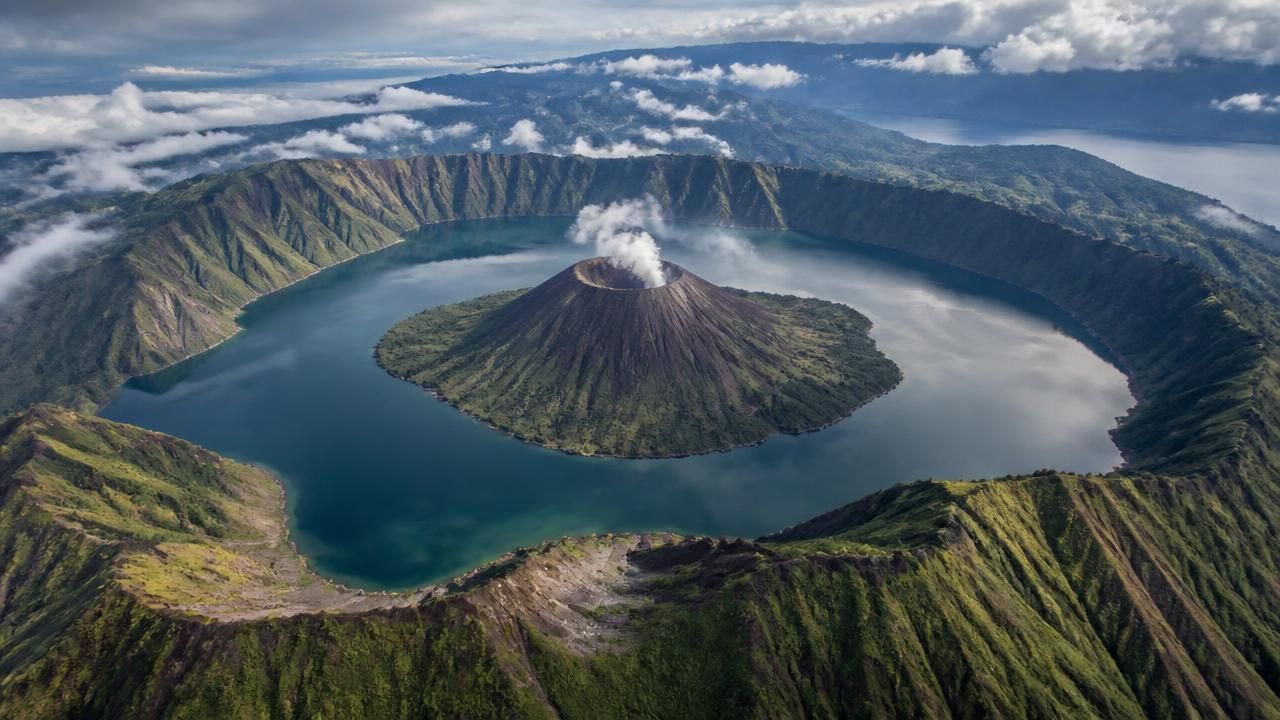
The Mount Toba eruption, which occurred roughly 74,000 years ago on the island of Sumatra, has long been considered one of the most dramatic natural events in human history. As the largest volcanic eruption of the past 2.6 million years, it ejected an estimated 2,800 cubic kilometers of magma—a thousand times more than the 1991 Mount Pinatubo eruption. For decades, researchers and popular media have speculated that this cataclysm plunged the planet into a volcanic winter, causing global temperatures to plummet and driving early humans to the brink of extinction. But a new study published in the journal Geology paints a far less apocalyptic picture.
The study, led by Jinheum Park, a geoscientist at Johannes Gutenberg University in Mainz, Germany, analyzed sediment cores from a crater lake on the Kenya-Tanzania border. The team expected to find evidence of a prolonged cooling event triggered by Toba's sulfur dioxide emissions. Instead, they discovered that the eruption's effects on global climate lasted less than two years and produced a temperature drop of only about half a degree Celsius.
“People thought it might have caused massive cooling of the planet, and hence threatened the survival of our ancestors,” Park said. But the data tell a different story.
Why Toba's Cooling Effect Was So Mild
Volcanic eruptions cool the Earth by injecting sulfur dioxide into the stratosphere, where it forms sulfate aerosols that reflect sunlight back into space. The prevailing theory holds that larger eruptions produce more aerosols and thus more cooling. However, Park and colleagues found that this relationship breaks down for super-eruptions. “Bigger sulfate aerosols settle quickly, because they are heavier,” he explained. These larger particles fall out of the stratosphere within months, drastically reducing their ability to block solar radiation. In effect, Toba's immense power may have made its climate impact shorter and weaker than that of many smaller eruptions, such as Pinatubo's.
The sediment cores from Lake Challa, a deep crater lake near Mount Kilimanjaro, provided a remarkably precise timeline. The lake's annual layers of mud act like natural calendar pages, allowing researchers to measure changes in the environment year by year. Analysis of organic compounds and diatoms revealed no prolonged changes in temperature or rainfall. “It was a surprising finding,” Park said. “We saw a brief disturbance, but the system recovered quickly.”
Supervolcanoes: The Broader Context
The Toba study arrives at a time when supervolcanoes are a topic of intense public interest. Headlines from outlets like BBC Science Focus ask, “Are Earth's supervolcanoes waking up?” and “Would a supervolcano eruption wipe us out?” Sites like Cracked have even listed Toba among history's most horrifying apocalyptic scenarios. While such stories often emphasize worst-case outcomes, the new research suggests that even the most extreme eruptions may be less catastrophic than feared.
Supervolcanoes—defined as those capable of producing eruptions with a magnitude of 8 or higher on the Volcanic Explosivity Index—exist across the globe. Notable examples include Yellowstone in the United States, Campi Flegrei in Italy, and Toba itself, which now forms a vast caldera filled by Lake Toba. Monitoring of these systems shows ongoing ground deformation and gas emissions, but scientists remain divided on the likelihood of another super-eruption in the near future. Most agree that such events occur on timescales of tens of thousands of years, making human-scale preparation difficult but not impossible.
Implications for Human Evolution
The Toba eruption has long been central to debates about human origins. The “Toba catastrophe theory” proposes that the eruption caused a genetic bottleneck—a severe reduction in population size—that shaped the genetic diversity of modern humans. Advocates point to signs of adaptive evolution and a sudden drop in genetic variation roughly 70,000 years ago. Critics, however, have argued that the evidence is inconclusive and that human populations in Africa may have been less affected than those elsewhere.
The new climate data undermines the bottleneck hypothesis. If Toba did not cause prolonged cooling in East Africa—a region key to human evolution—then it likely did not drive humans to near extinction. Instead, the study suggests that early Homo sapiens may have weathered the eruption with relative ease, potentially because they had already developed behavioral and technological adaptations that enabled them to cope with environmental stress. This aligns with archaeological evidence from sites like Pinnacle Point in South Africa, where humans appeared to survive quite well during the period.
Still, the story is not yet complete. New Scientist and Atlas Obscura have both explored the question of whether any volcanic eruption ever wiped out a hominin species. While there is no definitive answer, some researchers have proposed eruptions in the last million years may have contributed to population declines in certain regions. The Toba finding, however, shifts the focus from volcanic winter to other factors—such as climate variability, disease, or competition—as drivers of human evolution.
Different Framings of the Toba Story
The new study has been covered by outlets with strikingly different angles. Ars Technica, which first reported the research, offered a data-driven, skeptical analysis, emphasizing the mismatch between Toba's massive size and its mild impact. Atlas Obscura, in contrast, framed its “How Toba Changed Human Evolution” article around the broader mystery of humanity's ability to survive improbable disasters. Science Focus and BBC assumed a more sensationalist tone, asking whether today's supervolcanoes pose an existential risk.
These varying framings speak to the power of scientific discovery to challenge long-held assumptions. The public is naturally drawn to dramatic stories of apocalypse, but the reality of nature is often more nuanced. “It's not that Toba wasn't a gigantic eruption,” Park said. “It was. But its effects on climate and our ancestors were probably far less severe than we imagined.”
What This Means for the Future
Understanding the true impact of past super-eruptions is crucial for preparing for future ones. If Toba's fallout was as modest as this study suggests, then a modern super-eruption might not end civilization—though it would still be devastating regionally. The research also highlights the importance of studying local climate responses rather than relying on global averages. As Park and his colleagues continue to analyze Lake Challa cores, they hope to reconstruct in greater detail how ecosystems and human populations responded to the eruption.
For now, the image of Toba as a near-extinction event is fading. In its place emerges a more resilient story of early humans—one in which our ancestors faced a colossal eruption and came through, not because they were lucky, but because the planet itself was less fragile than once believed. Whether that resilience can extend to all of civilization in the face of future supervolcanoes remains an open question, but the past suggests we have reason for cautious optimism.