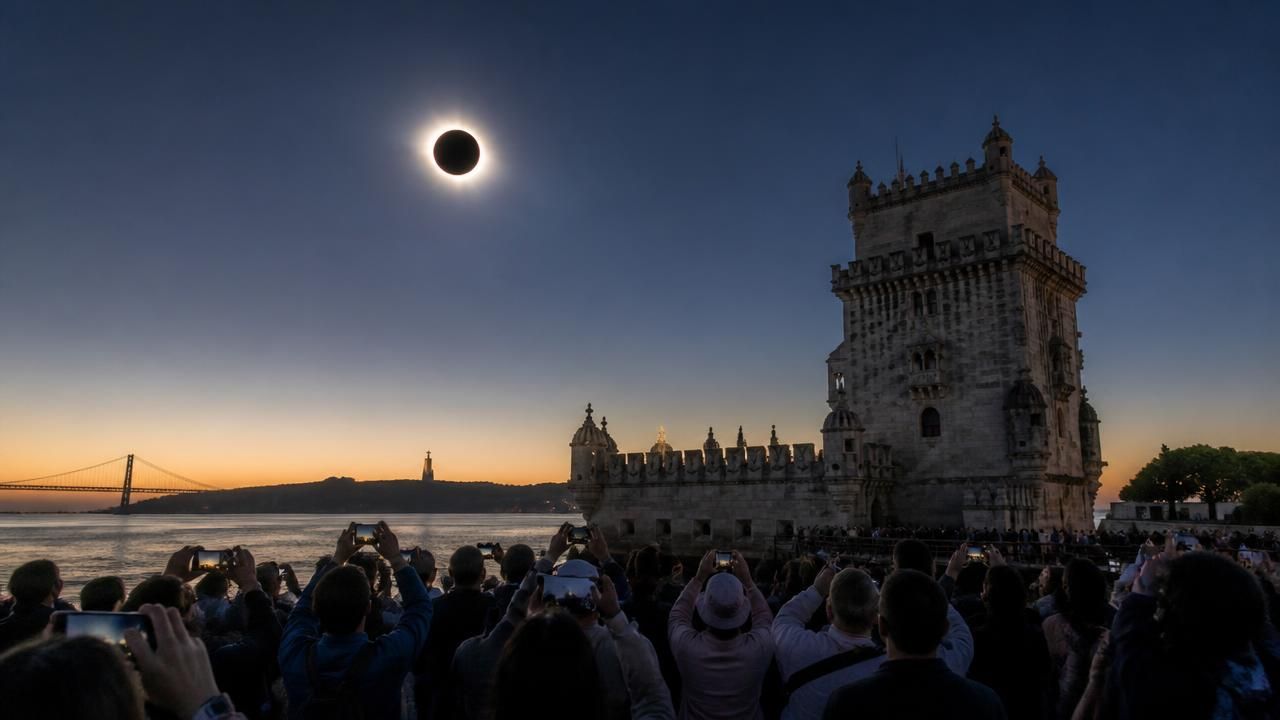
On Wednesday, August 12, 2026, a total solar eclipse will sweep across parts of the Northern Hemisphere, marking the first time in 27 years that totality will be visible from mainland Europe. The Moon’s shadow will race along a path stretching from the remote fjords of eastern Greenland, across Iceland, and then southward through Portugal and northern Spain, bringing darkness in the middle of the day to millions of spectators. It is the first total eclipse visible from central or western Europe since August 11, 1999, a date etched in the memory of a generation that watched from France, Germany, Austria, and the UK.
A Once-in-a-Generation Path
The path of totality — where the Sun is completely obscured — begins at sunrise in the Scoresby Sund region of eastern Greenland, then crosses the Denmark Strait to Iceland, where the capital Reykjavik sits just outside the central line. The shadow then makes landfall in mainland Europe along the Atlantic coast of Portugal and northern Spain, passing over major cities such as La Coruña, León, Bilbao, Zaragoza, and Palma de Mallorca before ending at sunset in the Balearic Islands. According to BBC Sky at Night Magazine, the eclipse will also be visible as a deep partial eclipse across the rest of Europe, including the UK, Ireland, Belgium, France, Italy, and Germany.
For those in the UK, the BBC reports that most of the Sun will be eclipsed across the island of Ireland, with the best views in western Wales and Cornwall. Royal Observatory Greenwich astronomer Imo Bell, speaking on Bloomberg's "This Weekend" with hosts David Gura and Christina Ruffini, emphasized the rarity: "This is the first total eclipse in our skies for over a quarter of a century. It’s a chance not just to see a spectacular natural phenomenon, but to study the Sun’s corona in detail we rarely get from the ground."
Science in the Shadow
Total solar eclipses are unique opportunities for scientists to observe the Sun’s outer atmosphere, the corona, which is normally hidden by the bright disk of the Sun. NASA is sending a specially equipped camera to chase the shadow from an aircraft, aiming to capture high-resolution images of the corona and the Sun’s magnetic field structure. Meanwhile, astronomers across Europe will use the event to study solar activity as the Sun approaches what is expected to be a strong peak in its 11-year cycle. The timing is particularly valuable because the corona appears in dramatic streamers and loops during periods of high solar activity.
“The corona is the Sun’s crown, and totality is the only way we can see it with the naked eye,” said Imo Bell. “Every eclipse teaches us something new about how our star works.”
Myths, Fears, and Eclipse Fandom
As with any major eclipse, misinformation tends to spread. Forbes has published a list of the seven biggest myths about total solar eclipses, debunking claims such as “eclipses emit harmful rays” (the Sun is no more harmful during an eclipse; the danger lies in looking at it without proper eye protection) and “eclipses can harm pregnant women or unborn babies” (a superstition with no scientific basis). Other myths include warnings about poison food and radiation, all of which have been thoroughly debunked by astronomers.
Yet the run-up to this eclipse has also highlighted the growing culture of “eclipse chasers” — a dedicated community of travelers who cross the globe to stand in the Moon’s shadow. France 24 is running a four-part series on these enthusiasts, noting that for many, chasing totality becomes a way of life. Some have seen more than 20 total eclipses; they book flights years in advance and obsess over weather forecasts. This year’s European path is especially attractive because it passes through accessible, densely populated regions, unlike remote eclipses in Antarctica or the South Pacific.
Where to Watch and How to Stay Safe
For those lucky enough to be within the path of totality, the advice is clear: arrive early, expect crowds, and hope for clear skies. Spain is expected to be the most popular destination, and local authorities are already preparing for an influx of tourists. The city of Zaragoza, with a population of over 600,000, is directly on the central line, promising up to 1 minute and 50 seconds of totality. In Iceland, weather is the wildcard — the Atlantic cloud cover often ruins eclipse viewing, but the dramatic landscape of black sand beaches and glaciers offers a spectacular backdrop if the skies clear.
For everyone else — including those in the UK, Ireland, and Belgium — a partial eclipse will be visible, weather permitting. The Brussels Times notes that Belgium will see a partial eclipse, with about 85% of the Sun blocked at maximum. In London, the eclipse will peak around 11:57 BST, with the Moon covering roughly 85% of the Sun. Viewers are warned never to look directly at the Sun without certified eclipse glasses, even during maximum partial eclipse. Regular sunglasses are not sufficient.
Global Perspectives: Who Misses Out
While Europe celebrates, much of the world will miss this eclipse entirely. In India, a major astronomy market, the event will not be visible — a source of disappointment for many enthusiasts, who will have to wait until 2027 for the next total eclipse visible from Rajasthan. Australia’s next taste of totality comes in 2028, when Sydney will be in the path — a fact highlighted by IBTimes as a reason for Australian astronomers to plan ahead. Meanwhile, North America will only see a faint penumbral lunar eclipse later in the month; the next total solar eclipse for the United States is in 2033.
A Sky Full of Fire
Adding to the spectacle, the August 12 eclipse falls during the peak of the Perseid meteor shower. Discover magazine notes that skywatchers may be treated to a double event: in some locations, the Moon will cover the Sun and then, once the sky darkens, bright meteors known as the Perseids will streak across the sky. That is, if the clouds cooperate. This cosmic coincidence underscores the importance of choosing a viewing site with a clear horizon and minimal light pollution.
Looking Ahead: Spain’s Eclipse Dynasty
Spain will be the epicenter of solar eclipses in the coming years. According to BBC Sky at Night Magazine, Spain will experience three solar eclipses in three years — the total eclipse of 2026, an annular eclipse in 2027, and another total eclipse in 2028. This makes the Iberian Peninsula the hottest destination for eclipse chasers in Europe, prompting a new wave of “eclipse tourism” and local economic booms. For scientists, the 2026 eclipse is only the beginning of a period of intense observation opportunities that will advance our understanding of the Sun-Earth connection.
“We leave this eclipse already looking forward to the next,” said Bell. “But for now, on August 12, we will stand in awe and remind ourselves how small we are.”
How to Follow the Eclipse Online
If you cannot travel to the path of totality, many sources will provide live streams. NASA plans a multi-camera webcast with commentary from experts, and the Royal Observatory Greenwich will broadcast from locations in Spain and Iceland. Timeanddate.com will host a global livestream, and Sky News will offer coverage of the event as it unfolds. The eclipse begins at approximately 08:58 UTC, with totality crossing the coast of Portugal at around 10:40 UTC and ending over the Mediterranean at 12:20 UTC.
Regardless of where you are, August 12, 2026, will be a day to look up — and to remember why the heavens have fascinated humanity for millennia.