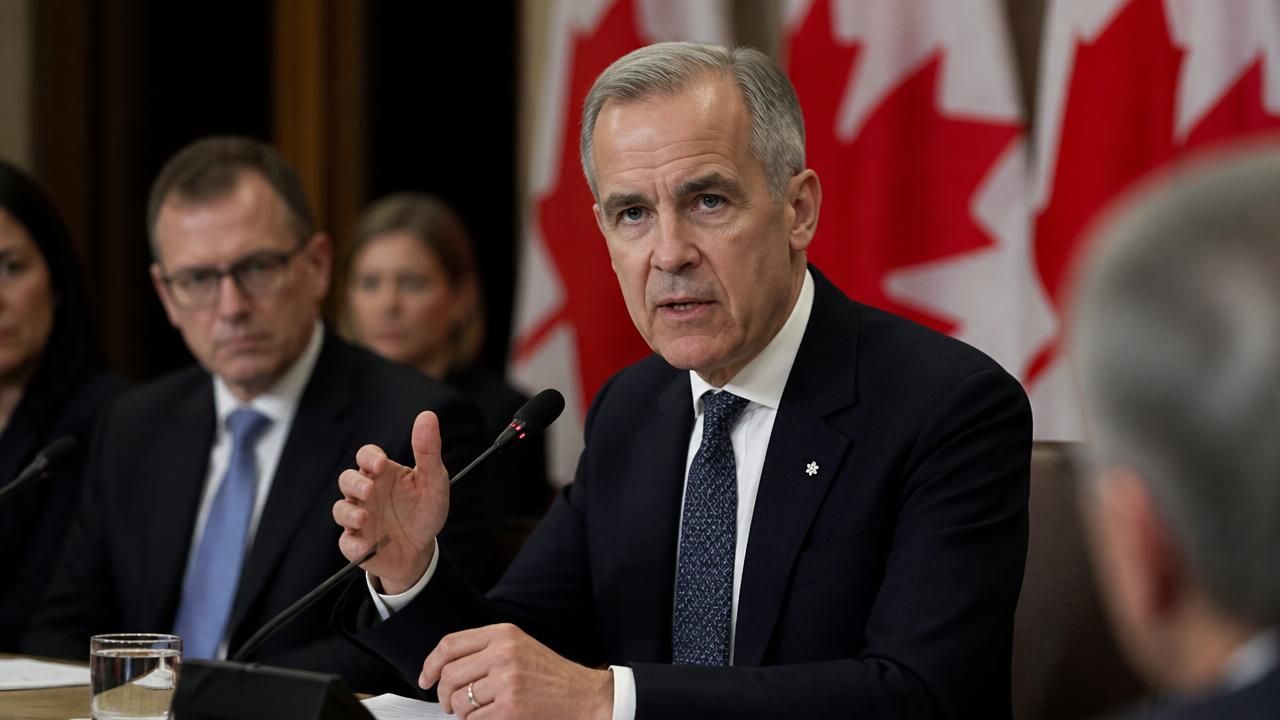
When Mark Carney took office as Canada's 24th prime minister, he inherited a country at a crossroads. A former central banker with a globetrotting résumé, Carney has quickly sought to translate his financial credibility into a new era of Canadian prosperity. The early signals are striking: foreigners poured a record $183 billion into Canadian stocks and bonds over the past year, NATO spending has finally hit the alliance's 2% target, and a high-stakes meeting with Chinese President Xi Jinping produced a surprise tariff truce. Yet for every cheering headline, a skeptical one follows — raising questions about ethics, sovereignty, and whether Carney's ambition outpaces his mandate.
A Banker's Honeymoon
The investment surge is, in large part, a referendum on Carney himself. As Bloomberg News Editor-in-Chief Emeritus Matt Winkler put it, Carney attracts investors because he is “somebody the world knows very well.” A Rhodes Scholar, former Governor of the Bank of Canada, and former Chair of Bloomberg's board, Carney has spent decades in the corridors of global finance. His appointment has been framed by Bloomberg as a triumph of “reasonable” policies — a sharp contrast to the unpredictability of his predecessor, Justin Trudeau.
“Follow the money all the way to Carney's Canada,” Winkler wrote, crediting the new PM for sending a signal of stability to global markets.
The numbers support that read. The $183 billion inflow, measured over the past year, reflects a broader bet that Canada under Carney will be a safe harbor in a stormy world. This optimism has translated into a strong currency and a buoyant stock market, with investors betting that Carney's technocratic instincts will translate into pro-growth policies.
The Price of Ambition
Carney has not been shy about spending that political capital. One of his first major announcements was the creation of Canada's first sovereign wealth fund — a proposal that the Fraser Institute, a conservative think tank, greeted with skepticism. “The Carney government's sovereign wealth fund is not the best way to help grow wealth in Canada,” the Institute argued, suggesting that pouring public money into state-managed investments risks crowding out private enterprise and inviting political interference. The fund, which Carney has pitched as a way to harness resource revenues for long-term prosperity, has become a flashpoint in the election campaign.
On defense, Carney has delivered a long-awaited milestone. Under his watch, Canada finally met NATO's 2% of GDP spending target, a commitment that had eluded successive governments and drew criticism from allies, particularly the United States. The New York Times noted that this achievement burnishes Carney's internationalist credentials, even as it raises questions about how sustainable the spending increase will be.
Domestically, Carney has pivoted sharply on climate policy. He has shifted the carbon price strategy, vowing to make Canada a “clean energy superpower.” This has pleased environmentalists but worried oil-producing provinces like Alberta. Politico dubbed this “Carney's Alberta problem,” noting that his attempts to balance climate action with energy development may satisfy neither side. The Fraser Institute, meanwhile, has published a list of ways the Carney government could “unshackle” Canada's energy sector — advice that likely goes unheeded in Ottawa.
Navigating a Fractured World
Overseas, Carney has moved quickly to reset key relationships. His meeting with Xi Jinping produced tangible results: China and Canada announced tariff relief, and Canadian beef is once again headed to Chinese markets. Reuters reported that the thaw came after a “high-stakes meeting” that Carney had framed as essential to diversifying Canada's trade dependence on the United States. But the deal has drawn criticism from human-rights advocates and opposition MPs, who accuse Carney of compromising on values for commercial gain. The Bureau flagged concerns about police cooperation clauses in the agreement, warning of “risks to Canada's sovereignty.”
On the other side of the border, Carney's relationship with Donald Trump got off to a rocky start. In a Davos speech, Trump took a thinly veiled swipe: “Canada lives because of US.” The remark, reported by the BBC, underscored the tension between the two neighbors as they renegotiate trade terms. Political analysts at the Atlantic Council suggest that Carney's reputation as a steady hand may help manage the relationship, but Trump's unpredictability remains a wildcard.
Carney is also rewriting Canada's role on the world stage. Politico reports that “Canada rewrites its UN script,” signaling a more assertive foreign policy. But when asked about potential Canadian involvement in the Taiwan Strait, his Foreign Minister demurred, saying Canada might help “just not yet.” That cautious stance reflects a broader balancing act between China, the US, and Canada's own interests.
The Domestic Backlash
Not everyone is impressed. Conservative critics, including Pierre Poilievre, accuse Carney of “steamrolling basic constraints on power,” as National Post put it. The Walrus has raised questions about Carney's wealth, asking whether his personal fortune tests the limits of Canada's ethics laws. Yahoo News ran an op-ed titled “Justin Trudeau was bad, but Mark Carney will be far worse,” arguing that the new PM is an elitist out of touch with working-class Canadians. Even progressives are wary: Mondoweiss has urged Carney to chart a new course on Palestine, a sensitive file he has yet to address substantively.
Carney's response has been to double down on his message of pragmatic ambition. “Build, baby, build,” he declared, promising action on housing, infrastructure, and energy. The phrase, captured by BBC News, is a deliberate echo of Trump's own rhetoric — a sign that Carney is ready to fight on the terrain of growth and national pride.
What Comes Next
Mark Carney's first months in office have been anything but timid. He has leveraged his financial reputation to attract capital, pushed through long-delayed defense commitments, and opened a new chapter with China. But the same qualities that make him a global statesman — his comfort with elite institutions, his willingness to make bold bets — also make him a target for domestic critics who see a man too eager to concentrate power and too willing to cut corners.
Canada is now a test case: Can a banker-turned-politician deliver both prosperity and accountability? The money says yes, but the politics are far from settled. As Carney prepares for an election, the battle lines are drawn — and the world is watching.