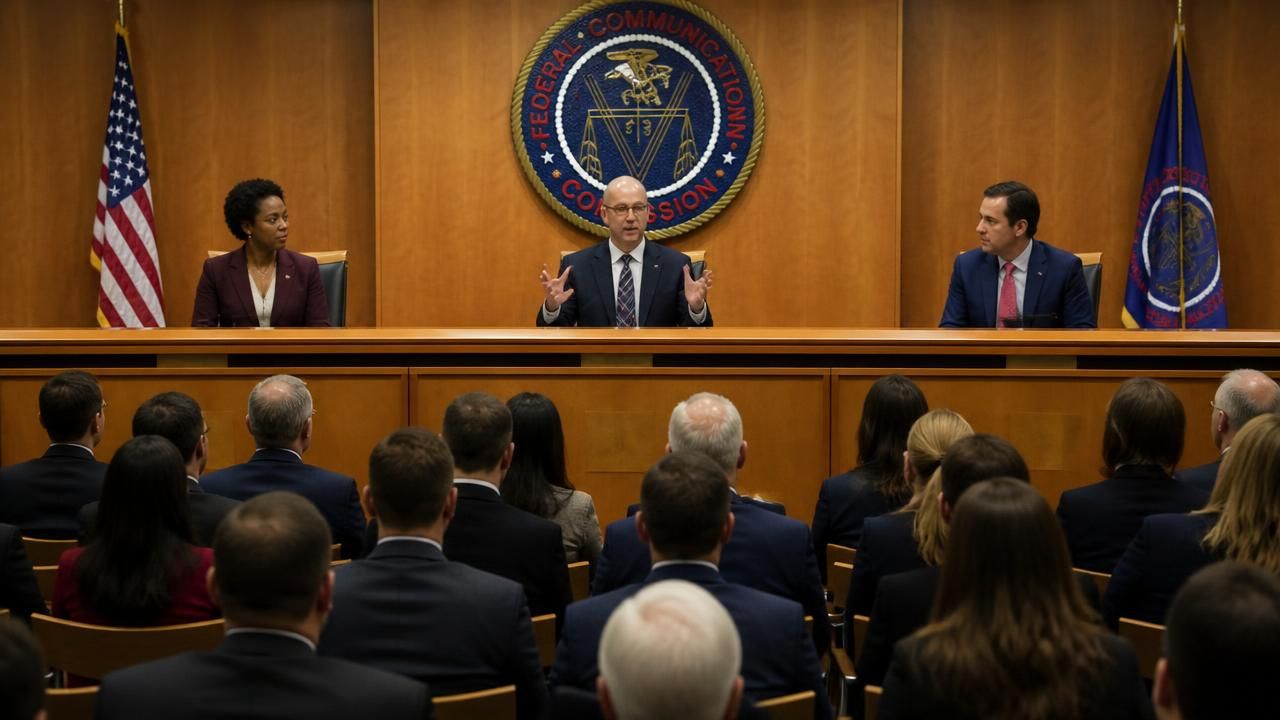
The Federal Communications Commission voted along party lines on Thursday to scrap a decades-old rule limiting how many U.S. television households a single broadcaster can reach, a move that could reshape the media landscape and ignite a legal battle over executive authority. The 2–1 decision eliminates the National Television Ownership Rule, which prohibited any broadcast station owner from reaching more than 39 percent of all TV households in the country.
Chairman Brendan Carr, who led the charge, argued that the rule is outdated and puts broadcasters at a competitive disadvantage against streaming giants like Netflix and Hulu that face no such ownership restrictions. "This will empower the FCC to approve deals that promote the public interest while allowing the agency to reject any deals that do not meet that standard," Carr's office said in a press release. Under the new framework, the FCC will review proposed mergers on a case-by-case basis rather than applying a rigid numerical cap.
A Rule Born in Congress, Now Repealed by an Agency?
The 39 percent cap was not merely an FCC regulation—it was written into law by Congress in the Telecommunications Act of 1996. That legislative origin now stands at the center of a fierce legal and political controversy. The Trump administration's FCC is claiming authority to override a statutory limit, a move that critics describe as an overreach of executive power.
Tom DeLay, the former House Majority Leader who helped craft the 1996 law, is among those crying foul. In an interview with Ars Technica, DeLay said the FCC has no authority to repeal a limit set by Congress. "The FCC is not Congress. They cannot unilaterally repeal a statutory limit," DeLay said, adding that the move sets a dangerous precedent for administrative agencies to ignore the will of the legislature.
"The FCC is not Congress. They cannot unilaterally repeal a statutory limit." — Tom DeLay, former House Majority Leader
Boost for Trump-Friendly Media? Critics See Consolidation Risk
Ars Technica's coverage framed the decision as a potential boon for Trump-friendly news organizations, which could now acquire more local stations and expand their reach. The timing is notable: Sinclair Broadcast Group, known for its conservative commentary, has long pushed to relax ownership limits. Proponents argue that allowing broadcasters to scale up will help them compete with tech platforms and streaming services that dominate the advertising market.
But opponents warn that the repeal will accelerate media consolidation, reducing the diversity of voices and increasing the power of a few corporations. "This is about protecting the public interest, not corporate profits," said a spokesperson for a media advocacy group. "Eliminating the cap without a clear alternative invites a wave of mega-mergers that could stifle independent journalism."
Case-by-Case Review: A Fig Leaf or a Genuine Safeguard?
Chairman Carr insists that the case-by-case approach will allow the FCC to scrutinize deals more effectively than an arbitrary cap. In practice, however, such reviews are often less transparent and less predictable than clear rules. The FCC will now weigh each merger based on its specific facts, but without a clear threshold, broadcasters may feel emboldened to push the envelope.
Legal experts expect challenges from public interest groups and possibly Congress. "The FCC has historically interpreted its authority narrowly when it comes to ownership limits," said a media law professor. "This decision is a direct challenge to Congress's role, and courts may not look kindly on the agency's reasoning."
First Amendment Advocates Alarmed: The Jimmy Kimmel Case in Context
The FCC vote comes amid broader anxieties about media freedom and free speech. First Amendment advocates have grown increasingly worried after ABC pulled Jimmy Kimmel's show earlier this week following controversial comments about conservative activist Charlie Kirk. The decision was reportedly made under pressure from advertisers and political groups, raising questions about whether broadcast networks are willing to cede to partisan demands.
According to the New York Post, Kimmel is set to return to ABC after a backlash from fans and colleagues, but he will not apologize for his remarks. "He's not backing down. He believes he was speaking the truth," a source told the Post. The incident has become a flashpoint in the debate over cancel culture and media independence, with some arguing that networks are too easily swayed by political pressure.
For First Amendment advocates, the Kimmel episode and the FCC's ownership cap repeal are two sides of the same coin. "We are seeing a convergence of threats to a free and independent press," said a representative from a civil liberties group. "On one hand, the government is reducing ownership restrictions, which could concentrate power in the hands of a few friendly outlets. On the other, private corporations are caving to partisan attacks and pulling programming that offends the powerful. Both trends undermine the public's right to diverse information."
What Comes Next?
The FCC's decision is not final in a broader legal sense. It will be published in the Federal Register, and then opponents can file lawsuits. Given the strong opinions on both sides, the battle over the TV ownership cap is likely to move to the courts, where the question of administrative authority will be tested.
For now, broadcasters and media moguls are celebrating a major deregulatory victory. But the longer-term impact on the American media landscape remains uncertain. Will the case-by-case approach stand? Can Congress reclaim its authority? And how will this affect the news viewers see every day?
- The FCC voted 2–1 to eliminate the 39% TV ownership cap, replacing it with case-by-case merger reviews.
- The cap was established by Congress in the Telecommunications Act of 1996; Tom DeLay argues the FCC lacks authority to override it.
- Critics say the decision benefits Trump-friendly media and could lead to increased consolidation.
- The Jimmy Kimmel/ABC controversy highlights separate but related First Amendment concerns in media.
- Legal challenges are expected, with the outcome likely to shape the future of broadcast ownership in the U.S.
As the debate unfolds, one thing is clear: the fight over who controls America's airwaves is far from over.