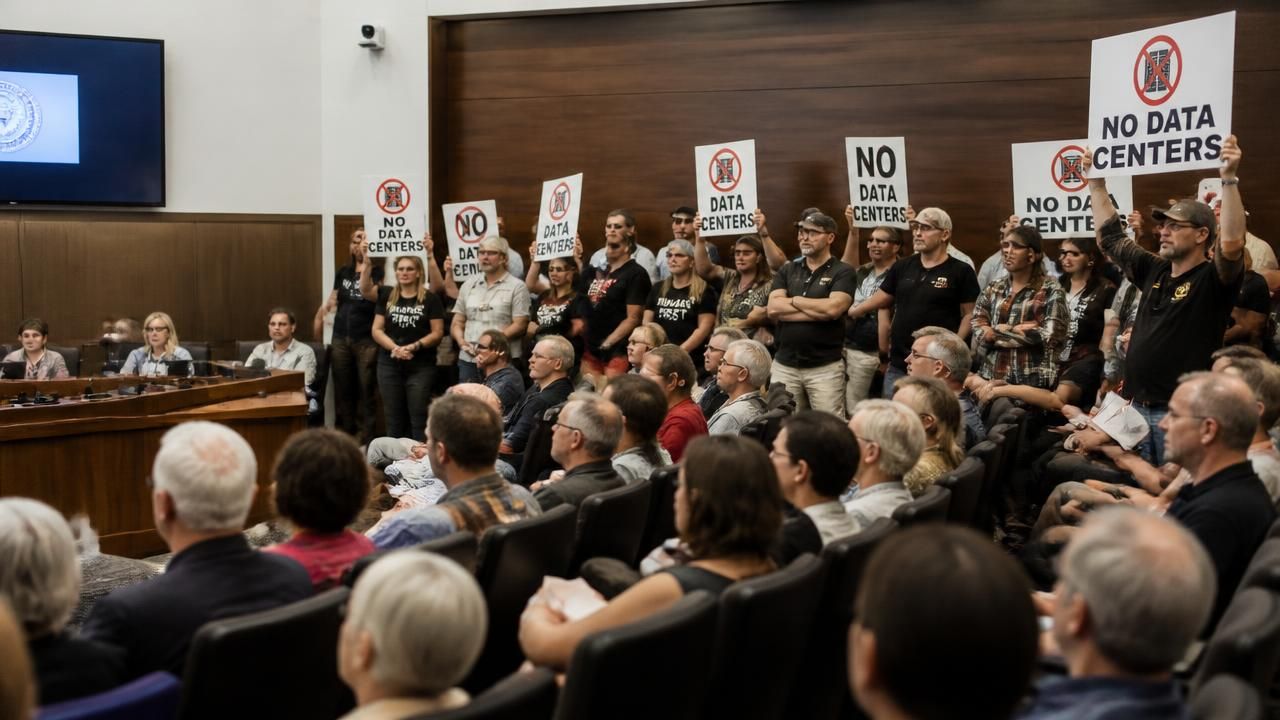
In Hernando County, Florida, last month, the county commission unanimously approved a yearlong moratorium on new data center construction—not because of a partisan fight, but because of a rare moment of unity. The meeting was attended by protesters from Humans First, a conservative grassroots group that has become an unlikely standard-bearer in a fast-growing movement against the physical infrastructure of the AI boom.
The scene is emblematic of a broader rebellion sweeping across the United States. Data centers—the warehouses of servers that power artificial intelligence—have become the target of intense community opposition, uniting voters across the ideological spectrum in ways that few issues can. The New York Times recently dubbed it “the most bipartisan issue since beer,” while the Michigan Advance declared that “just about everyone hates data centers.”
A proxy for AI anxieties
According to Gaby Del Valle, a policy reporter at The Verge who attended the Hernando County protest and covered the moratorium, data center construction has become a proxy for the public’s feelings about AI: “something physical they can aim their fear and frustration at—and even create enough pressure to stop through community organizing and protests.”
“It was part of a bigger, broader, and bipartisan opposition to data centers. Not only as physical buildings, but as infrastructure that powers an AI boom that takes local jobs and fills feeds with slop.” — Gaby Del Valle, The Verge
Del Valle notes that the issue is scrambling traditional party lines. Many of the protesters in Florida are diehard Trump voters who now find themselves championing causes often associated with the left, such as groundwater contamination and “forever chemicals” (PFAS). “Data centers are scrambling party lines, turning diehard Trump voters into protesters who care about left-coded issues,” she observed on The Verge’s Decoder podcast.
Groundwater, noise, and taxpayers
The specific complaints vary by location, but the pattern is consistent. In Hernando County, residents worry about water usage, contamination, and noise. In Independence, Missouri, residents have filed a lawsuit against the city over massive tax breaks granted to an AI data center. According to KCUR, the lawsuit argues that the incentives will not deliver the promised economic benefits and will instead shift the tax burden onto ordinary citizens.
- Hernando County, FL: Unanimous one-year moratorium on data center construction after community protests.
- Independence, MO: Residents sue city over tax abatements for a proposed AI data center.
- Ohio: OpenAI reportedly in talks to lease a 10-gigawatt data center, with backing from Nvidia—an enormous facility that could become a lightning rod.
- Virginia: Lawmakers and local governments grapple with a surge of data center proposals and their impact on grid reliability and rural landscapes.
Political realignment in real time
The backlash is already shaping elections. At the first GOP gubernatorial debate in Michigan, candidates traded personal blows but found rare agreement on taxes and data centers. In South Dakota, a similar dynamic emerged: key moments from the debate included sharp criticism of data center incentives. As The Oakland Press reported, candidates across the Republican field are sensing a winning issue by aligning with voters who feel left behind by the AI rush.
The political appeal cuts both ways. While conservatives often oppose government subsidies, they are equally suspicious of big tech and its cultural influence. Progressives, meanwhile, cite environmental justice and labor concerns. The result is a genuine convergence—one that may be unique in modern American politics.
The staggering scale of AI’s footprint
The opposition comes as tech companies are spending billions on new infrastructure. The Information reports that OpenAI is in talks to lease a 10-gigawatt data center in Ohio with backing from Nvidia—a project that would be among the largest facilities of its kind in the world. Such investments highlight the immense energy and water demands of AI, which are expected to grow exponentially as models become larger and more ubiquitous.
Yet local communities are increasingly unwilling to absorb those costs without commensurate benefits. “Data centers bring few permanent jobs,” notes a recent analysis. “They typically employ only a handful of engineers and security guards after construction, while consuming as much electricity as a mid-sized city.”
Broader fears about AI’s trajectory
The data center revolt is also a symptom of deeper unease about where AI is heading. The Atlantic recently published a piece titled “America Isn’t Ready for What AI Will Do to Jobs,” warning of massive disruption to the labor market. TechPolicy.Press challenges the “Myth of AGI,” arguing that the hype surrounding artificial general intelligence obscures the more immediate, tangible impacts of the technology. And The Guardian has explored why we can no longer agree on what’s true—a problem amplified by AI-generated slop flooding social media.
“The physical data center has become the visible symbol of an invisible revolution—and the public is pushing back.” — This article’s synthesis of multiple sources
What happens next?
The pushback is likely to slow the pace of AI infrastructure buildout, at least temporarily. Moratoriums give communities time to study the long-term effects, while lawsuits may force companies to negotiate better terms. Some state legislatures are already considering bills to regulate data centers or eliminate tax breaks. In Virginia, for example, lawmakers have debated special session measures to address grid capacity and siting rules.
At the same time, demand for AI computing power shows no signs of abating. Major cloud providers and AI labs are competing for scarce energy contracts, and a single large training cluster can consume more electricity than thousands of homes. The clash between local resistance and global ambition will likely define the next phase of the AI era.
For now, one thing is clear: in an age of deep political polarization, the low hum of a data center is a sound that unites left and right—in opposition. From rural Missouri to the Florida Gulf Coast, communities are demanding a voice in the AI revolution, and politicians on both sides are paying attention.