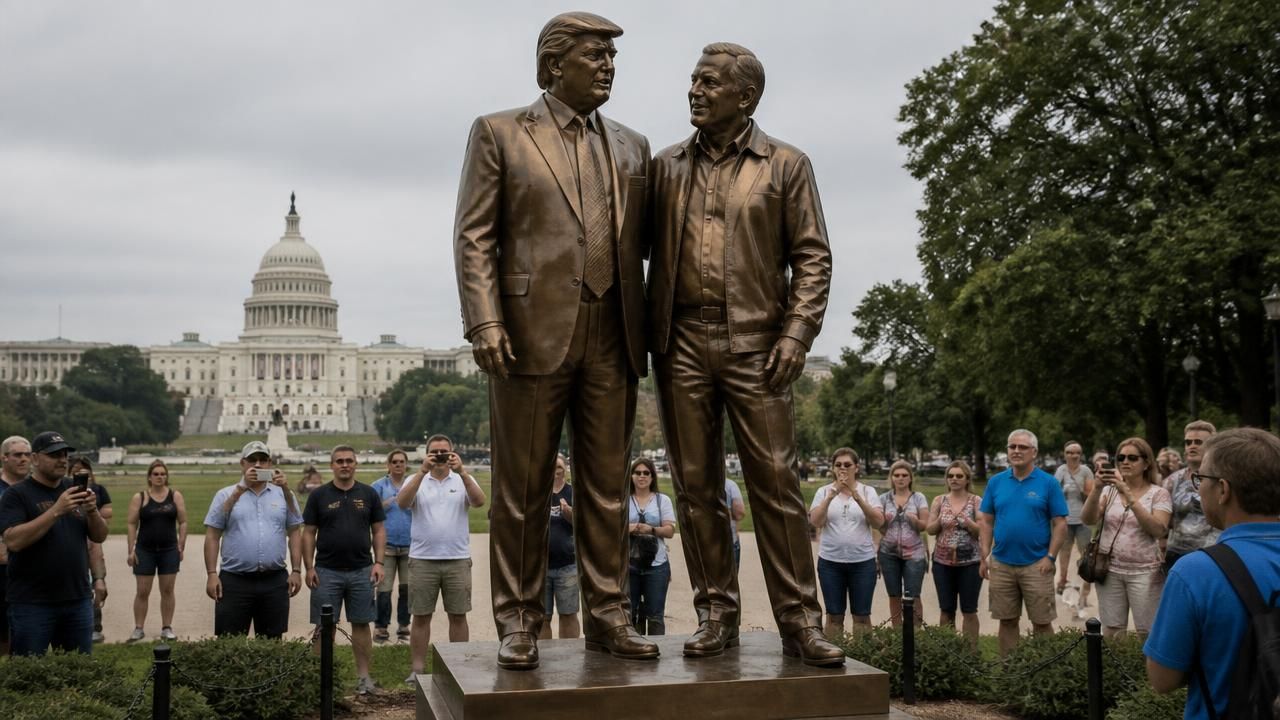
It was a week of stark contrasts in Washington. As President Trump threatened new action in the Middle East and slapped massive new tariffs on Chinese goods, a peculiar and provocative piece of political art appeared on the National Mall—a statue depicting Trump alongside convicted sex offender Jeffrey Epstein, titled “Best Friends Forever.” The statue, which briefly stood in the nation's capital, included lines from Trump's birthday message to Epstein, stirring fresh debate about the president's past associations and his current foreign policy decisions.
A Statue That Shook the Capital
The statue appeared Tuesday on the National Mall, drawing immediate attention from tourists and press alike. It depicted President Trump and Epstein standing together, with a plaque referencing Trump's 2021 birthday tribute to Epstein—who died in 2019 while awaiting trial on sex trafficking charges. The artwork, likely an act of political protest, was quickly removed, but not before images flooded social media.
The incident highlights the enduring controversy over Trump's relationship with Epstein, which has become a recurring flashpoint in American politics. Critics argue the statue serves as a blunt reminder of the former president's connections to a man convicted of serious crimes. Supporters, meanwhile, dismiss it as a cheap stunt by political opponents. The statue's brief appearance coincided with more consequential White House actions, creating a jarring news cycle that juxtaposed the absurd with the grave.
Mideast Moves and Mixed Signals
According to the New York Times, the president's latest round of threats and pullbacks in the Middle East has left analysts and lawmakers scrambling to interpret his intentions. The central question: whether negotiations with Iran will genuinely begin Monday or whether the president is merely cycling through unappealing options. The Times report quotes unnamed analysts who say the administration's approach remains “unpredictable,” fueling uncertainty in an already volatile region.
“Analysts and lawmakers are trying to divine whether Mr. Trump’s latest announcement means negotiations with Iran will truly get underway Monday or if the president is just working through unappealing options.” — The New York Times
This ambiguity is consistent with Trump's broader style, which often oscillates between confrontation and diplomacy. His latest threats toward Iran have raised tensions in the Strait of Hormuz, while his administration simultaneously hints at possible talks. The lack of clear direction complicates efforts by allies and adversaries to craft a coherent response, and it leaves U.S. policy in the Middle East in a state of flux.
Tariff Turmoil and Investor Anxiety
Meanwhile, Reuters reported that investors are reacting to Trump's massive increase in China tariffs. The move, which escalated the ongoing trade war, has sent ripples through global markets. While the full impact remains unclear, the tariff hike raises costs for businesses and risks reigniting inflationary pressures. Investor sentiment swung from cautious optimism to fear of a prolonged trade conflict, with equity markets showing increased volatility.
For businesses that rely on cross-border supply chains, the tariff increase could prove significant. Some companies are scrambling to adjust sourcing, while others are passing costs onto consumers. Economists warn that a full-scale trade war would harm both nations and undermine global economic growth, but Trump has repeatedly framed tariffs as a negotiating tool to force China to the table.
When a Salad Recipe Becomes a Distraction
In an era of information overload, even a sour cream and onion dip recipe can capture the public's fleeting attention. A New York Times Cooking recipe, which reimagines the classic dip as a bright, punchy salad with a creamy dressing, went viral on social media this week—the exact same week as the statue controversy and the political upheavals. The Facebook post promoting the recipe drew praise like “This is such a clever recipe. I'm impressed by the flavor and simplicity.”
While the recipe has no political connection, its virality underscores how social media can simultaneously amplify trivial content and major news. For many users, the statue, the tariff announcement, and the Mideast tensions all competed for attention alongside a comforting image of salad. This eclectic mix reflects the fragmented nature of modern news consumption, where serious policy issues and casual lifestyle content share the same feeds.
What It All Means
The convergence of these stories—a provocative statue, volatile foreign policy, economic upheaval, and a viral recipe—paints a portrait of a moment defined by contradiction. President Trump remains a figure who dominates the news cycle, whether through deliberate policy moves or unintended cultural flashpoints. The statue may be gone, but its symbolism lingers, reminding the public of past controversies. The Iran and China decisions, by contrast, carry real-world consequences that will unfold for months.
As lawmakers and citizens puzzle over the administration's direction, one thing is certain: the news cycle under Trump never lacks for surprises. From the serious to the surreal, the events of this week offer distinct yet overlapping perspectives on a presidency that defies easy categorization.