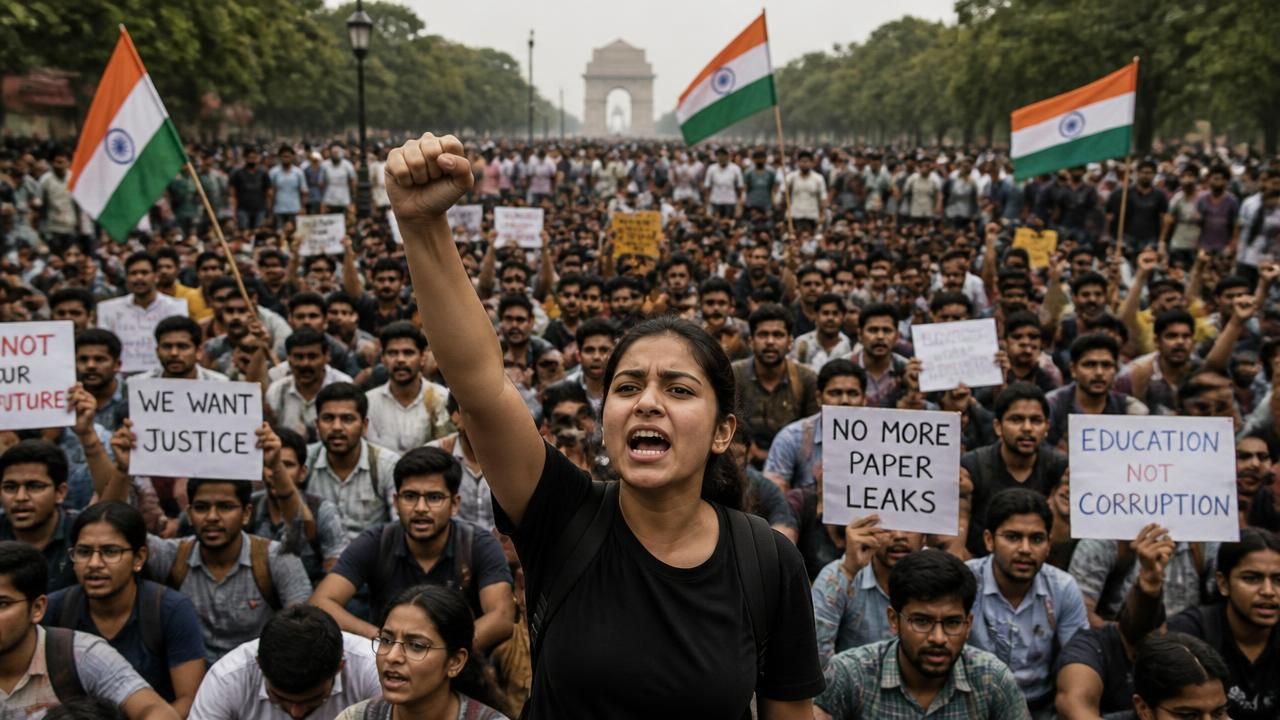
In a political earthquake that has rattled India's establishment, a loose coalition of students and young professionals—self-deprecatingly calling themselves 'cockroaches'—has forced the resignation of Education Minister Dharmendra Pradhan and challenged the aura of invincibility surrounding Prime Minister Narendra Modi. What began as outrage over leaked exam papers and chronic unemployment has morphed into a full-blown youth movement, amplified by sharp-edged memes, social media virality, and a generation that refuses to be silenced by traditional political machinery.
The movement, which Bloomberg News describes as the 'Cockroach Movement,' erupted after leaks in the NEET medical entrance exam and other competitive tests shattered the dreams of millions. For India's youth, the leaks were not just a bureaucratic failure but a symbol of systemic rot: an education-to-employment pipeline that rewards the connected and punishes the meritorious. With youth unemployment hovering near historic highs, the anger quickly metastasized into broader protests against economic stagnation and a government seen as increasingly out of touch.
Who Are the 'Cockroaches'?
As The Guardian reports, the name itself was born from an insult hurled at protesters by a politician's relative, who dismissed them as 'cockroaches.' Far from being crushed, the protesters embraced the label. 'What if all cockroaches came together?' became a rallying cry, spawning a deluge of memes, GIFs, and satirical videos that flooded Instagram, X, and WhatsApp. The movement's decentralized nature—no single leader, no formal organization—makes it both elusive and resilient. It is powered by Gen Z's native fluency in digital spaces, a tactic that The New York Times notes has blasted through Modi's carefully constructed media control.
One striking image, captured by an Associated Press photographer, has become the movement's defining visual: a 27-year-old woman standing calmly before a police van full of detained students, her arms crossed, her expression defiant. That woman, whose identity remains partly anonymous, embodies the accidental heroism that has inspired thousands to take to the streets in cities from New Delhi to Kolkata.
A 37-Day Standoff and a Minister's Fall
The protests reached a crescendo over 37 days of sustained agitation. Activists, many of them medical aspirants and their families, camped outside government offices, clashed with police, and endured mass arrests. In a significant escalation, dozens of student leaders were detained, prompting the movement to threaten a nationwide restart of protests. The government's initial response was heavy-handed: tear gas, water cannons, and internet shutdowns. But the digital cockroaches proved impossible to stamp out.
Pressure mounted as iconic figures joined the cause. Environmental activist Sonam Wangchuk, who had been on hunger strike in solidarity with the students, ended his fast only after the government agreed to formal talks with protest leaders. The Guardian's reporting highlights that the Biden-era diplomatic corps took note, and international media amplified the movement's grievances. Finally, in a dramatic concession, Education Minister Dharmendra Pradhan resigned—a move the government framed as voluntary, but which protest leaders claimed as a direct victory.
'PM shaken, govt jittery,' said Congress spokesperson Jebi Mather, capturing the opposition's glee. 'The youth have shown that the emperor has no clothes.'
Different Lenses, One Story
The protest movement has been dissected across the political spectrum. Bloomberg Markets frames it primarily as a political challenge for Modi ahead of major elections, underscoring that youth disaffection could translate into a demographic dividend turned demographic disaster. The left-leaning Struggle-La-Lucha argues that the 'cockroach' revolt is a working-class uprising, and that Modi's government could be broken if labor joins students. Meanwhile, AI-focused newsletters interpret the movement as a 'disturbance in the Force'—the moment when technology-empowered youth begin to disrupt entrenched political monopolies. PBS News notes the irony that Modi, who rode to power on promises of employment and development, now faces the deepest cracks in his support base from the very people he sought to uplift.
Even conservative outlets like Chosun and Pakistan Today have covered the story, the latter emphasizing that the government is 'seeking time' on further demands. The Philippines-based Mothership.sg captures the global resonance: 'Derided as India's cockroaches, youth protesters have shaken Modi's grip on power.'
What the Protesters Want
- Immediate cancellation of leaked exams and a transparent re-test process.
- Judicial inquiry into the leaks and punishment for those responsible.
- Concrete action on India's jobless growth—not just lip service.
- Accountability from the Election Commission and politicians who dismiss their concerns.
Concessions and a Tense Future
Modi has offered an olive branch by 'forgiving' students involved in protests and pledging to examine their grievances. But critics note that the resignation of Pradhan, while significant, may be a sacrificial lamb rather than a systemic fix. The government has thus far stopped short of yielding to all demands, and protest leaders have vowed to remain mobilized. The Guardian warns that unless meaningful changes occur, the movement could reignite at any moment.
This youth rebellion does not exist in a vacuum. It coincides with other headaches for Modi: trade tensions with the United States, threats of 25% tariffs on Indian goods, farmer protests over agricultural policies, and opposition outrage over the Election Commission's credibility. As India heads into a crucial election cycle, the 'cockroaches' have demonstrated that political power no longer resides solely in party offices or TV studios; it lives on smartphone screens and in the collective memory of a generation that refuses to be ignored.
The Bigger Picture
Analysts see this movement as a watershed moment for Indian democracy. Historically, youth-led protests in India—from the anti-corruption Anna Hazare movement of 2011 to the student activism at Jawaharlal Nehru University—have sparked change but often fizzled. The 'cockroaches' may be different. Their use of AI-generated satire, encrypted messaging, and global solidarity networks suggests a new playbook for civic engagement. As one viral post put it: 'You call us cockroaches, but you can never exterminate us—we are everywhere.'
For now, the world watches as a phalanx of youth—armed with little more than smartphones and a fierce belief in fairness—roaches forward, challenging the most powerful politician in the world's largest democracy. Whether this moment becomes a footnote or a turning point depends on whether India's leaders truly listen. But one thing is certain: the cockroaches have already crawled out of the shadows, and they are not going back.