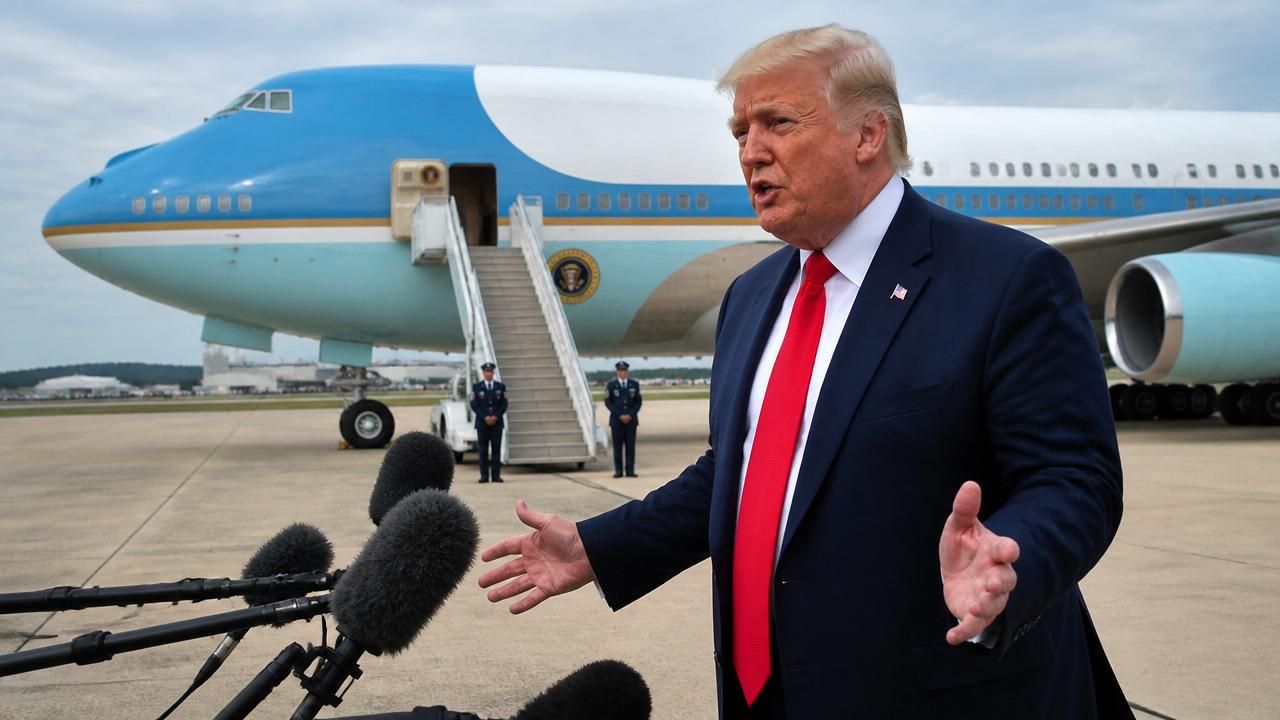
The White House announced that President Donald Trump's new Air Force One—a Boeing 747 donated by Qatar—will be taken out of service for approximately one month this fall to receive unspecified 'upgrades' that the President described as being 'maxed out' with security enhancements. The decision, confirmed by press secretary Karoline Leavitt, has sparked debate among security experts and aviation analysts about the adequacy of the aircraft's defensive systems and the timeline for completion.
Background: A Gift Under Scrutiny
The aircraft, a converted Qatari government 747-8i, was donated to the United States in 2023 as a gesture of goodwill from the Gulf nation. It replaced the aging VC-25A fleet that had served presidents for over 35 years. However, from the outset, questions emerged about whether the plane possessed sufficient defensive capabilities to protect the commander-in-chief, especially given heightened tensions with Iran. According to multiple reports, including from The New York Times and CNN, the plane lacked certain countermeasures standard on U.S. military aircraft, such as advanced missile warning systems and electronic warfare suites.
President Trump, speaking to reporters on the South Lawn, said the aircraft 'is going to be maxed out. We're going to make it the best plane in the world, maybe the best plane ever.' The White House later clarified that the upgrades would include 'enhancements to communications, security, and defensive systems,' though specific details remain classified.
Timeline and Operational Impact
During the upgrade period, President Trump will revert to using the older VC-25A, the iconic blue-and-white 747 that has served as Air Force One for decades. The White House confirmed that the older aircraft remains fully operational and will be used for both domestic and international travel as needed. 'The President will continue to fly on the current Air Force One while the new aircraft undergoes these important modifications,' Leavitt stated.
The one-month timeline has drawn skepticism from experts. 'Retrofitting a commercial airliner with military-grade defensive systems typically takes many months, if not years,' said John G. Smith, a former Air Force One program manager. 'A month seems optimistic, especially if they are integrating classified systems.' CNN reported that some experts believe the work could take up to six months, while others question whether the aircraft can be adequately hardened at all given its civilian origins.
Differing Perspectives: Framing the Story
Coverage of the announcement varies widely by outlet. Conservative-leaning media, such as the New York Post, framed the upgrades as a necessary step to ensure presidential safety, quoting Trump's assertion that the plane will be 'the best ever.' Meanwhile, The Guardian and Sky News highlighted the controversy surrounding the Qatari donation, noting that the gift came amid concerns over Qatar's ties to Islamist groups and its relationship with Iran. Firstpost raised questions about the timing, suggesting that the upgrades are a response to 'Iran tensions' and that a one-month window may be insufficient.
Some outlets, like USA Today and NBC News, focused on the logistical aspects, noting that the older Air Force One will continue to serve. Al-Monitor and Punch covered a farewell ceremony for the old planes at Joint Base Andrews, where staff bid goodbye to the fleet that transported presidents from Reagan to Biden. CNN reported that the White House is 'rushing' to secure the new jet, but that Trump plans to use it for domestic flights even before all upgrades are complete.
Historical Context and Implications
The use of a foreign-donated aircraft as Air Force One is unprecedented in modern history. Previous presidents have flown exclusively on U.S.-built and -owned aircraft, often heavily customized by Boeing and the Air Force. The Qatari jet, originally intended for the Qatar Amiri Flight, was repainted in the familiar blue-and-white livery and outfitted with basic presidential accommodations, but its defensive systems were never brought to U.S. military standards.
This has raised national security concerns. 'You have a plane that was designed for a wealthy sheikh, not for a head of state facing sophisticated threats,' said defense analyst Rebecca Grant. 'It's like putting a bulletproof vest on a civilian car—it can only do so much.' The decision to 'max out' the plane suggests that initial assessments found it lacking.
The upgrade plan also has political implications. Critics argue that accepting the gift from Qatar, a country with a controversial human rights record and alleged ties to terrorism, creates a perception of indebtedness. Supporters counter that the donation saved taxpayers an estimated $1.5 billion that would have been spent on a new Air Force One program.
What's Next?
The aircraft is expected to enter the modification facility this fall, with the White House aiming for completion in about 30 days. However, as The Telegraph and Japan Today noted, the timeline may slip. 'We'll see how it goes,' Trump said. 'If it takes longer, it takes longer. But we want it done right.'
In the meantime, the older VC-25A will continue to serve, a reminder of a bygone era. The farewell ceremony for the old fleet, covered by CNN and The Washington Examiner, underscored the historic transition. 'These planes have carried presidents through wars, peace, and everything in between,' said one Air Force crew chief. 'But it's time for the new bird to take flight.'
Whether that flight will be secure remains an open question—one that the coming month's work aims to answer.