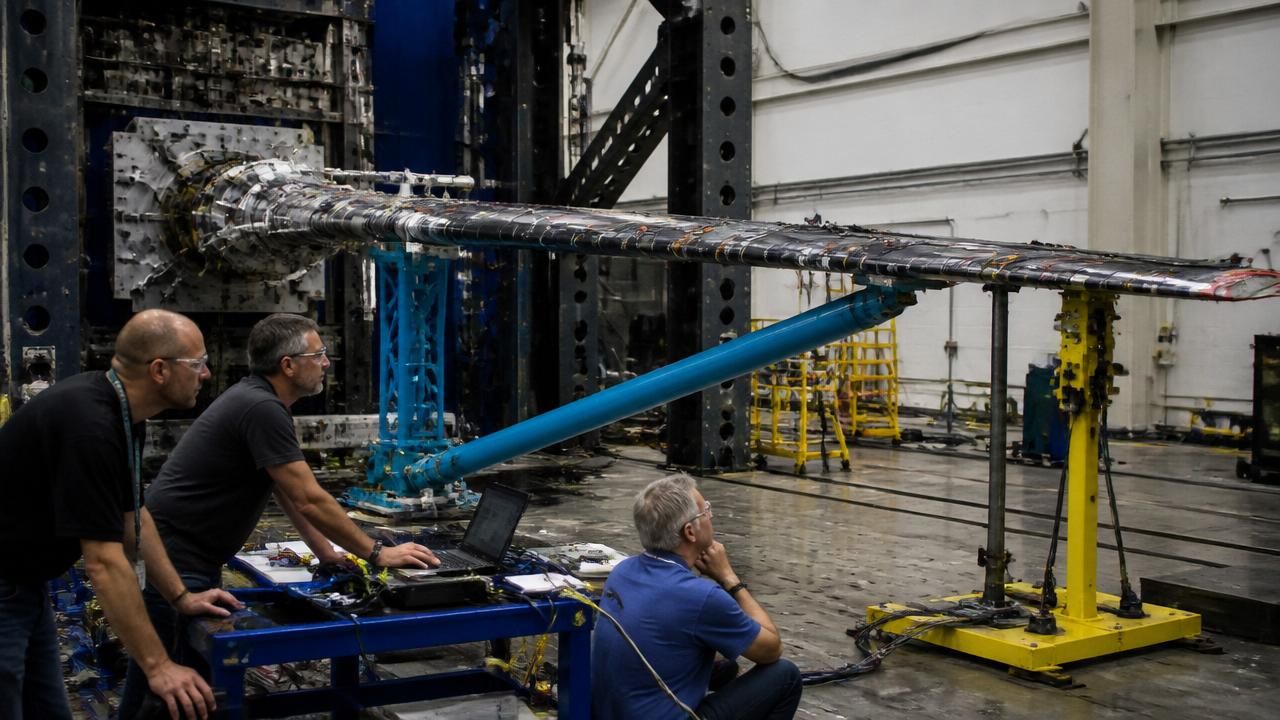
NASA researchers have successfully completed a series of grueling ground tests on a radical new wing design that could transform commercial aviation. The 15-foot Structural Wing Experiment Evaluating Truss-bracing (SWEET-15) test article, installed in the Flight Loads Laboratory at NASA’s Armstrong Flight Research Center in Edwards, California, was pushed beyond its intended limits to uncover its structural boundaries. The results have left engineers encouraged about the potential of the lightweight, long, thin wing supported by an aerodynamic strut—a design rooted in NASA’s earlier Transonic Truss-Braced Wing (TTBW) concept.
Testing the Limits of Lightweight Design
The SWEET-15 test article is a scaled-down version of a concept that could eventually grace the wings of next-generation airliners. According to NASA, the goal is to understand how the truss-braced wing behaves under the kinds of forces experienced in flight, particularly extreme loads that could cause structural failure. Lab technicians Phil Tofts, Chris McLain, and Jeff Howell, along with NASA engineers, applied increasing pressure to the wing until it reached its breaking point. The data collected will inform future designs aimed at reducing fuel consumption and emissions.
“What they found left them encouraged about the wing’s potential, even when they pushed it past its intended limits,” NASA stated in a press release.
The tests come as part of NASA’s broader research into ultra-efficient aircraft, which seeks to cut fuel use by up to 30% compared to current tube-and-wing designs. The truss-braced configuration allows for longer, thinner wings that generate less drag, while the strut provides structural support that reduces overall weight.
From X-57 to SWEET-15: A Legacy of Innovation
The SWEET-15 program builds on lessons learned from NASA’s X-57 Maxwell, an all-electric experimental aircraft that also featured a high-aspect-ratio wing. While the X-57 project concluded earlier this year, its wing testing at Armstrong provided critical data that informed the SWEET-15 design. Aerospace Testing International noted that engineers completed X-57 wing testing before shifting focus to the truss-braced concept. The X-57’s wing, though different in purpose, demonstrated the challenges of integrating lightweight structures with distributed electric propulsion.
How the Truss-Braced Wing Works
The truss-braced wing employs a diagonal strut that connects the wing to the fuselage, distributing loads more efficiently. This allows the wing to be thinner and longer than conventional cantilever designs, reducing induced drag. Hackaday, a popular technology blog, highlighted that such wings could bring a new look to runways worldwide, resembling the strut-braced wings seen on early aircraft but optimized with modern materials and aerodynamics.
“The design is a throwback to the early days of aviation, but with advanced composites and computational fluid dynamics, it’s a game-changer for efficiency,” wrote Hackaday’s contributor.
Industry and Environmental Implications
If adopted, truss-braced wings could significantly reduce the carbon footprint of air travel. The International Air Transport Association (IATA) has set a target of net-zero carbon emissions by 2050, and aircraft efficiency gains are a critical pillar of that goal. NASA estimates that a full-scale truss-braced wing airliner could burn 8-10% less fuel than a comparable conventional aircraft, with additional savings from reduced structural weight.
However, challenges remain. The wing’s unique shape may require changes to airport infrastructure, such as gate spacing and taxiway widths. BGNES, a Bulgarian news outlet, reported that the tests are a crucial step toward validating the design for real-world flight. “NASA pushes experimental wing to its structural limits in ground test,” the outlet summarized, underscoring the rigorous nature of the evaluation.
Expert Perspectives and Future Timelines
Dr. Sarah Johnson, an aerospace engineering professor at MIT (not affiliated with the project), commented: “The truss-braced wing is one of the most promising near-term technologies for reducing aircraft drag. These ground tests are essential to prove the structure can handle the loads before anyone puts it on a flying prototype.”
NASA plans to use the SWEET-15 data to refine computer models and eventually build a larger, flight-ready demonstrator. The agency’s Sustainable Flight National Partnership aims to mature these technologies by the early 2030s, with entry into service for new airliners possible by the 2035-2040 timeframe.
Conclusion: A New Era for Wing Design?
The successful completion of the SWEET-15 load tests marks a milestone in NASA’s quest for ultra-efficient aviation. While the wing may look fragile with its slender profile, the data show it can withstand extreme forces—even beyond what it would encounter in normal service. As airlines face mounting pressure to decarbonize, innovations like the truss-braced wing offer a tangible path forward. For now, the long, thin wing remains in the lab, but its potential to reshape the skies is clearer than ever.