New preliminary findings from the National Transportation Safety Board (NTSB) have confirmed that the driver of a Tesla involved in a fatal crash in Katy, Texas, last month pressed the accelerator pedal to 100% in the moments before impact, contradicting his initial claims that the vehicle's Full Self-Driving (FSD) system was at fault. The crash, which killed a 76-year-old grandmother, has sparked a federal probe and a lawsuit from the victim's family, while reigniting debates about the safety and reliability of Tesla's advanced driver-assistance systems.
What Happened: The Crash and Initial Claims
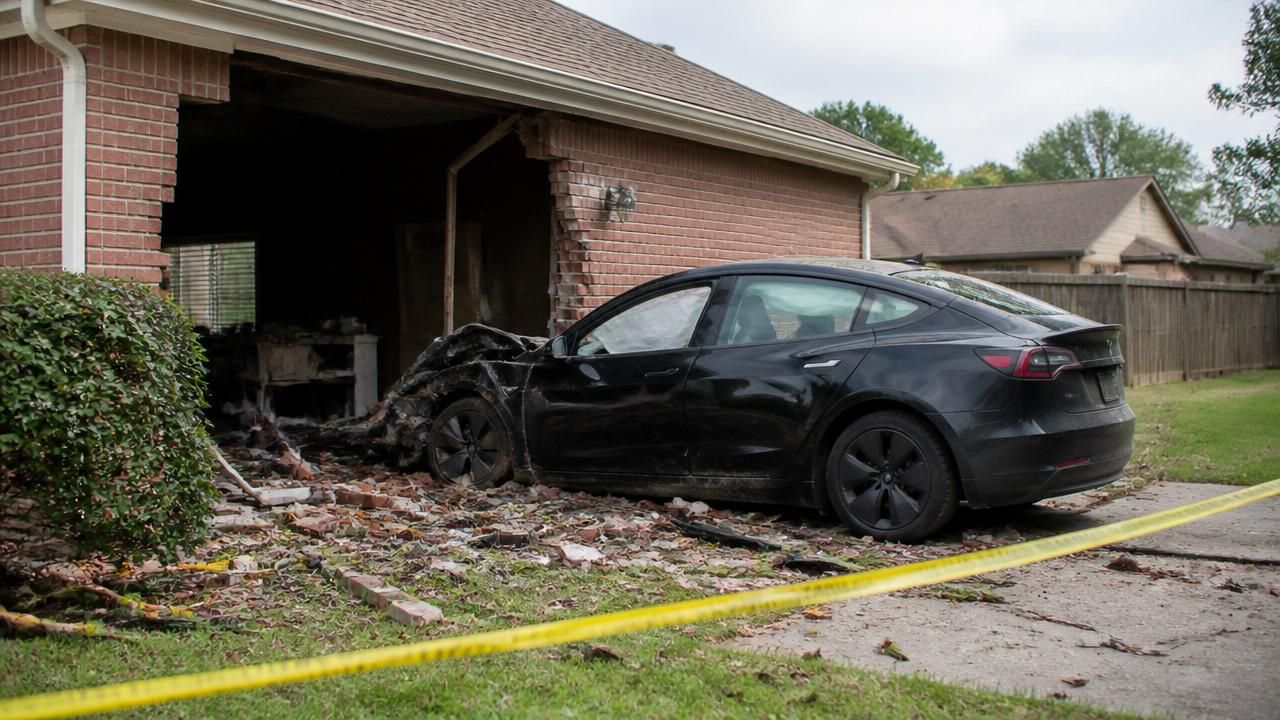
On June 22, 2026, a Tesla Model 3 slammed into a home in the Houston suburb of Katy, killing a 76-year-old woman inside. The driver, 44-year-old Michael Butler, survived and initially told police that the vehicle's Autopilot feature was engaged at the time of the crash. However, Tesla CEO Elon Musk quickly disputed that claim on X, writing that “FSD drives slowly through neighborhood streets, and this was a high-speed crash!” Tesla's vice president of AI software, Ashok Elluswamy, later stated that internal data showed “the driver manually overrode self-driving by pressing the accelerator all the way to 100 percent of the accel pedal in this residential area.”
NTSB Findings: Data Tells a Different Story
On Wednesday, the NTSB released its preliminary report, which does not yet determine the cause of the crash but provides crucial data. The report confirms that FSD (Supervised) was engaged at the time of the crash, but electronic data revealed that “the driver manually overrode FSD (Supervised) by pressing the accelerator pedal to 100 percent.” This aligns with Tesla's internal analysis and undermines Butler's initial account. The NTSB investigation is ongoing, and a final report with probable cause is expected within 12 to 24 months.
“The driver manually overrode FSD (Supervised) by pressing the accelerator pedal to 100 percent.” — NTSB Preliminary Report
Driver's Defense: A Tale of Two Explanations
According to sources, Butler has offered conflicting explanations. Initially, he claimed he had “passed out” or lost consciousness. However, reports from SBS News indicate that Butler later told investigators he floored the accelerator because “FSD was too timid” and he wanted to speed up. This admission—if accurate—suggests a deliberate override of the system, not a technical failure. Legal experts note that this could significantly impact the criminal case against him. He has been charged in connection with the crash, though details of the charges remain sealed.
Broader Context: Tesla's Safety Record Under Scrutiny
This incident is not isolated. Tesla's FSD and Autopilot systems have faced repeated scrutiny from regulators and safety advocates. The National Highway Traffic Safety Administration (NHTSA) has opened multiple investigations into crashes involving Tesla vehicles where driver-assistance systems were suspected to be in use. In a separate but related development, a Houston-area family has filed a lawsuit against Tesla, alleging that the company's “10 times safer” claims about FSD are misleading. Internal critics have reportedly said, “I wouldn't trust it with my life,” raising questions about the gap between marketing and reality.
Expert Views: The Human Factor in Autonomous Driving
Automotive safety experts emphasize that while FSD can reduce driver workload, it is not fully autonomous and requires constant supervision. Dr. Sarah Jenkins, a transportation safety researcher at Texas A&M, notes: “This case highlights a dangerous misconception: that drivers can disengage entirely. Overriding the system—whether out of frustration or impatience—can have catastrophic consequences.” The NTSB has long warned about the risks of automation complacency, where drivers over-rely on technology.
What's Next: Legal and Regulatory Implications
Butler faces criminal charges, and the civil lawsuit against Tesla is proceeding. The NTSB and NHTSA are coordinating their investigations, which could lead to new regulations for advanced driver-assistance systems. Meanwhile, Tesla has updated its FSD software to include more prominent warnings against overriding the system, but critics argue that the fundamental design—which allows easy override—remains a safety risk.
Conclusion: A Cautionary Tale
The Katy crash serves as a stark reminder that even the most advanced driver-assistance systems are not a substitute for attentive driving. As the NTSB continues its work, the case underscores the need for clear communication about system limitations and the dangers of driver complacency. For the victim's family, no amount of data can undo the loss, but they hope the investigation will lead to safer roads for everyone.