India is racing to become a global hub for artificial intelligence, with a wave of massive data center investments totaling over $240 billion announced by major players including Reliance Industries, the Adani Group, Blackstone-backed AirTrunk, and Meta. But as the country scrambles to build the digital backbone for the AI era, local communities and environmentalists are raising alarm over the immense strain on already scarce water and energy resources.
Who Is Building What?
Reliance Industries, led by billionaire Mukesh Ambani, has committed $110 billion to AI infrastructure, according to the Wall Street Journal. The Adani Group plans a $100 billion bet on AI data centers by 2035, as reported by Press Insider and Network World. Blackstone-backed AirTrunk has pledged $30 billion to build 5 gigawatts of data center capacity in India by 2030, per MLQ.ai and Data Centre Magazine. Meta, meanwhile, is partnering with Reliance to establish data centers in India, according to Yahoo Finance and BeInCrypto, while also building a $10 billion facility in Indiana, Reuters notes.
Where and Why?
Much of the new capacity is being developed in coastal cities like Chennai, Mumbai, and Visakhapatnam, where access to submarine cable landings and cooling water is abundant. The New York Times reports that a Google campus in a Chennai suburb has already sparked anxiety over water use. India's government has designated data centers as a priority sector, aiming to capture a share of the global AI market projected to be worth trillions. The country's vast digital economy, cheap engineering talent, and growing domestic demand for AI services make it an attractive destination.
The Resource Dilemma
Data centers are notoriously thirsty and power-hungry. A single large facility can consume as much electricity as a small town and millions of gallons of water daily for cooling. The Ken reports that water is becoming "the new air" in the race to cool India's data centers, with operators investing in expensive liquid cooling and air-cooling technologies to mitigate usage. Sify notes that India "woke up late to AI" and is now grappling with a power problem—the country's grid is already strained, and adding massive data center loads could exacerbate blackouts and carbon emissions.
Local Opposition and Global Parallels
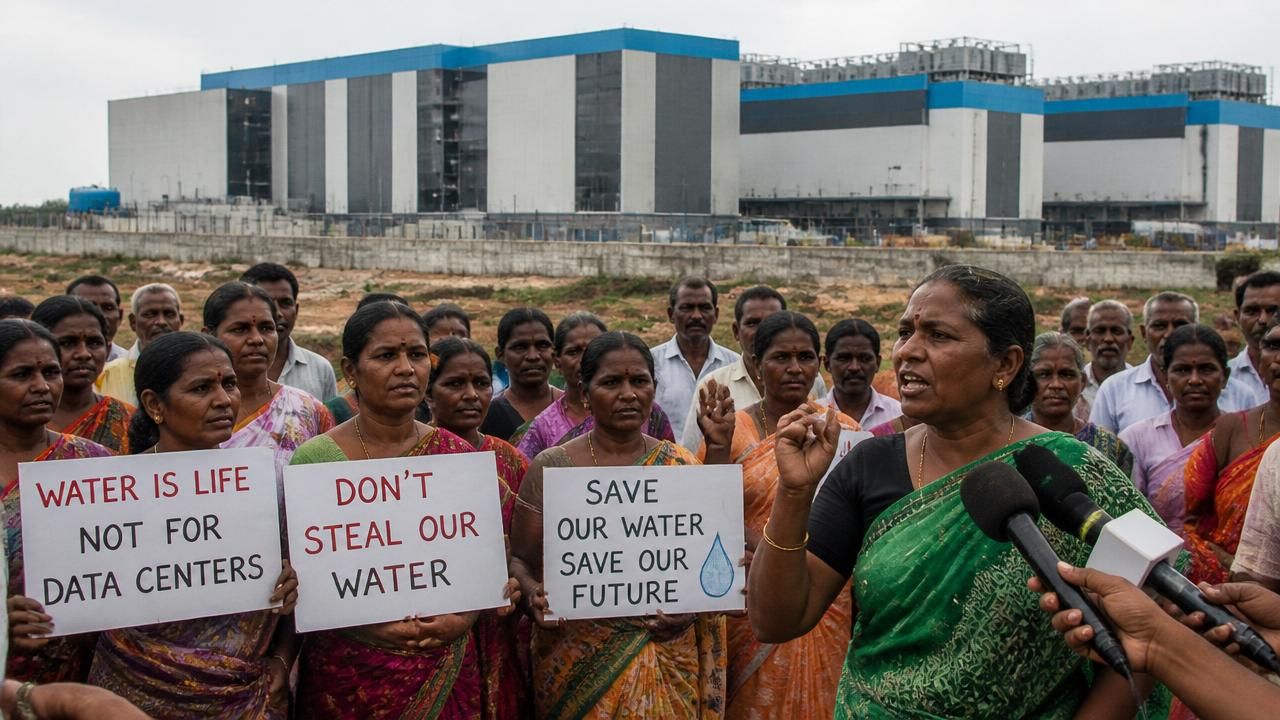
Resistance is mounting. The New York Times describes how a proposed Google campus in Chennai has fueled fears among residents that their water table will be depleted. Similar protests have erupted in Mexico and Ireland, as the NYT reports in a separate article titled "From Mexico to Ireland, Fury Mounts Over a Global A.I. Frenzy." In India, activists argue that the benefits of AI data centers accrue to global tech giants while local communities bear the environmental costs. Sify's article "You Can Now Host an NVIDIA Data Centre in Your Home" highlights the surreal reality of data center proliferation, with neighbors pushing back against installations in residential areas.
Differing Perspectives
Industry proponents frame the investment as a once-in-a-generation opportunity. The Adani Group's chairman Gautam Adani has called data centers "the new steel mills" of the digital age, per Network World. Reliance's Ambani sees AI as a tool to transform Indian agriculture, education, and healthcare. The World Economic Forum (behind a paywall) has described the global data center gold rush as essential for AI progress.
Critics, however, question the sustainability. Sify's analysis "Indian AI's Power Problem" warns that without massive renewable energy buildout, India's AI ambitions could be powered by coal, worsening climate change. DataCenterDynamics asks whether AWS can hit its sustainability targets while winning the AI race. The Information Technology and Innovation Foundation (DataInnovation.org) compares AI race dynamics among the US, China, and EU, noting that India risks falling behind if it doesn't address infrastructure bottlenecks.
Historical Context and Future Implications
India's data center boom mirrors earlier infrastructure frenzies—from telecom towers in the 2000s to solar parks in the 2010s. But the scale is unprecedented. Manufacturing Today India calls data centers "India's defining infrastructure bet" for the 21st century. If executed well, the investments could create millions of jobs, spur innovation, and position India as a leader in AI. If mismanaged, they could exacerbate water crises, energy shortages, and social inequality.
The coming years will test whether India can balance its AI ambitions with the needs of its 1.4 billion people. As one Chennai resident told the NYT: "We want progress, but not at the cost of our water."