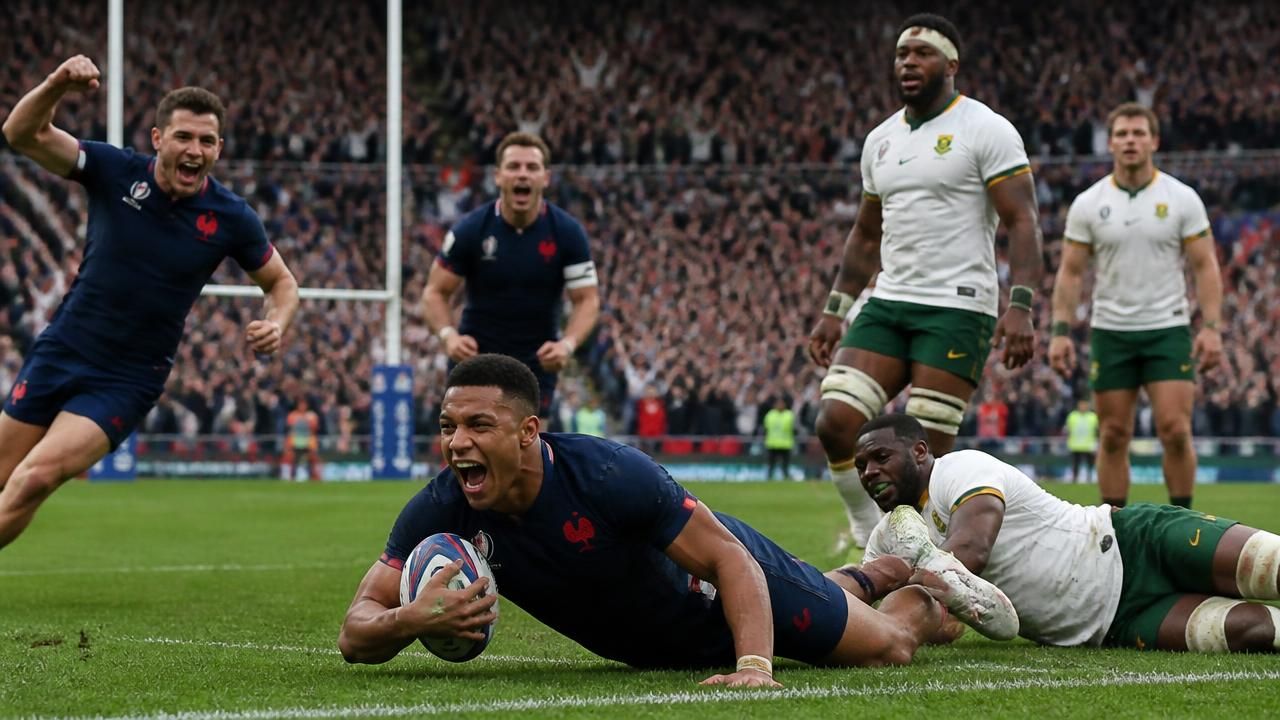
The Nations Championship final ended in one of rugby’s most extraordinary finishes as France beat South Africa 40-34 at Twickenham, with Theo Attissogbe scoring a last-gasp try that snatched the title from the Springboks in the dying moments.
For much of the closing stages, a South Africa victory looked imminent. The Springboks had appeared to have done enough to claim the trophy, only for France to produce a final attack of precision and nerve. Attissogbe finished it, completing a stunning late turnaround and leaving the South African players and bench stunned as the final whistle approached.
A finish for the ages
BBC Sport framed the climax around Attissogbe’s score, calling it “one of the most dramatic tries of all time” and emphasising that the match had been turned on its head in the “dying embers” of an incredible game. That language captured the sense of disbelief around Twickenham: South Africa were not merely beaten after a long battle; they were beaten by a score that arrived when the title appeared to be within their grasp.
“one of the most dramatic tries of all time” — BBC Sport
The New York Times led with the bare result — France win Nations Championship after thrilling 40-34 victory over South Africa — foregrounding the scoreline and the entertainment value of a final that produced 74 points. MSN’s coverage stressed the same astonishing finish from a different angle, with one headline saying Attissogbe’s try “denies Springboks glory in Twickenham thriller” and another simply declaring: “France win dramatic Nations Championship final.”
How the final unfolded
The match was not a cagey final decided by a single penalty. The 40-34 scoreline points to a contest of shifting momentum, attacking ambition and defensive anxiety. Both sides found ways to score, but South Africa seemed to have the decisive edge as the game moved towards its conclusion. France, however, retained enough composure and ambition to mount one final assault.
The decisive moment came in the final moments, when France moved the ball with the kind of precision that had been missing at key stages earlier. Attissogbe’s finish turned a likely Springboks celebration into a French one. The try was not merely a late score; it was a title-winning intervention that instantly became the defining image of the tournament’s final.
Scoreline tells story of attack and anxiety
A 40-34 final is unusual in a championship decider and reflects how both teams were forced to chase the game at different points. South Africa will look back at passages in which they controlled territory and momentum but failed to close the door. France will point to their persistence, their willingness to keep playing until the last second and their ability to execute under extreme pressure. In a match of fine margins, the last margin belonged to France.
Framing the result
- BBC Sport centred its coverage on the drama of Attissogbe’s try, presenting it as a moment of rugby history rather than merely a winning score.
- The New York Times put the 40-34 result at the top of its report, treating the match as a thrilling contest whose final score demanded attention.
- MSN emphasised both the astonishing finale and South Africa’s heartbreak, framing the result as glory denied to the Springboks at Twickenham.
Despite those different emphases, the outlets converge on the essential facts: France won the Nations Championship, South Africa lost a final they had seemed likely to win, and Attissogbe delivered the decisive blow at the death. The divergence is one of emphasis — BBC Sport leans into the historic drama, The New York Times into the scoreline and spectacle, and MSN into the emotional swing between French triumph and South African despair.
What it means
For France, the victory adds a major international title and validates a campaign that ended with the ultimate test of nerve. Winning a final in such circumstances can shape a team’s self-belief, especially when the opposition is South Africa, one of rugby’s most formidable sides. For South Africa, the defeat will be difficult to absorb. The Springboks had positioned themselves for another trophy and were forced to watch a last-gasp try overturn their prospects.
The result also underlines the growing appeal of the Nations Championship as a competition capable of producing finals that rival the drama of rugby’s biggest tournaments. A final decided in the dying moments, at a historic venue, with a scoreline that kept shifting, gave the competition a headline moment that will be replayed for years.
When the final whistle came, the scoreboard read France 40, South Africa 34. But the story was not simply about points. It was about a team refusing to accept defeat, a player seizing the last chance, and a Springboks side left to rue how close they had come to glory before Attissogbe struck.