For much of his second term, Gavin Newsom framed California's homelessness crisis as the defining moral test of his governorship — a problem he intended to bend, if not break, before leaving office. Now, as the Democratic governor approaches the end of his tenure and weighs a presidential bid, the ledger is far more complicated than his early promises suggested. His administration moved thousands of people off the streets and into shelter, yet the crisis itself has grown more visible, more expensive and, by many measures, worse.
The paradox is at the center of a fresh wave of national coverage of Newsom, who has spent the past year operating simultaneously as a sitting governor, a leading antagonist of President Donald Trump and a de facto candidate-in-waiting for 2028.
A Homelessness Agenda That Moved People — But Not the Needle
Newsom entered office in 2019 promising an aggressive, data-driven assault on street homelessness. He poured unprecedented state money into interim shelters, converted motels and hotel rooms, and pressured reluctant cities and counties to adopt stricter enforcement and more shelter beds. By the administration's own accounting, those programs have moved thousands of individuals indoors — a genuine achievement that supporters say would have been politically impossible a decade earlier.
But reporting from NPR this week underscores the harder truth: the crisis has not receded. Encampments remain a fixture of California's urban landscape, public frustration has hardened, and voters across the political spectrum cite homelessness as a top concern. Critics on the left argue the state prioritized visible encampments over permanent housing and treatment capacity; critics on the right say the billions spent produced too little accountability. Even allies concede that a problem decades in the making cannot be unwound in six years.
The result is a legacy argument that Newsom cannot fully control — one that will follow him into any national campaign, where rivals are already prepared to use California's streets as a symbol.
The Trump Dynamic: Disaster Relief and Death Penalty Fights
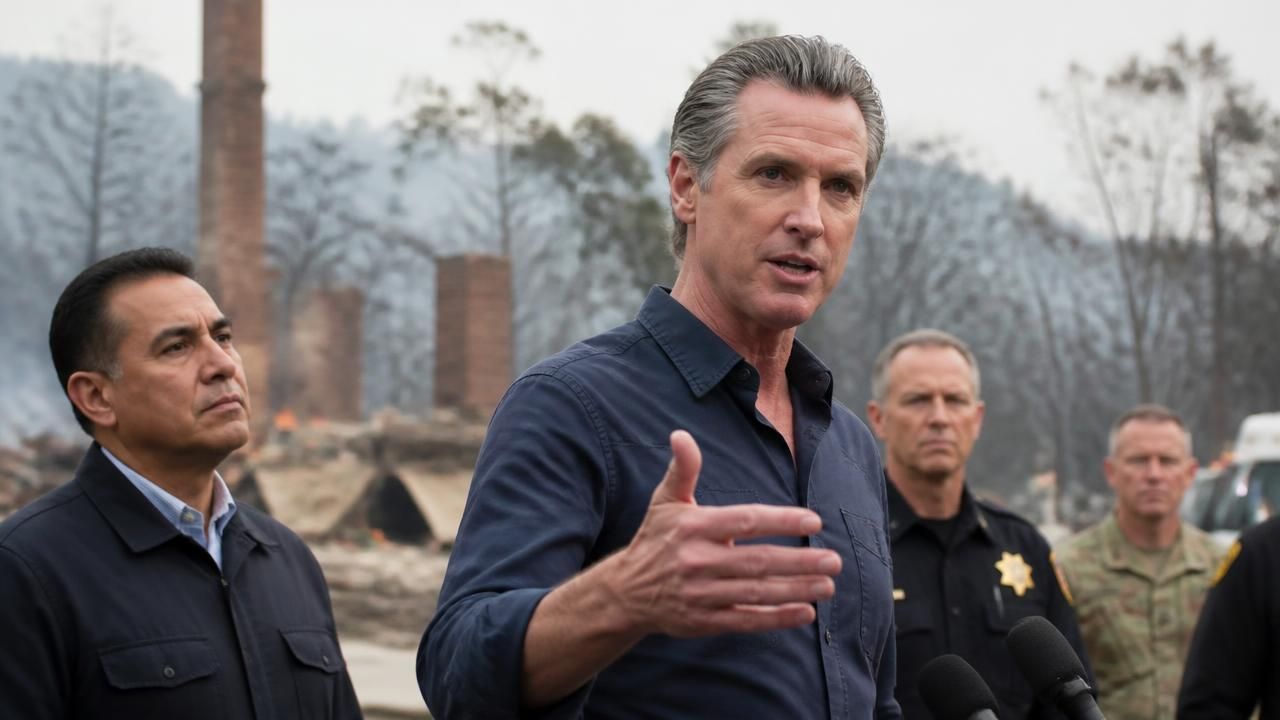
If homelessness is Newsom's domestic vulnerability, his running battle with Trump has become his political engine. After the devastating Los Angeles-area wildfires, Newsom publicly accused the federal government of slow-walking disaster assistance to survivors, describing the administration's posture in blunt terms.
"He just turned his back," Newsom said of Trump, framing the delayed relief as a betrayal of fire survivors who had lost homes and livelihoods.
The federal government has disputed characterizations of delay, and the specifics of the aid pipeline remain contested. But the exchange reinforced a familiar dynamic: Newsom positions himself as the chief Democratic counterweight to Trump, and the White House treats him accordingly.
That dynamic ran in both directions this week. Trump attacked Newsom over his decision to commute death sentences — a move the governor has defended on moral and fiscal grounds, and one that has long animated conservative criticism of his leadership. For Trump, who has made California a frequent target, Newsom remains a useful foil: a longtime adversary and a potential 2028 opponent whose record can be litigated from the White House podium.
Political analysts note the symmetry. Each man benefits from the confrontation: Trump energizes his base by attacking the country's most prominent Democratic governor, while Newsom raises his national profile and small-dollar fundraising by casting himself as the Democrat willing to punch back.
No Regrets, and No Answers
Asked directly whether he has any regrets about his tenure, Newsom has declined to offer the kind of reflective accounting that often accompanies a departure. As he looks toward 2028, the governor has instead emphasized forward momentum — touting California's economy, its climate policies and its resistance to federal pressure — while sidestepping the areas where his record is most vulnerable.
That reticence is itself telling. A candid postmortem on homelessness would require conceding that the state's spending did not produce the visible transformation voters were promised. A detailed discussion of the death penalty commutations would invite a fight he does not need before a national primary. And a full accounting of the disaster relief dispute would tie him to a federal bureaucracy he does not control.
What Comes Next
Newsom's next chapter will be shaped by how three storylines resolve:
- Homelessness: Whether his successor inherits momentum or a stalemate, and whether voters credit or blame him for the billions spent.
- The Trump relationship: Whether the sparring over wildfire aid and commutations remains a rhetorical clash or escalates into a larger fight over federal-state authority.
- The 2028 question: Whether a California record — with its genuine accomplishments and stubborn failures — becomes an asset in a primary or a liability in a general election.
For now, the governor's defenders argue that history will judge his homelessness agenda more kindly than contemporary polls do, crediting him with normalizing state intervention in a crisis long treated as a local matter. His critics counter that ambition is not the same as results, and that California's streets remain the most persuasive evidence.
What is not in dispute is that Newsom leaves office as one of the most consequential — and most polarizing — governors in modern California history, a figure whose record on housing, disaster politics and capital punishment will be litigated long after he hands over the keys.