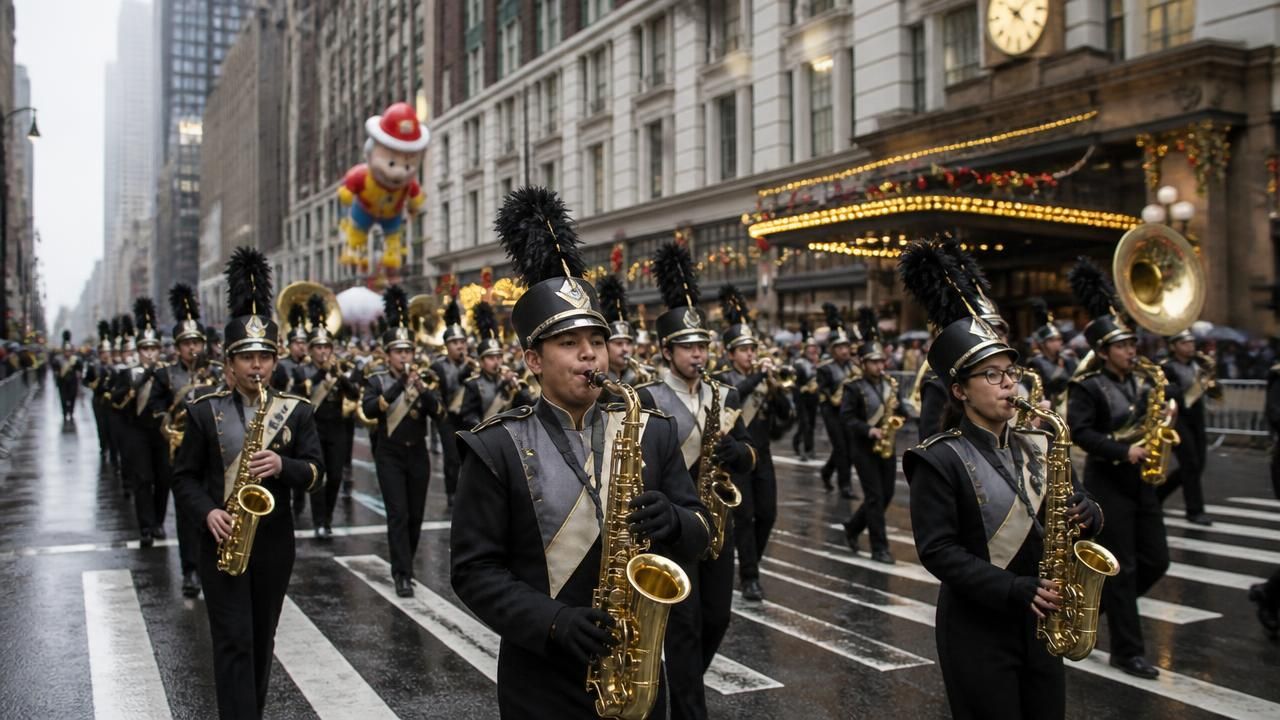
For the first time in its century-long history, the Macy's Thanksgiving Day Parade did not march on Thanksgiving. A stormy forecast — heavy rain and gusting winds that made the handling of giant character balloons unsafe — forced New York City officials to postpone the holiday institution, leaving dozens of high school and college marching bands stranded in Manhattan with hotel bills, bus contracts and return flights already paid for and nowhere to perform.
What followed was an improvised, crowd-funded rescue operation stretching from Texas to South Carolina to Tennessee and Illinois. Within days, donors big and small had poured more than $1.2 million into band programs so that student musicians could afford to extend their stays and take part in the rescheduled procession, according to reporting across CNN, NPR, local Texas outlets and a wave of regional newsrooms tracking individual bands.
A first in a century of parades
The postponement was unprecedented. The parade has been held annually since 1924, surviving the Great Depression, world wars and, in 2020, a pandemic-driven cancellation that was later replaced by a televised, audience-free production. Weather had threatened the event before — most memorably high winds that have grounded balloons in past years — but never had the entire parade been pushed to a new date.
For participating bands, the decision landed at the worst possible moment. Most groups had spent a year or more fundraising simply to reach New York, holding car washes, selling candy and wrapping paper, and in some cases paying thousands of dollars per student for a trip that represents the pinnacle of a marching-band career. The parade slot itself is a prestigious honor, awarded through a competitive application process.
A Texas-sized rescue effort
The most prominent story came from Pearland, Texas, where the high school's marching band — roughly 500 students strong — faced the prospect of flying home without ever having marched. A rapid community campaign raised about $350,000, enough to cover the additional hotel nights, meals and rebooked travel needed to keep the entire ensemble in the city.
Houston's Click2Houston described the group as raising $350,000 to stay and perform in what local coverage called Macy's 100th Thanksgiving Parade, while WSLS framed the effort as "Texas-sized generosity" that saved "Pearland's historic Macy's Thanksgiving Day Parade performance." The figure became the benchmark against which other bands' campaigns were measured, with national outlets including CNN and NPR highlighting the Pearland total in headlines.
Venmo, GoFundMe and 24-hour blitzes
Pearland was far from alone. In South Carolina, a high school band mounted a 24-hour fundraising blitz that allowed its students to remain in New York for the rescheduled date, according to the Post and Courier. In Tennessee, the Dobyns-Bennett band director publicly appealed for donations after the delay upended the group's plans. And in Illinois, organizers confirmed that the Marching Illini would indeed perform at the rescheduled event.
"Yes, the Marching Illini will perform in rescheduled Macy's Thanksgiving Parade." — headline from regional Illinois coverage, answering the question on every band parent's mind
Social media became the scaffolding of the effort. Families and boosters launched Venmo accounts, GoFundMe pages and cash appeals almost immediately, with one account describing how performers "started a Venmo" to cover unplanned nights in Midtown hotels. Small-dollar donations dominated: a few dollars from strangers, matched against the far larger sums from local businesses and alumni networks.
Not everyone could stay
The story was not uniformly triumphant. Reporting from People, aggregated by MSN, noted that four marching bands raised more than $1.2 million combined to remain in New York — but at least one group could not make it work. That band's director posted video of the ensemble's final rehearsal, a bittersweet coda for students who had trained for months and traveled hundreds of miles for a performance that never happened.
The gap between the bands that stayed and those that went home exposed an uncomfortable truth: the difference between a career-defining moment and a costly disappointment often came down to the affluence of a school's booster network and the speed of a community's digital fundraising reflexes.
The cost of staying
The Seattle Times framed the episode around logistics and expense, noting that the postponement upended travel plans and added significant costs for bands already operating on thin margins. Extending a trip by several days means additional hotel rooms for hundreds of teenagers, chaperones and staff; renegotiated charter bus and airline contracts; extra meals; and, in many cases, unplanned substitute-teacher coverage and missed school days back home.
- Hotel and meals: Multi-night extensions for groups ranging from dozens to 500 students.
- Travel rebooking: Change fees and new bookings on buses and flights during one of the busiest travel weeks of the year.
- Lost revenue: Canceled local performances and fundraisers back home.
- Uneven outcomes: Wealthier booster programs closed gaps quickly; others could not.
Why it matters
The episode offered a rare, unscripted window into how the parade is made — and who pays for it. Macy's covers the cost of participation logistics for invited groups, but the journey to New York is financed by the bands themselves, a burden distributed unevenly across American public schools. When the schedule broke, so did the assumption that a once-in-a-lifetime trip would go as planned.
It also demonstrated the speed of decentralized generosity. In under a week, hundreds of thousands of dollars moved through payment apps and crowdfunding pages with little institutional oversight, driven by alumni, neighbors and strangers who had seen a headline. For the bands that made it to the rescheduled route, the performance became something more than a holiday tradition: a demonstration that the crowd lining the street had, in a sense, paid for the parade.
As one band member's family put it in the swirl of coverage, the trip had already been historic. The only question was whether the music would actually play.