Nimble's SharePower has a gimmick so literal it doubles as its own product demo: the 10,000mAh portable charger snaps apart into two separate 5,000mAh batteries, each capable of topping up a phone on its own. Since launching, the gadget has become a small obsession among gadget reviewers — and right now it is also one of the cheaper ways to buy into the idea.
Thanks to a lingering Black Friday promotion, the SharePower is available for $59.96 at Amazon for Prime members and $59.97 direct from Nimble at checkout, down from its $79.95 list price. According to The Verge, which flagged the deal, that represents the lowest price yet seen on the charger and applies across all four colorways — including the crystal pink finish — though the blue model is currently stocked only through Nimble itself.
How a power bank learned to share
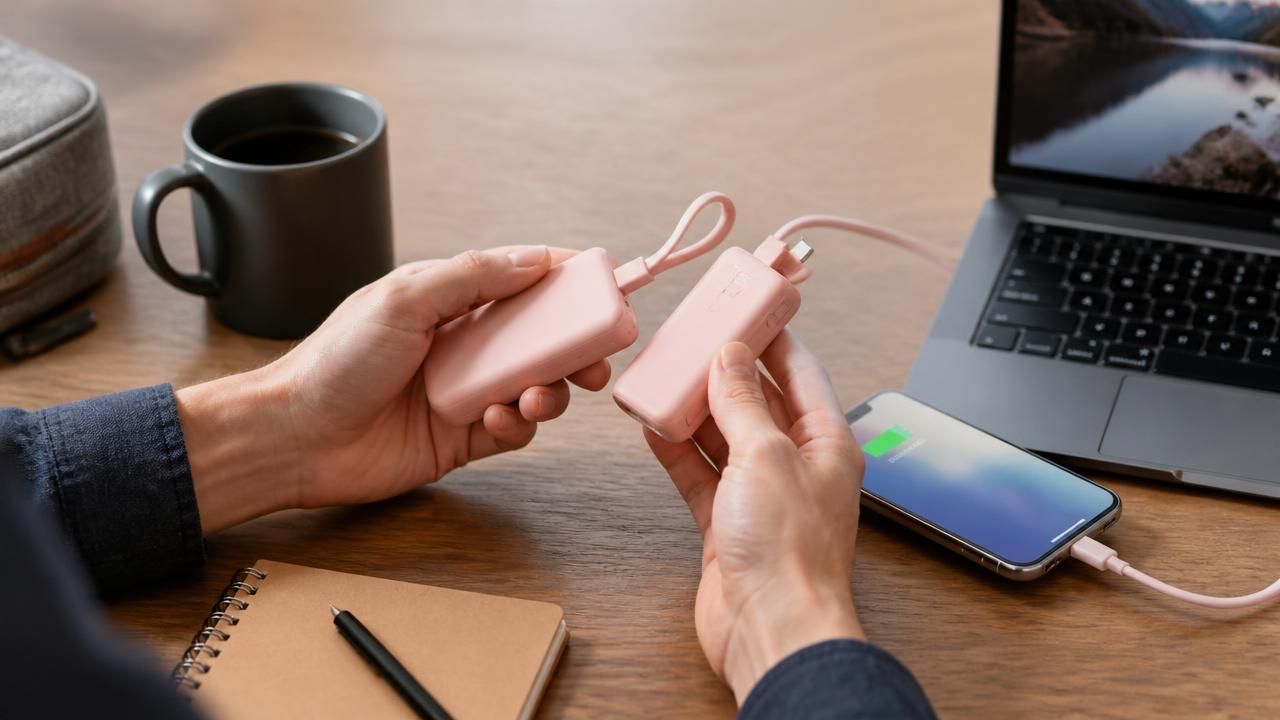
The SharePower's party trick is mechanical rather than electrical. A magnetic connection holds the two halves together as a single 10,000mAh brick; pull them apart and you have two independent 5,000mAh chargers, each delivering up to 20W over USB-C Power Delivery — enough to fast-charge a modern smartphone, though not enough to drive a laptop.
The industrial design does double duty. One half carries a fixed USB-C plug that folds out of the way, while the other has a short integrated USB-C cable that doubles as a carrying handle. Nimble also includes a 2.4-foot USB-C cable in the box, and both halves accept a charge over USB-C.
That split personality is why the device has traveled well beyond the usual deal-hunting coverage. Digital Trends called it "the coolest power bank idea I've ever seen," while Android Guys framed the launch as Nimble "reinventing portable charging with a social twist." MacRumors, The Gadgeteer and Macworld have all covered it primarily as a curiosity-first product, with Macworld going further and publishing a full review of the two-in-one design. MSN's syndicated coverage emphasized the same headline benefit: a 10,000mAh battery that splits in half "so you can share it with others."
The case for two halves
Battery anxiety is usually a solo problem, but charging is frequently a social one. Two people traveling together, a parent and a teenager, or a table of colleagues at a conference all tend to fight over the same outlet — or the same borrowed brick. Splitting the pack in two solves a coordination problem that capacity alone cannot: instead of one person hoarding 10,000mAh, each person gets a self-contained 5,000mAh unit with its own cable and its own plug.
The core pitch, as reviewers have framed it, is less about wattage than about etiquette: a charger designed to be handed over rather than hovered around.
Nimble's broader brand identity adds a second layer. The company has built its reputation on accessories made with recycled materials and post-consumer plastic, alongside take-back programs for old electronics — a positioning that makes a "share the battery instead of buying two" product fit neatly into its marketing narrative, even if the sustainability math of manufacturing one split device versus two conventional packs is more complicated than any single spec sheet suggests.
What buyers should weigh
- Capacity per person: Split, each half offers 5,000mAh — roughly one full phone charge, not two. Sharing halves the total available to each user.
- Power ceiling: 20W USB-C PD is fine for phones and earbuds, marginal for tablets, and insufficient for most laptops.
- Charging logistics: Both halves accept USB-C input, but the sources covering the launch do not spell out whether the two units can be topped up together as a single connected pack, or must be charged individually — a detail worth confirming before buying.
- Pricing: At $79.95 the SharePower competes with high-capacity conventional bricks; at roughly $60 in the current promotion, the flexibility argument becomes far more persuasive.
Why it matters
The portable charger market is mature, crowded and largely undifferentiated: capacity, port count, price. The SharePower stands out because it rethinks the form factor rather than the spec sheet, betting that a magnetic seam is a more meaningful innovation than another 10 watts of output. The breadth of coverage — deal blogs, Apple-focused sites, design-minded tech outlets, general-interest aggregators — suggests the bet is landing with editors, if not yet conclusively with the mass market.
For now, the pitch is simple and unusually tactile. One charger in a bag, two chargers on a table, and no negotiating over who gets the cable. At $59.96, that is a fairly cheap way to settle an argument.