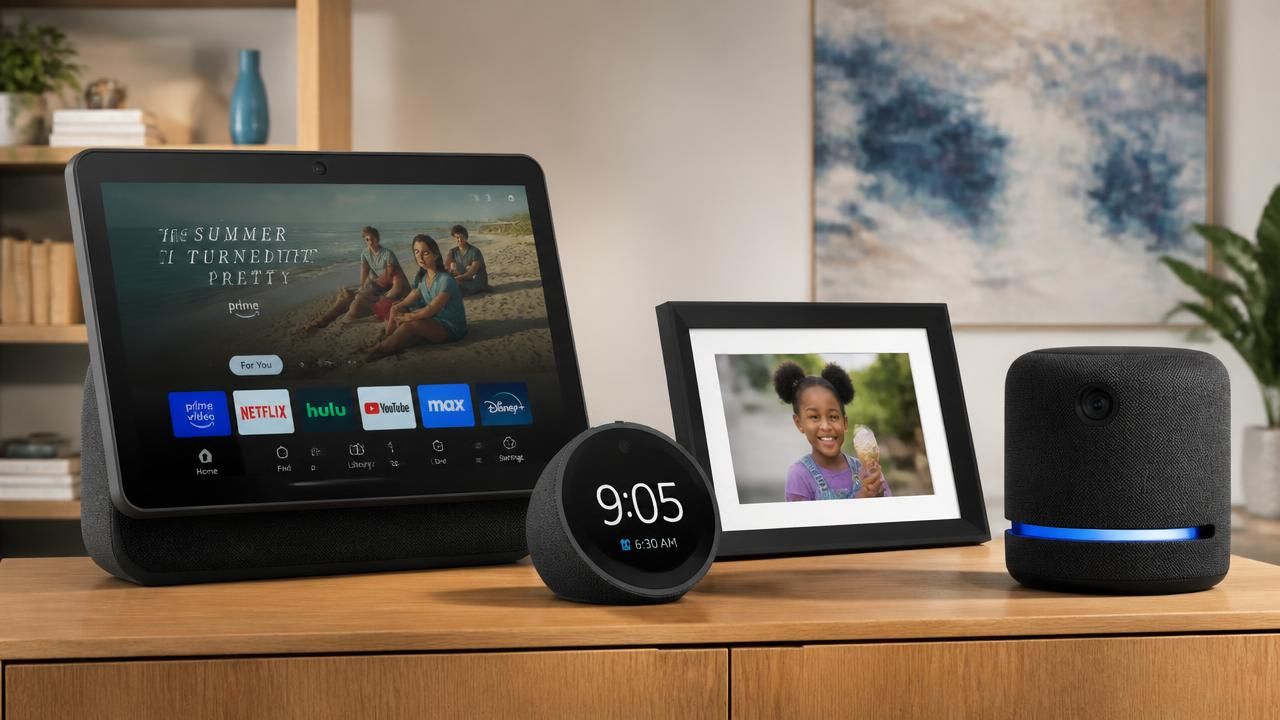
Amazon has unveiled one of the broadest refreshes of its Echo hardware family in years, introducing a 16-inch Echo Show smart display, a bedside smart clock called Echo Time, an Alexa-enabled digital photo frame, and a redesigned Echo Studio that — notably — now carries a camera. The announcements, covered simultaneously by Reuters, WIRED, The Verge, CNN, Android Authority and a cluster of smart-home trade outlets, collectively push Alexa further out of the countertop cylinder and into the walls, the bedside table, and the living-room wall display.
The timing matters. Amazon's Alexa division has spent the past two years under pressure to prove that voice assistants can be more than a loss-leading novelty, and the new lineup reads as an attempt to spread Alexa across more rooms and more moments of the day — while quietly betting that customers will trade a little privacy for convenience.
What Amazon actually announced
Across the coverage, a consistent picture of the new hardware emerges:
- Echo Show 16: A 16-inch smart display that Android Authority describes as "a smart display and Fire TV rolled into one" — Amazon's most direct attempt yet to merge the kitchen-counter assistant with the living-room television.
- Echo Time: A bedside smart alarm clock, reported by WIRED, which frames it as a lower-cost, screen-light way to keep Alexa within arm's reach overnight.
- Alexa Photo Frame: A smart speaker disguised as a digital photo frame, which quickly became the most-discussed product of the launch.
- Echo Studio with a camera: Per The Next Web, Amazon has "put a camera in its Echo Studio so Alexa can see" — the most consequential and most contested change in the lineup.
MSN's roundup counted eight new Echo and Alexa gadgets in total, suggesting the announcement was a full portfolio reset rather than a single flagship launch. Amazon, as is typical, did not lead with detailed pricing and availability in every market, leaving regional rollout questions open.
The photo frame and the problem nobody named
Of everything announced, the Alexa Photo Frame generated the most emotional coverage — largely because The Verge's Jennifer Pattison Tuohy framed it not as a gadget review but as a confession. "I have to face facts: I'm a digital hoarder," she wrote, describing a scrapbook she made for her son's high-school graduation and his reaction: he had never seen most of the pictures.
"Unlike my childhood — documented in photo albums sitting on shelves for anyone to browse — the photographic evidence of my son's childhood is sitting on my phone."
That is the real market the Photo Frame is chasing. It is not competing with other smart frames so much as with the thousands of unviewed images trapped in camera rolls. "My phone holds thousands of pictures of my son that he's never seen. And that just feels wrong," Tuohy added — a sentiment CNN echoed from a more consumer-facing angle, calling the device something that "could be the perfect splurge gift." The Verge's headline verdict was blunter still: it is "the Echo Show without the bits you hate" — a screen that does one thing well and does not try to be a tablet.
The Echo Show 16 bets on Fire TV
The 16-inch Echo Show is the strategic centrepiece. Android Authority's framing — a smart display and Fire TV in a single device — captures why: Amazon already owns the living-room streaming platform and the smart-display category, but has struggled to make them the same purchase. A large-format Echo Show that doubles as a television could consolidate two devices into one for bedrooms, kitchens and secondary rooms, and it gives Amazon a stronger position against rival displays from Google and a growing field of frame-style TVs.
Trade publication coverage framed the launch differently again. CE Pro's angle — "what integrators need to know" — signals that Amazon is pitching the new lineup at the custom-install and smart-home channel, where large wall-mounted displays are specified alongside lighting, shades and audio. That is a slower, higher-margin market than retail, and it suggests Amazon wants the Echo Show 16 considered as infrastructure, not an impulse buy.
A camera in the Echo Studio: convenience versus consent
The most contentious element is the camera added to the Echo Studio. The Next Web's headline — "Amazon puts a camera in its Echo Studio so Alexa can see" — states the trade-off plainly. A camera-enabled speaker opens up gesture control, video calling, visual context for Alexa+ style AI queries, and home-monitoring features. It also invites the questions that have shadowed Amazon since the original Echo: what is recorded, what is stored, and who can access it.
The company has consistently said its devices process wake words locally and offer microphone-off controls, but a camera adds a second, less understood sensor to the room. Expect privacy advocates and regulators in Europe and the US to press for detail on retention windows and on-device processing — and expect Amazon to lean heavily on the fact that the lens is shuttered or disabled by default.
Why it matters
Read together, the four products tell a coherent story about where Amazon thinks Alexa goes next: onto a big screen in the living room, onto a small clock at the bedside, into a frame in the hallway, and — with the Studio's camera — into the visual world. The company is less interested in selling one hit device than in making Alexa ambient.
For consumers, the Alexa Photo Frame is likely to be the sleeper hit, precisely because it solves a problem people feel guilty about rather than one they searched for. For Amazon, the harder sell is the camera — a feature that must be useful enough to justify turning a listening device into a watching one. The next few quarters of reviews, privacy scrutiny and integrator adoption will determine whether this lineup is remembered as the moment Alexa grew up, or the moment it overreached.