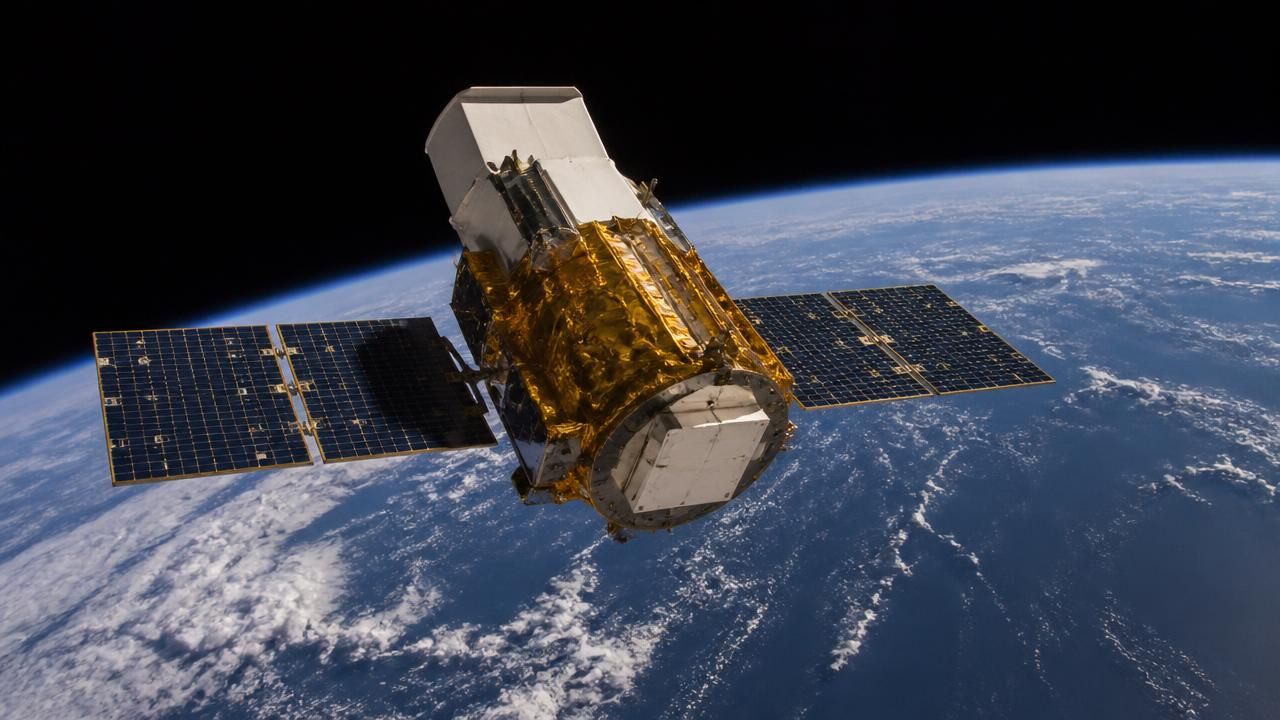
NASA's Neil Gehrels Swift Observatory — a spacecraft that was built to last two years and instead spent nearly 22 watching the most violent explosions in the universe — has fallen back to Earth, burning up in the atmosphere after an eleventh-hour rescue effort reportedly worth about $30 million failed to save it.
The reentry closes the book on one of the most productive astrophysics missions NASA has ever flown, and it has reignited debate over how the space agency retires aging hardware in an era of increasingly crowded low Earth orbit.
What Swift Was
Launched in November 2004 and named after NASA astrophysicist Neil Gehrels, Swift was a multi-wavelength observatory designed to chase gamma-ray bursts — fleeting, extraordinarily energetic flashes produced by collapsing massive stars and merging neutron stars. Its Burst Alert Telescope would detect a flash and, within about a minute, autonomously slew the spacecraft so its X-ray and ultraviolet/optical telescopes could study the afterglow.
"Swift was designed for a two-year mission," the observatory's builders noted — a modest goal for a spacecraft that would ultimately log thousands of gamma-ray bursts and other transient phenomena over more than two decades of operation.
The mission's scientific haul extended well beyond its headline target. Swift proved to be a workhorse for catching stars being shredded and swallowed by supermassive black holes — so-called tidal disruption events — and for rapidly relaying alerts that ground- and space-based observatories could follow up within minutes. That rapid-response model reshaped how modern astronomy handles time-domain events, a legacy now carried forward by newer facilities built around the same principle.
The Rescue That Wasn't
Swift operated in low Earth orbit, where a tenuous remnant of atmosphere creates constant drag. For most of the mission, periodic thruster firings were enough to hold the orbit steady. But as solar activity climbed toward its current maximum, the upper atmosphere puffed outward, accelerating the decay of satellites across low Earth orbit.
According to multiple reports, NASA attempted a rescue operation — described in several accounts as a roughly $30 million effort — to raise Swift's orbit and extend its life. The attempt failed, and the spacecraft was left on an unstoppable descent. Coverage of the mission's final months was dominated by the same practical questions: how fast was it falling, and where would the pieces come down?
The observatory survived far beyond its design life, outlasting its original two-year mission by roughly two decades before atmospheric drag finally won.
Where the Debris Went
Space.com and other outlets fielded the obvious public question in their headlines — "Where will it fall?" — and the answer was, as usual, reassuring. Most of a satellite of Swift's size is consumed by the heat of reentry; surviving fragments typically land in the ocean, given that water covers roughly 71 percent of the planet's surface. There were no reports of damage or injury from the reentry, and the risk to any individual from a given falling satellite remains vanishingly small.
Weather-oriented outlets such as AccuWeather picked up the story as a space-weather-adjacent item, framing the reentry around timing and visibility. ScienceDaily emphasized the span of the mission — nearly 22 years — while Wired focused squarely on the science: the secrets of the universe Swift extracted before returning to Earth. The varied framing reflects how a single satellite's demise can be read simultaneously as an engineering failure, a scientific triumph, and a public-safety footnote.
Why It Matters
Swift's reentry is a small but telling data point in a much larger problem. Low Earth orbit now hosts thousands of active satellites, led by mega-constellations such as SpaceX's Starlink, and the population is growing fast. Solar maximum has made drag unpredictable for everyone, forcing operators to spend propellant and money to keep spacecraft aloft.
- End-of-life disposal is now a design requirement, not an afterthought: newer satellites carry propulsion specifically to deorbit themselves within 25 years, or far sooner.
- Aging observatories rarely get dedicated rescue funding; NASA must weigh the cost of extending a mission against the cost of launching a replacement.
- Reentries of large spacecraft will become more common as the first generation of mega-constellation hardware ages out.
For Swift, the arithmetic was unforgiving: a $30 million rescue attempt against a spacecraft long past its warranty, in an environment where drag was steadily increasing. The failure was not a surprise so much as a reminder of how the space environment sets hard limits on even the most successful missions.
A Legacy in Data
Swift's real monument is not wreckage but archive — two decades of gamma-ray burst positions, afterglows and alerts that fed observatories worldwide. Astronomers will continue mining those observations for years, pairing Swift's quick-look detections with follow-up data from newer instruments to refine models of how black holes feast and how massive stars die.
The spacecraft is gone. The bursts it caught, and the thousands of alerts it sent before falling silent, are not.