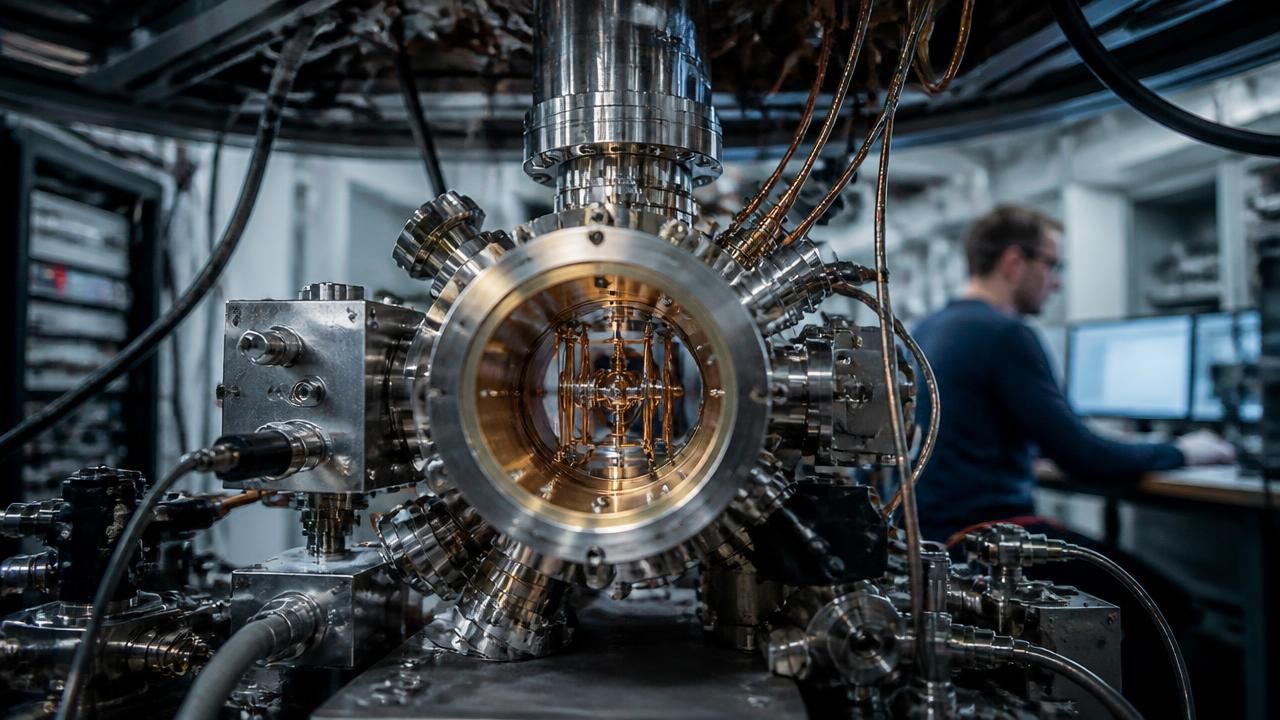
Physicists have trapped a single particle of antimatter, cooled it to temperatures close to absolute zero and kept it isolated for months in a wall-free trap, a technical feat that opens the way to the most precise comparison yet between matter and its mirror image. The particle is a positron, the antimatter counterpart of the electron, according to ScienceDaily. The achievement, reported across science and mainstream outlets, is being framed both as a step toward explaining why the universe exists and as a reminder that a better instrument is not the same thing as a discovery.
The basic puzzle is one of the biggest in physics. The Big Bang should have produced matter and antimatter in equal amounts. Yet the visible universe is almost entirely matter, with antimatter surviving only in fleeting, high-energy environments or carefully controlled laboratories. If the electron and positron were exact mirror images in every respect, that asymmetry would be difficult to explain. Any measurable difference between them could expose cracks in the Standard Model of particle physics and point toward new laws that favored matter in the early universe.
What was actually achieved
According to the accounts, the team suspended a single positron in a wall-free trap, using electromagnetic fields to keep it from touching ordinary matter. Contact would be fatal to the experiment: when antimatter meets matter, both annihilate in a burst of energy. Cooling the particle to near absolute zero slows its motion and reduces noise, making it easier to study with precision. Holding it for months, rather than fractions of a second, gives researchers time to perform measurements that would otherwise be impossible.
Smithsonian Magazine described the result as the first trapping of an elusive antimatter particle and containment for months, potentially allowing scientists to test an enduring physics theory. WIRED focused on the opportunity to study the particle’s secrets. Newswise tied the advance to mysteries of the Big Bang, while the New York Post emphasized the laboratory challenge of studying antimatter without destroying the experiment, a dramatic framing that reflects how difficult it is to handle a particle that vanishes on contact with any ordinary surface.
Why precision matters
The immediate goal is not to create or store large amounts of antimatter. It is to compare a positron with an electron in unprecedented detail. Researchers plan the most precise comparison yet of matter and antimatter properties. Such tests are sensitive to violations of CPT symmetry, a cornerstone principle that says physics should look the same if particles are swapped with antiparticles, mirrored in space and run backward in time. A difference between electron and positron could reveal physics beyond the Standard Model.
The result is best read as a precision milestone: it does not yet show that matter and antimatter differ, but it gives physicists a sharper tool for asking whether they do.
The historical background is important. Antimatter was predicted by Paul Dirac in 1928 and the positron was discovered by Carl Anderson in 1932. Since then, physicists have learned to produce antiprotons, trap antihydrogen and compare protons with antiprotons. But controlling a single antimatter particle for months at near absolute zero is a different kind of achievement. It turns antimatter from a fleeting curiosity into a laboratory specimen that can be interrogated again and again.
Competing framings
The coverage reveals a split in emphasis. Some headlines suggest the experiment could explain why the universe exists, a sweeping claim that captures the stakes but outruns the evidence so far. Others, including a skeptical MSN headline, note that matter-antimatter asymmetry still provides no evidence of new physics. That is not a contradiction. The trap is an enabling technology. It may eventually produce evidence of new physics, or it may tighten the constraints on physics beyond the Standard Model by showing that electron and positron remain identical to extraordinary precision. Both outcomes are scientifically valuable.
Some outlets also described the particle as forgotten. That label is misleading: the positron is one of the best-known antimatter particles. What is new is not the particle’s existence but the level of control. The achievement belongs to a broader push in precision antimatter physics, where the goal is to test whether nature treats matter and antimatter differently in mass, charge, magnetic moment or other fundamental properties.
Implications and next steps
- The experiment provides a long-lived, isolated positron for repeated measurements.
- Researchers can compare electron and positron properties with higher sensitivity than before.
- A confirmed difference would challenge the Standard Model and could help explain matter’s dominance.
- No difference would set stricter limits on new physics and guide future experiments.
The next phase will be measurement, replication and peer scrutiny. The team will need to demonstrate that the trapped positron’s environment is understood well enough to trust tiny differences, and independent groups will want to reproduce the trapping technique. For now, the breakthrough is best understood as a new window on an old question: why is the universe made of matter? The answer is not yet in, but physicists now have a more powerful way to look for it.