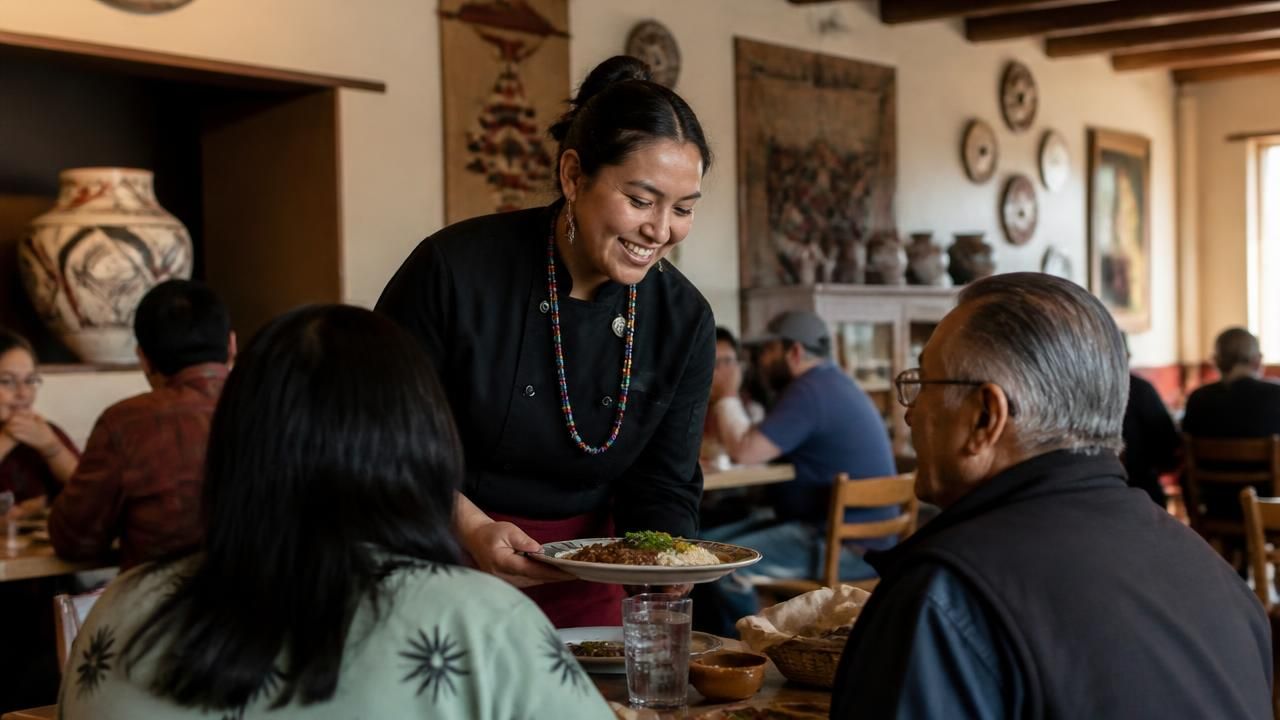
At the Indian Pueblo Cultural Center in Albuquerque, New Mexico, visitors come for the exhibitions — and increasingly, they stay for lunch. The museum's on-site restaurant, Indian Pueblo Kitchen, has become as much of a draw as the galleries themselves, serving dishes that center Native American culinary traditions rather than treating them as a side attraction.
The menu reads like a tour of the Pueblo world: green chile stew, biscochitos scented with anise and cinnamon, and a rotation of specialties rooted in the foodways of the region's Pueblo communities. It is comfort food with a pedigree — recipes passed down through generations, now plated for a public that arrives by the busload.
At the Albuquerque museum, the restaurant is just as much of a draw as the exhibitions — a rare arrangement in which the kitchen is treated as a cultural exhibit in its own right.
A Restaurant as a Cultural Institution
The setup is unusual in the museum world. Most institutional cafés are an afterthought, a place to rest tired feet between galleries. At Indian Pueblo Kitchen, the food is part of the interpretive mission: dishes are presented as living culture rather than curated artifacts, and the kitchen functions as a bridge between the museum's historical exhibits and the present-day Pueblo communities it represents.
That distinction matters. Native American cuisine has long been flattened in the popular imagination into a handful of generic tropes — fry bread, corn, the Thanksgiving table. A menu built around specific Pueblo ingredients and techniques pushes back against that, insisting on regional particularity. Green chile stew, after all, belongs to New Mexico in a way that no national food holiday can capture.
The sweet biscochitos — the official state cookie of New Mexico, traditionally made with lard and flavored with anise and cinnamon — illustrate the point neatly. The recipe is a product of centuries of exchange and adaptation, Spanish and Pueblo traditions folded into one small, sugar-dusted cookie. It is history you can eat.
Route 66 and the Reframing of Native Tourism
The restaurant's rise comes as travel media increasingly treat Native American culture as a central draw of the Southwest rather than a footnote. Forbes has framed the region through the lens of Route 66, the storied highway that cuts across New Mexico and passes through communities with deep Pueblo, Navajo and Apache roots. In that telling, the road trip is not just about neon signs and vintage diners but about proximity to living Indigenous cultures — and to the food that comes with them.
USA Today, meanwhile, has approached the same territory with a broader traveler's guide to New Mexico's history, food and culture, positioning the state as a destination where the three are inseparable. The framing differs — Forbes leans into nostalgia and the romance of the open road, USA Today into practical itinerary-building — but both point toward the same shift: cultural tourism in New Mexico is being sold on authenticity rather than scenery alone.
Why Food Is the Entry Point
For travelers, food is often the most accessible doorway into a culture. You do not need a guided tour or an anthropology degree to order a bowl of stew. That accessibility has made restaurants like Indian Pueblo Kitchen valuable ambassadors — places where visitors encounter Native culture on its own terms, in a setting controlled by Native institutions rather than outside operators.
The Indian Pueblo Cultural Center, owned and operated by the 19 Pueblos of New Mexico, is a case in point. Its founding in the 1970s was itself an act of self-representation, a response to decades of outsiders narrating Pueblo history. The kitchen extends that logic to the plate: the story is told by the people who live it.
The Economics of Attention
There is a business story underneath the cultural one. Culinary tourism has become a significant driver of visitor spending, and institutions that can offer a distinctive dining experience enjoy longer dwell times, stronger word-of-mouth and healthier gift-shop receipts. For a museum, a restaurant with a genuine identity is both mission and margin.
It also creates opportunity for Native chefs and food entrepreneurs, who have spent the past decade building a national profile through cookbooks, pop-ups and television. That visibility has begun to translate into real commercial infrastructure — a shift from being featured to being in charge.
- The draw: A museum restaurant that rivals the exhibitions as a reason to visit.
- The menu: Green chile stew, anise-and-cinnamon biscochitos and other Pueblo and New Mexican staples.
- The context: Growing travel-media interest in Native-led cultural tourism along Route 66 and across New Mexico.
- The stakes: Self-representation, visitor spending and the long-term viability of Native-run hospitality.
What to Watch
The question now is whether the attention translates into durable support. Cultural tourism is vulnerable to fashion — a destination spikes, then fades. Institutions like Indian Pueblo Kitchen are betting that authenticity, rooted in community ownership, is more resilient than a trend cycle. If they are right, the model may spread: more museums treating their kitchens as galleries, and more travelers understanding that the most memorable exhibit in Albuquerque might arrive in a bowl.