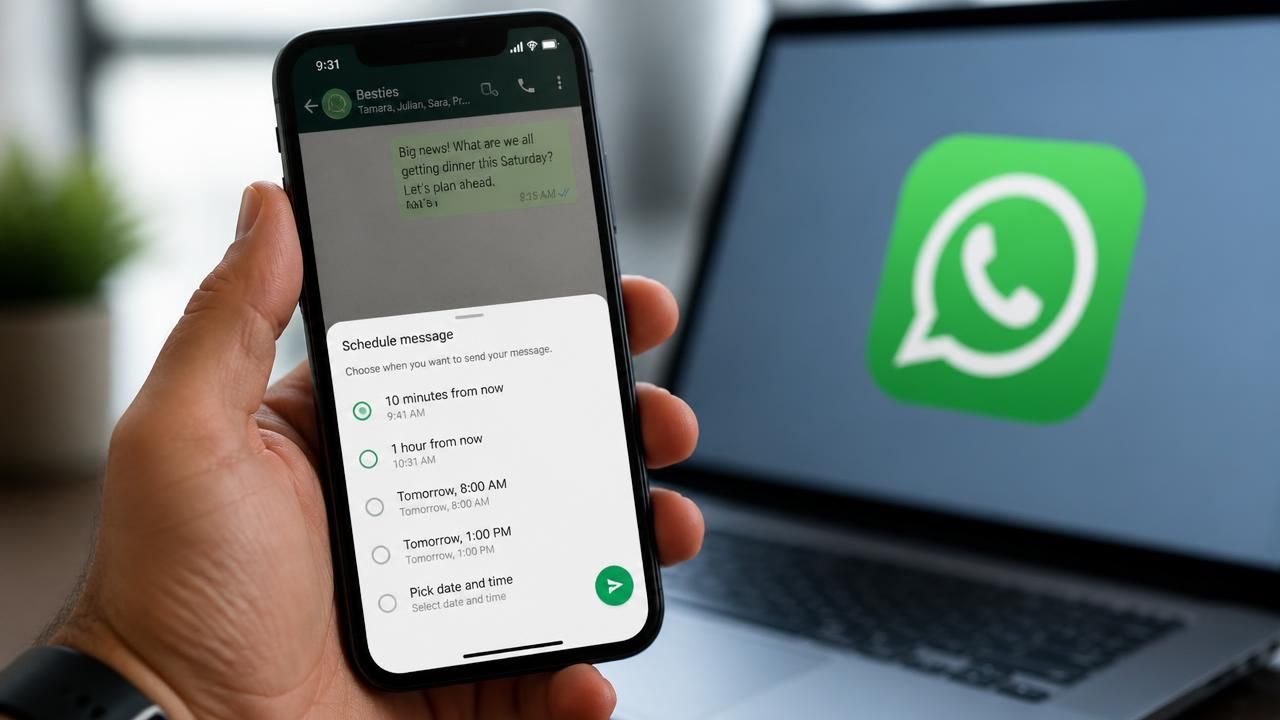
WhatsApp is rolling out scheduled messages to its roughly 3 billion users, Meta confirmed this week, adding a capability that most rival messaging apps have offered for years. The feature, which Meta describes as one of its most-requested additions, allows people to compose a message or attach media and choose a future date and time for delivery — in both one-to-one conversations and group chats.
The rollout was reported across a broad spread of outlets, from The Verge and Android Authority to MacRumors, iClarified, Redmond Pie and MSN's syndicated news feed, an indication of just how closely the world's biggest messaging platform is watched. Coverage converged on a single storyline: a small, mundane utility that matters enormously at WhatsApp's scale.
How scheduled messages work
The mechanics are deliberately simple. Users type their message as usual, then press and hold the send button rather than tapping it. A scheduling panel appears, and the message can be queued for any point between 10 minutes and two weeks in the future. Photos and videos can be scheduled the same way, and once a message is pending, it can be reviewed and cancelled from a dedicated list before it goes out.
To schedule a message, press and hold the send button and pick the date and time you want it to arrive.
The feature is available on both iPhone and Android, ending a period in which the capability surfaced first in limited tests. Several outlets — including Daily Times, TheNextWeb and MacObserver — had earlier reported that WhatsApp was trialling scheduled messages on iOS, following years of user requests and leaks from beta builds. Those reports framed the work as a test; this week's coverage reframed it as a finished product shipping to the general user base.
A feature everyone else already had
Much of the coverage leaned on the same framing device: WhatsApp catching up. Android Authority's headline put it bluntly, noting that the app was finally matching Google Messages, which has long offered scheduling for texts and media. Telegram introduced scheduled messages back in 2019. Email clients have had the option for years, and Gmail's own scheduled send became a default workplace habit after launching in 2019.
Apple's iMessage still lacks a native scheduling toggle, which makes WhatsApp's move notable for iPhone users in particular — the platform's iOS base has arguably had the least access to a first-party option. That gap helps explain why the request has been such a persistent refrain inside Meta's feedback channels.
Why scheduling matters at WhatsApp's scale
On a smaller app, scheduled messages are a convenience. On WhatsApp, they are infrastructure. The service is the primary communications layer for much of Latin America, South Asia, Africa and large parts of Europe, and it carries a growing share of small-business commerce. Scheduling changes behaviour in several practical ways:
- Time zones: families and work contacts spread across continents can send at a recipient-friendly hour without staying up.
- Small business: shopkeepers and solo operators can queue order updates, promotions or reminders for opening hours rather than typing them at midnight.
- Observances: birthdays, anniversaries and religious holidays can be prepared in advance — a use case The Verge singled out directly.
- Professional etiquette: drafts can be written when they occur to you but delivered when they read as appropriate.
That last point cuts both ways. Critics of scheduling tools have long noted that they can make communication feel automated, and that a message timed for 9:00 a.m. sharp can read as performative rather than thoughtful. There is also the practical risk of the forgotten draft: a hastily written note queued two weeks out, then overtaken by events.
The offline question and other caveats
Not every detail is settled in the public reporting. TechRepublic's earlier coverage of the test phase raised the question of whether scheduled messages fire when the sender is offline — a technically thorny issue for a service built around end-to-end encryption and device-based delivery. Meta has not made the underlying delivery mechanics a central part of its announcement, and coverage so far has focused on the user-facing behaviour rather than what happens if a phone is powered down at the appointed minute. Users should expect the feature to behave best when their device is online around the scheduled time.
The rollout also appears to be staged rather than instantaneous, consistent with how Meta ships features across a user base measured in billions. Some users will see the option before others.
What it signals
The strategic read is straightforward. WhatsApp's growth phase is over in most mature markets, so product velocity now hinges on retention and on deepening its business messaging ecosystem, where Meta sees meaningful revenue potential. Features that reduce friction for merchants and professional users do double duty: they improve the consumer product and they make the platform stickier for the small businesses Meta wants to monetise.
It is also a reminder of how high the bar is for the app. A scheduling toggle is not a technological leap; Google Messages, Telegram and email clients have offered it for years. But at 3 billion users, even a modest addition generates global headlines — and, for millions of people, quietly removes a small daily annoyance.