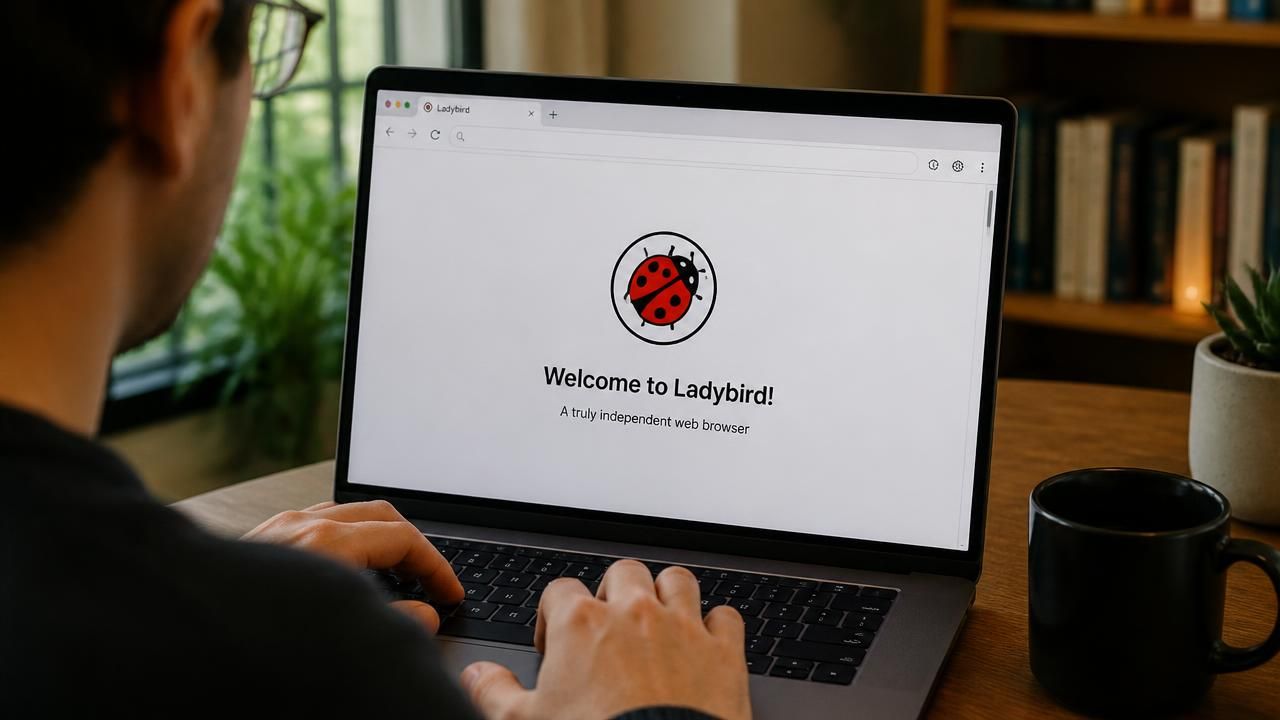
After four years of building a browser engine from the ground up, the Ladybird project shipped its first downloadable alpha on November 23, publishing prebuilt packages for macOS and Linux. Previously, anyone curious enough to try the browser had to compile it themselves from source. The new release arrives as an installable package with automatic updating — a small logistical milestone that marks a much larger technical one.
Ladybird is most notable for what it is not. Chrome, Edge, Brave and Opera all run on Google's Blink engine; Firefox depends on Gecko; Safari relies on WebKit. Ladybird's rendering engine and its LibJS JavaScript engine were written from scratch, making it the first serious new browser engine to reach a public, installable milestone in years.
"The engine is our own, built from the ground up, and not a fork," project lead Andreas Kling wrote in the announcement. "The browser around it is modest, but functional."
Why a fourth engine matters
Nearly the entire modern web runs on three browser engines. WebKit, Gecko and Blink collectively determine which features developers can use, how quickly standards are implemented, and — critically — whose bugs get worked around. Because Chromium accounts for the overwhelming majority of traffic, developers routinely optimize for Blink first and treat everything else as an afterthought. The result is a web platform that drifts toward whatever the dominant engine supports.
The historical record is not encouraging. Once-major engines have died off one by one: Trident (Internet Explorer), Presto (Opera), and EdgeHTML (Microsoft's original Edge), which was abandoned in favor of Chromium in 2020. Each retirement narrowed the pool of independent implementations, and with it the number of parties who can meaningfully push back on a single vendor's interpretation of web standards.
That concentration is the argument Ladybird's backers make most often. A healthy standards process depends on at least a few independent implementations — engines that can disagree, and in disagreeing, expose ambiguities in specifications before they harden into de facto behavior. A single-engine web is easier to build for, but it is also easier for one company to steer.
What it's like to actually use
Early testers describe the alpha as surprisingly capable for a piece of software still in its infancy — a verdict that comes with immediate caveats. Coverage from TechSpot framed the release bluntly: this is the first new browser engine in years, and of course some sites are broken. Modern websites lean heavily on decades of accumulated quirks, vendor-prefixed properties and JavaScript corner cases that mature engines have absorbed through years of brute-force bug reports. A young engine will stumble on those, and Ladybird's alpha does.
The practical limits are just as significant. There are no Windows builds yet, no mobile version, and no extension ecosystem to speak of. Performance, memory use and battery impact have not been benchmarked at any scale. And for a browser that will eventually handle passwords, payments and sensitive sessions, security hardening is a multi-year project rather than a launch checkbox — an area where a four-year-old codebase simply has fewer eyes on it than Chromium's two decades of adversarial review.
From hobby project to institution
Ladybird's origins are unusually grassroots for a project of this ambition. It began as a component of SerenityOS, Kling's from-scratch operating system, before growing into a standalone browser and eventually spinning out as an independent venture backed by a non-profit organization. That structure matters: without an advertising business or a platform owner's strategic interest, the project's stated goal is to compete on standards compliance and user interests rather than on ecosystem lock-in.
Writing a browser engine from scratch is among the most daunting undertakings in consumer software — a decades-long slog through HTML parsing, CSS layout, GPU-accelerated compositing, JavaScript JIT compilation and a vast, constantly shifting specification landscape. That the project has reached a downloadable alpha at all puts it in rare company.
The road ahead
The alpha is explicitly a developer and enthusiast milestone, not a daily driver. The next targets are broader platform support — Windows in particular — along with deeper standards coverage, performance work and the long, unglamorous grind of compatibility fixes. A beta has been discussed as a follow-on goal, but the timeline will depend on how quickly the team can close the gap on the thousands of small failures that separate a demo from a dependable browser.
For the broader web, the significance is less about whether Ladybird dethrones Chrome — it will not, at least not soon — and more about whether it can establish itself as a credible fourth implementation. Every bug that a site fixes because a second engine renders it differently is a small check on the concentration of the web. Four years in, that check now has an installer.