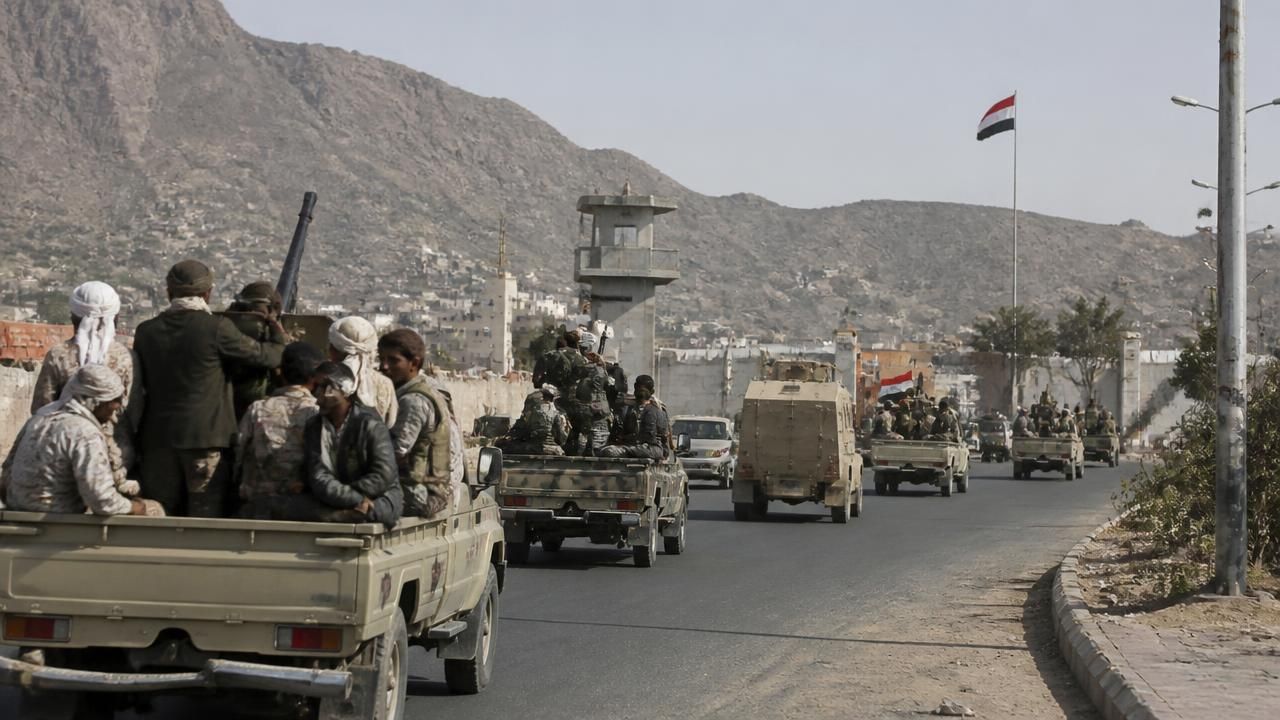
Houthi fighters are closing in on Aden, Yemen’s provisional capital, forcing Saudi-backed government troops into a defensive scramble and raising the prospect of a decisive battle for the port city that has anchored the anti-Houthi camp for a decade. The advance has been reported by outlets ranging from The New York Times and NBC News to Al-Monitor and regional broadcasters, all describing the same broad shift: anti-Houthi forces are pulling back, Houthi units are seizing ground, and civilians and wounded fighters are flowing into Aden as the front line moves closer.
The immediate trigger is the intensification of a wider regional conflict involving Iran, which has reignited Yemen’s long-running civil war. Yemen’s internationally recognized government, supported by a Saudi-led coalition, has relied on Aden as its temporary capital since Houthi rebels overran Sanaa in 2014 and 2015. Now that arrangement is under strain. The New York Times reported that wounded are being taken to Aden as Saudi-backed troops scramble to defend the city. NBC News and Al-Monitor reported that those forces have retreated to defend Aden as Houthi fighters advance. Another report said Yemeni forces had pulled out of Bab al-Mandeb, the strategic strait at the southern end of the Red Sea, as Houthis edged closer to Aden.
A capital under threat
Aden is more than a symbolic seat of government. It is Yemen’s main southern port, a humanitarian lifeline, and the center of whatever administrative and military coherence remains in the anti-Houthi camp. Its fall, or even a prolonged siege, would deal a severe blow to the Saudi-backed government and complicate international efforts to contain the conflict. The city has already absorbed displaced families and wounded from earlier rounds of fighting, and aid groups have warned that renewed urban combat could overwhelm hospitals and supply routes.
The military picture is fragmented. The Detroit News reported that government forces in Aden are divided as they prepare for a Houthi assault, a reminder that Yemen’s anti-Houthi coalition has never been unified. The New Arab, citing Yemen’s armed forces, reported that the Houthis are ready to attack Aden. That claim could not be independently verified from the blocked source material, but it matches the broader pattern described by other outlets: Houthi forces are pressing forward while their opponents regroup.
The Houthis are ready to attack Aden, Yemen’s armed forces said, according to The New Arab.
Strikes, oil sites, and a widening war
The conflict is also spreading beyond Yemen’s borders. Dawn reported Saudi strikes on Yemen as Houthis targeted Aden. The Saudi-led coalition said it destroyed Houthi missile facilities, according to Daily News and Courant, in an effort to degrade the rebels’ long-range strike capacity. Yahoo reported that the Houthis said they targeted Saudi oil sites, while attacks were also reported in Aden. Such claims are part of the war’s information battle, but they underline the risk that the Yemen front could disrupt energy infrastructure and maritime traffic.
Regional actors are being drawn in further. Egypt’s parliament authorized military support for Saudi Arabia to defend against Houthi attacks, according to NewspressNow, a move that could deepen Cairo’s involvement in a war it has largely sought to manage from a distance. One MSN report linked the anti-Houthi retreat in Yemen to Iranian strikes on Bahrain, illustrating how the Yemeni civil war is increasingly entangled with a broader confrontation involving Iran, Gulf states, and Western powers. The various headlines do not agree on every detail, but they converge on a central point: Yemen’s war is no longer contained within Yemen.
The southern separatist wild card
A Houthi advance on Aden may also revive Yemen’s southern separatist movement. MSN reported that the Houthi push could spur a resurgence of southern separatists, who have their own armed formations and a longstanding demand for independence or autonomy. The Southern Transitional Council, backed by the United Arab Emirates, has clashed with the internationally recognized government before. If Aden appears vulnerable, southern factions may seek to reassert control, complicate the defense of the city, or bargain for a larger share of power.
That dynamic helps explain why the battle for Aden is not simply a two-sided contest between Houthis and the Saudi-backed government. It is a layered conflict involving Yemeni military units, tribal fighters, southern secessionists, Saudi and Emirati-backed forces, and regional powers. Each actor has different priorities: some want to repel the Houthis, some want to protect southern interests, and others want to use the crisis to reshape Yemen’s political order.
Why it matters
The strategic stakes extend far beyond Aden. Bab al-Mandeb connects the Red Sea to the Gulf of Aden and is a chokepoint for global shipping. Houthi control of the Yemeni coastline, or even the threat of missile and drone attacks, could raise insurance costs, reroute vessels, and draw further international naval deployments. Saudi Arabia’s oil infrastructure remains a target, as Houthi claims about attacking oil sites make clear. Egypt’s parliamentary authorization of military support signals that Arab governments are preparing for a longer confrontation.
For Yemenis, the immediate concern is civilian harm. Aden has already suffered from years of war, economic collapse, and inadequate public services. A new assault could displace thousands more and cut off supplies at a moment when humanitarian funding is scarce. The New York Times’ image of wounded being brought into the port city captures the human cost behind the tactical maps.
What happens next depends on whether Houthi forces can sustain their advance, whether Saudi-backed units can hold Aden’s approaches, and whether southern separatists choose to reinforce the defense or pursue their own agenda. The sources describe a fast-moving front and a widening regional war. They also describe a familiar Yemeni pattern: a divided anti-Houthi coalition, a resilient rebel movement, and a civilian population caught between outside powers.
For now, Aden is bracing. The city that became Yemen’s provisional capital is once again the center of the war, and the outcome of the coming battle could shape not only Yemen’s future but the security of the Red Sea and the wider Middle East.