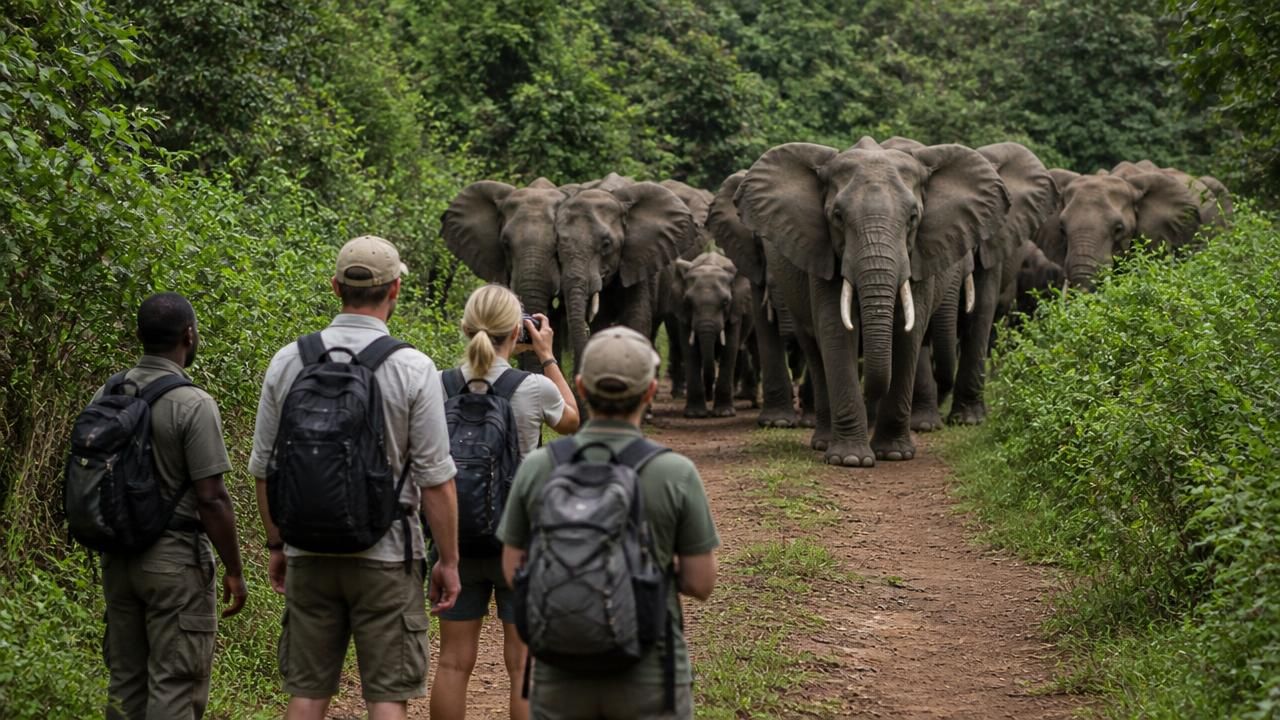
A hiking excursion in south-western Cameroon turned fatal on 19 November when a group of six foreign tourists and their local guides encountered a herd of elephants on a trail near the village of Bakingili, on the southern edge of Mount Cameroon National Park. One Swiss national was killed and two others — a British tourist and an American — were injured, according to accounts carried by multiple outlets including the Guardian and a cluster of aggregator reports on MSN.
The dead man was named in British media as Alain Throo, an insurance executive based in London. Reports say he was gored by the animals and died of his injuries. The group comprised four British tourists, one Swiss and one American, accompanied by local guides.
What happened on the trail
According to the accounts available, the party was walking a path that elephants routinely use to reach a nearby lake when they came upon a herd of roughly 15 animals. The encounter appears to have been sudden and close-range, leaving little time to retreat.
Coverage of the aftermath has emphasised the panic of the moment. Headlines on MSN and the Sun described terrified hikers scrambling up trees to escape the charging animals, with at least one British tourist reportedly hiding inside a tree stump while others were attacked. These details, circulated widely through syndicated and aggregated copy, have not been independently confirmed by park authorities in the reporting available so far.
One British tourist reportedly hid in a tree stump as the elephants attacked, while other members of the group climbed trees to escape the herd.
The condition of the injured British and American tourists has not been disclosed in detail. Nor has it been confirmed whether the local guides were harmed. Requests for comment from Cameroon's forestry and wildlife ministry, the Mount Cameroon National Park administration and the British Foreign, Commonwealth and Development Office were not immediately reflected in early reporting.
Why elephants and hikers keep meeting
Mount Cameroon, an active volcano rising more than 4,000 metres from the Gulf of Guinea coast, is the highest peak in West Africa and the centrepiece of a national park that shelters forest elephants, chimpanzees and other species. The mountain's lower slopes are also densely populated, with farming villages such as Bakingili sitting close to park boundaries.
That proximity creates predictable friction. Elephants are large-ranging animals that follow established corridors between forest cover and water sources — exactly the kind of routes that also make attractive hiking trails. Conservationists have long warned that when tourist paths overlap with wildlife corridors, encounters become a question of when rather than whether.
Forest elephants in the region are classified as critically endangered, their numbers driven down over decades by poaching and habitat loss. The International Union for Conservation of Nature has documented steep declines across Central Africa. In Cameroon, the animals are legally protected, and killing one in retaliation or self-defence carries serious legal consequences — a factor that shapes how local communities and park managers respond to conflicts.
A wider pattern of human-wildlife conflict
The incident fits into a broader trend across Africa and Asia in which expanding human settlement, agricultural conversion and tourism push people and large animals into closer contact. Crop raiding by elephants devastates smallholder livelihoods, while tourism — a vital source of revenue for conservation — depends on putting visitors near exactly these animals.
- Tour operators in the region typically rely on armed or experienced local guides when leading walks in elephant territory.
- Safety briefings usually emphasise avoiding dawn and dusk hikes, when elephants are most active, and maintaining downwind approaches.
- Conservation groups argue that corridor mapping and community compensation schemes reduce both attacks and retaliatory killings.
How the story has been framed
The differences between outlets are instructive. The Guardian's reporting is restrained and factual, leading with the nationalities of the victims and the location, and noting the elephant herd's likely purpose — accessing a lake — as context. It attributes details to media reports rather than first-hand confirmation.
Aggregators and tabloid titles, by contrast, foreground the drama: charges, rampages, hikers hiding in tree stumps and scaling trees. Several of the MSN entries are headline-only, syndicating the same underlying wire copy under different framings. The Sun's version leans hardest into sensory detail, though its page content was inaccessible at the time of writing. Notably, inkl.com's version of the story was blocked behind a JavaScript and cookie wall, a reminder of how unevenly this story has propagated across platforms.
What none of the coverage yet answers: whether the hiking party had a permit for that specific route, whether the guides were armed, how long it took for rescue services to reach the scene, and what — if anything — park authorities intend to change about trail access.
What comes next
Cameroon's authorities are expected to review safety protocols around guided hikes in the national park, one of the country's flagship eco-tourism destinations. For the travel industry, the death raises familiar questions about risk disclosure in adventure tourism, where itineraries in protected areas are marketed on the promise of close wildlife encounters.
For conservationists, the tragedy underscores the difficulty of balancing protection of a critically endangered species with the safety of the people who live and walk among them. Elephants follow corridors that predate the trails, the villages and the tourists. Managing that overlap — through better route planning, community engagement and clear visitor guidance — is likely to be the practical legacy of this incident, far more than any single headline about a rampage.
The identities of the injured tourists have not been released, and no official statement from Cameroon's government had been published in the sources reviewed.