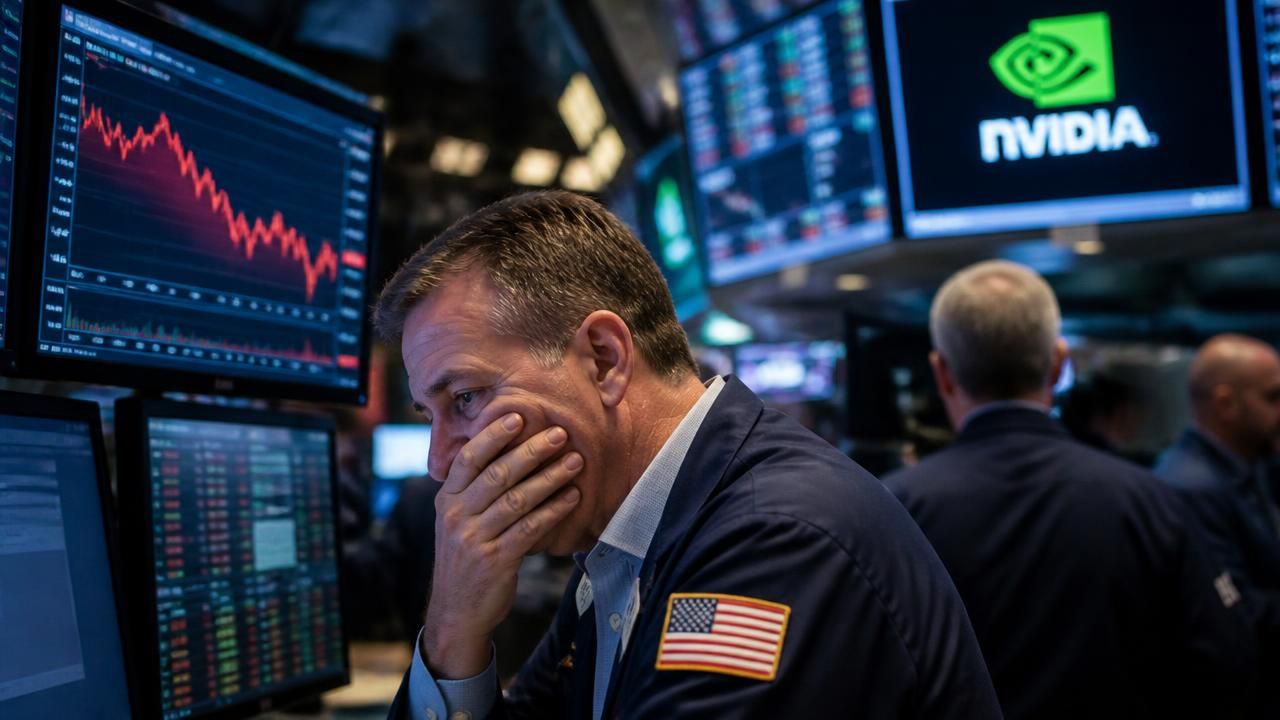
The relief rally lasted barely a session. Nvidia Corp., the world's most valuable chipmaker and the defining trade of the artificial intelligence boom, saw its shares slump again after a brief bounce tied to the return of Chief Executive Officer Jensen Huang, and the numbers attached to the decline have become a story in themselves.
Depending on how you measure it, Nvidia has shed somewhere between $1.57 trillion and $2 trillion in market value — a range that reflects a simple truth: at this scale, even the choice of a starting date changes the headline by hundreds of billions of dollars. One outlet framed the loss as "Nvidia's $1.57 trillion wipeout," noting it is now bigger than Tesla's entire market value. Another put the figure at $2 trillion by measuring from a different peak. Both are directionally correct, and both undersell how unusual the situation is: a single company's drawdown now exceeds the total value of one of the most celebrated carmakers on earth.
The Euphoria Wears Off
Bloomberg Markets captured the mood shift most precisely, reporting that "the euphoria surrounding Nvidia Corp. shares following the return of Chief Executive Officer Jensen Huang on Monday is wearing off as investors come to grips with the questions still hanging over the world's biggest chipmaker." That framing — euphoria giving way to questions — is the crux of the story. The rally was built on the visible return of Nvidia's most recognizable figure. The selloff resumed because visibility into the company's next phase is far less clear.
"The euphoria surrounding Nvidia Corp. shares following the return of Chief Executive Officer Jensen Huang on Monday is wearing off as investors come to grips with the questions still hanging over the world's biggest chipmaker." — Bloomberg Markets
Each outlet is telling a different version of the same event. Bloomberg emphasizes the durability of the underlying business questions. The market-value tallies lean on the sheer spectacle of the number, benchmarking it against Tesla to make an abstract trillions-scale figure legible. And coverage of options positioning shifts the lens forward, from what has already been lost to what traders are pricing for the next catalyst: earnings.
What the Options Market Is Pricing
Options activity around Nvidia has become its own barometer of market psychology. Traders heading into an earnings report are not simply betting on direction; they are pricing the probability of a violent move in either direction. For a stock of Nvidia's weight, the implied move is a market-wide event in miniature.
- Elevated implied volatility: Options premiums reflect expectations of an outsized post-earnings swing, a function of both genuine uncertainty and the stock's enormous notional footprint.
- Two-sided positioning: Hedges against further downside coexist with call buying from investors unwilling to bet against the AI capex cycle.
- Index contagion: Because Nvidia's weighting in major indexes is so large, a single earnings print transmits directly into broad-market volatility.
The practical implication is that the options market is treating Nvidia not as one stock among many but as a macro instrument — a proxy for the entire AI trade.
Can Nvidia Afford to Lose Jensen Huang?
The most provocative framing came from coverage asking a governance question rather than a valuation one: Nvidia's trillion-dollar bind — can it afford to lose Jensen Huang? It is a question about key-person risk at a company whose strategic narrative is inseparable from its founder's public persona.
Huang's return was treated by the market as a stabilizing signal, which is itself revealing. When a single executive's presence can move hundreds of billions of dollars in market capitalization, the concentration of value in one individual becomes a structural risk that no balance sheet line item captures. Nvidia's board, like those of other founder-led giants, faces the perennial succession question — but few companies carry it at this valuation.
Why the Questions Persist
Beneath the headlines, the concerns are familiar and unresolved. Demand for AI accelerators remains extraordinary, but it is concentrated among a handful of hyperscale customers whose capital spending is itself under scrutiny. Competition from custom silicon designed in-house by those same customers is real, if not yet at scale. Export restrictions continue to reshape the addressable market. And valuation itself remains the argument: even after a multi-trillion-dollar drawdown, Nvidia's multiple still assumes years of near-flawless execution.
What has changed is not the technology story but the market's tolerance for ambiguity. In the earlier phase of the rally, questions were deferred. Now they are being priced.
What to Watch
- Earnings guidance that either validates or undermines the AI capex thesis for the coming year.
- Options-implied moves versus realized post-earnings volatility — a test of how efficiently the market is pricing this stock.
- Any signal on succession, governance, or the durability of Huang's operational role.
- Customer concentration disclosures and the trajectory of hyperscaler spending.
The essential story is not that Nvidia has lost a trillion or two in paper value. It is that the market has moved from buying a narrative to auditing one — and the audit is being conducted in public, at a scale no company has ever had to endure.