China launched its Shenzhou-24 space mission on Wednesday, carrying three astronauts to the Tiangong space station — a crew that includes Pakistan's Muhammad Zeeshan Ali, the first foreign national ever to fly on a Chinese crewed mission and the first foreign visitor to China's orbital laboratory.
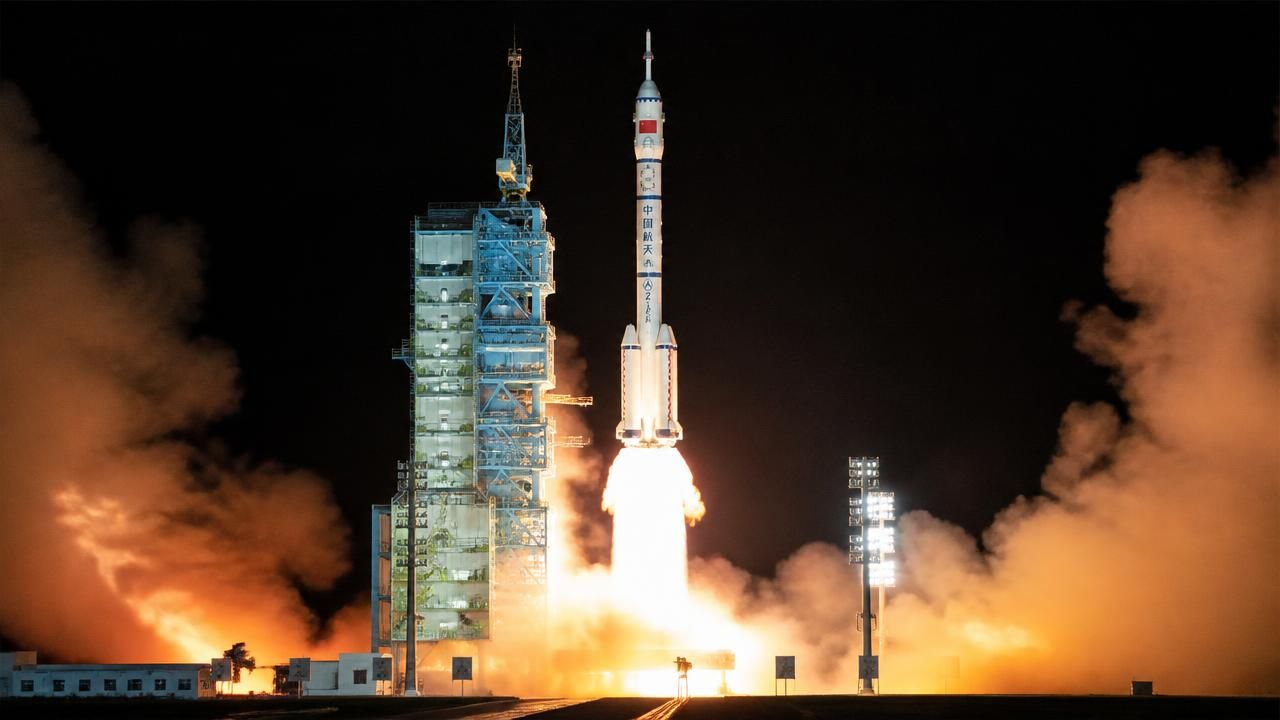
The spacecraft lifted off atop China's workhorse Long March 2F rocket and later docked with Tiangong, according to NBC News and Chinese state media, completing a rendezvous that Chinese officials described as a "complete success." Alongside Ali were two Chinese astronauts, making Shenzhou-24 the first crew in the station's history to include a non-Chinese member.
The flight was celebrated in Pakistan as a national breakthrough. "Pakistan's Big Leap," read the headline on India's NDTV, capturing the regional attention the mission drew, while Pakistani outlets from The Nation to Daily Times ran rolling coverage under banners celebrating Ali's arrival in orbit. Pakistan's prime minister led the official reaction, declaring: "We are grateful to brother China," a remark that Chinese state broadcaster-linked outlet Global Times amplified as evidence of the enduring China-Pakistan relationship, noting that netizens on both sides had turned the launch into a celebration of the bilateral "iron brothers" partnership.
A first for Tiangong
Tiangong, assembled in low Earth orbit between 2021 and 2022, had until now hosted only Chinese crews. Ali's presence marks its opening as a platform for international cooperation — a shift Beijing has signalled for years but had not previously executed with a crewed flight. The station is designed to host up to three astronauts on long-duration missions and can accommodate short-term crews of six during handovers.
The docking was confirmed by NBC News, which reported that the spacecraft had reached the station with "the first foreign astronaut" aboard, and by Pakistani media, which described Ali's arrival at Tiangong as the culmination of a years-long bilateral programme. Ahsan Iqbal, a senior Pakistani federal minister, travelled to China for the send-off, according to Daily Pakistan and the Associated Press of Pakistan, which reported that he witnessed the launch in person.
Who is Muhammad Zeeshan Ali?
Ali was selected through a cooperation arrangement between Pakistan's Space and Upper Atmosphere Research Commission (SUPARCO) and China's human spaceflight programme — a pathway that mirrors, in miniature, the multilateral training pipelines long run by NASA, ESA and Roscosmos. Pakistani outlets had trailed the mission for weeks under headlines such as "Pakistan's Zeeshan Ali set for historic flight to China's space station," and Firstpost published an explainer devoted to the question "Who is Zeeshan Ali?"
Details of his background and the precise terms of his selection have been reported only sketchily across outlets, with Pakistani coverage emphasising the symbolic weight of the moment over technical specifics. In Lahore, Karachi and Islamabad, the launch was treated as a national event, with broadcasters carrying live feeds and commentators invoking the language of a new spacefaring era for a country whose space programme has historically been modest and Earth-observation focused.
Space diplomacy, and a message to Washington
The mission's significance extends well beyond the crew manifest. Western outlets framed the launch primarily through geopolitics: Britain's Yahoo News ran the story as "China sends first Pakistani astronaut into space amid Moon race with US," positioning Shenzhou-24 as a data point in a broader contest over lunar architecture, orbital infrastructure and the rules that will govern both.
The scientific journal Nature covered the flight straightforwardly as "Pakistani astronaut to become first foreign visitor to China's space station" — a framing that underlines how the story reads differently inside the research community, where access to crewed platforms is the headline and great-power rivalry is context.
Chinese coverage leaned into the diplomatic register. Global Times emphasised the prime ministerial tribute and the outpouring of goodwill online, presenting the mission as a public good extended to a partner rather than a competitive move. Pakistani coverage, meanwhile, was almost uniformly celebratory — a tone echoed across outlets in the Gulf and Southeast Asia that aggregated the story, from Gulf Today to Malaysia's Yahoo News edition.
"We are grateful to brother China." — Pakistan's prime minister, on the Shenzhou-24 mission
The bigger picture
Beijing has spent a decade building an alternative to the US-led architecture of human spaceflight. The International Space Station is approaching retirement at the end of the decade, and China has positioned Tiangong as a facility that will remain operational and open to foreign partners — particularly those, like Pakistan, for whom access to Western crewed programmes has historically been limited or politically difficult.
The same logic underpins the International Lunar Research Station, a China-led project intended to rival the US Artemis accords framework. Bringing a Pakistani astronaut to orbit is, in that context, both a technical milestone and a recruitment tool: a demonstration that participation in China's programme delivers tangible, visible results for partner nations.
For Pakistan, the dividends are largely intangible but politically potent. The flight gives Islamabad a spaceflight first it can point to at a time of economic strain, and it deepens a strategic relationship that already spans ports, defence procurement and the China-Pakistan Economic Corridor.
What happens next
Ali is expected to spend a period aboard Tiangong conducting experiments and participating in outreach activities before returning to Earth with the Shenzhou-24 crew. Chinese officials have indicated that further foreign astronauts could follow, with several partner countries reportedly in discussions about flight opportunities.
Whether Shenzhou-24 becomes the model for a genuinely international Chinese station or remains a carefully calibrated diplomatic gesture will depend on how many foreign crews Beijing is willing to train, launch and — crucially — give meaningful research time to. For now, the mission has achieved something no amount of official communiqués could: a Pakistani citizen is in orbit, aboard a Chinese spacecraft, and both capitals are calling it history.