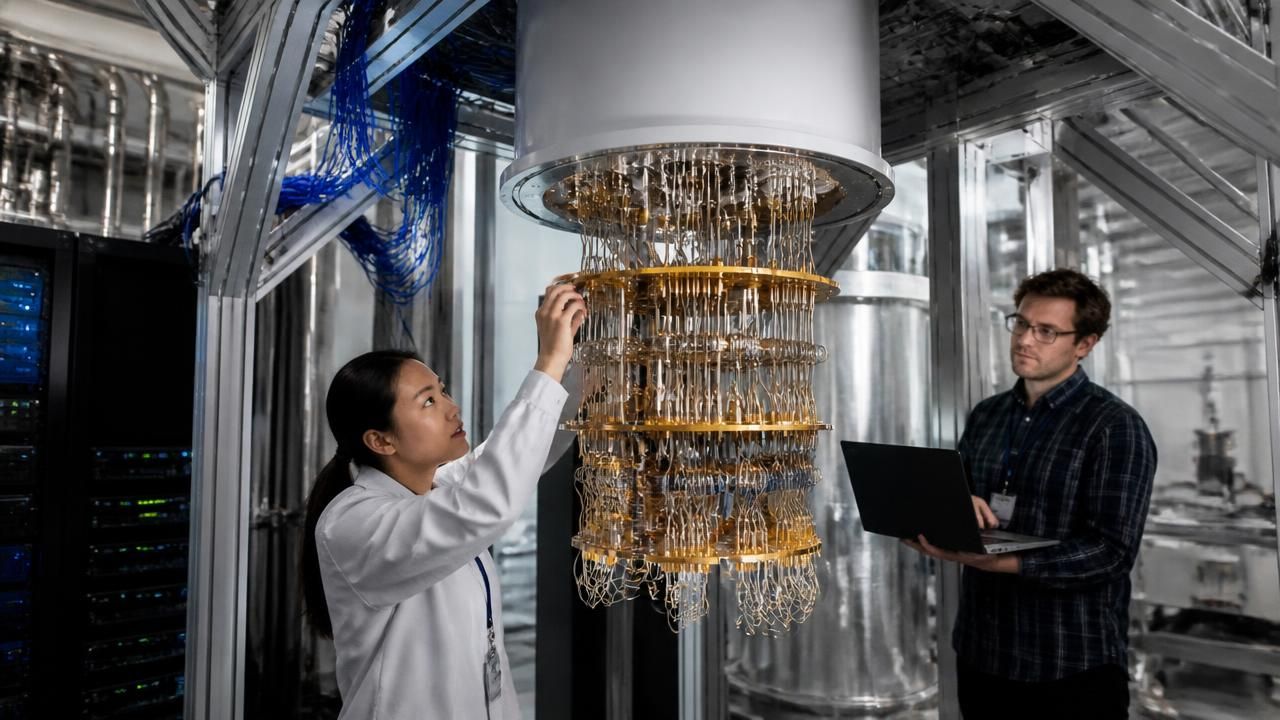
IBM and University of Chicago researchers have reported that a quantum computer completed an extraordinarily complex calculation in just 15 minutes, a result they say lies beyond the practical reach of leading classical computing methods. The demonstration, reported by Science Daily and summarized in syndicated headlines such as IBM's quantum computer solves problem in 15 minutes, is significant not only for the speed claim but for a second advance: a novel error-detection technique that gave the team confidence in the accuracy of the output.
Quantum computers promise to tackle problems in chemistry, materials science, cryptography and optimization that are intractable for conventional machines. But the field has been dogged by a credibility problem. Quantum processors are noisy, their outputs are probabilistic, and claims of quantum advantage have often been challenged by classical-algorithm specialists who find faster ways to simulate the same task. The IBM-University of Chicago result attempts to address that challenge directly by pairing a hard calculation with a method for checking whether the answer is right.
A calculation beyond practical classical reach
According to the research summary, the quantum computer completed the calculation in 15 minutes. The team described the problem as extraordinarily complex and beyond the practical reach of leading classical computing methods. That wording is important. It does not claim that classical computers can never solve the problem in principle. It claims that, with current leading methods, the task is not practically achievable on a classical machine within a comparable timeframe.
Coverage on Phys.org framed the milestone as a quantum computer completing a verified task beyond the practical reach of classical simulations. Newswise approached the same development from a broader angle, under the headline Calculating a New View on Quantum Mechanics Using Quantum Computers, emphasizing the role of quantum hardware in calculating quantum-mechanical behavior. The different frames reflect the dual nature of the announcement: it is both a benchmarking result and a step toward using quantum computers to study quantum systems themselves.
According to the research summary, the calculation was beyond the practical reach of leading classical computing methods, and a novel error-detection technique established confidence in the accuracy of the results.
Why verification matters
The central hurdle in quantum computing is not simply building more qubits. It is controlling error. Quantum states are fragile, and interactions with the environment can corrupt a computation before it finishes. Full fault-tolerant quantum computing, which would correct errors continuously, remains a long-term goal. In the meantime, researchers rely on error mitigation and error detection, techniques that do not eliminate every error but can make a result more trustworthy.
The IBM-University of Chicago team says its error-detection technique allowed scientists to establish confidence in the accuracy of the results. That is a meaningful shift in how such demonstrations are judged. A fast quantum calculation is of limited value if no one can verify that the output is correct. By adding a verification layer, the researchers are trying to move the conversation from raw speed to reliable computation.
- Who: Researchers at IBM and the University of Chicago.
- What: A quantum computer completed an extraordinarily complex calculation in 15 minutes.
- Why it matters: The task is described as beyond the practical reach of leading classical methods, and a new error-detection technique supports confidence in the result.
- How it was covered: Science Daily reported the technical claim; MSN syndicated the 15-minute headline; Phys.org stressed verified computation; Newswise framed it as a new way to calculate quantum mechanics.
The quantum advantage debate
The result lands in a field that has learned to be cautious about superlatives. Since Google's 2019 claim of quantum supremacy, researchers have debated what counts as a genuine advantage. Classical algorithms improve, hardware improves, and benchmarks age quickly. A problem that is out of reach for classical simulation today may become tractable tomorrow with better software, more memory or new mathematical insights.
For that reason, the strongest part of the IBM-University of Chicago announcement may be the verification method rather than the 15-minute figure alone. If the team can show that the quantum processor produced a correct answer to a problem that classical machines cannot practically check, it strengthens the case that the machine is doing something genuinely different. But independent replication will be essential. Scientific claims in quantum computing carry more weight when other groups can reproduce the result and when the benchmark is clearly specified.
The commercial and scientific implications are substantial. A verified quantum calculation could eventually help researchers model molecules, design materials, optimize logistics or probe fundamental physics. It could also reshape the security landscape, because quantum computers threaten some forms of encryption. Those applications remain years away, and the IBM-University of Chicago demonstration is a proof point rather than a product. Still, it shows that the gap between quantum hardware and classical simulation is being tested in more rigorous ways.
A new view of quantum mechanics
Newswise's framing points to another dimension of the work: quantum computers are natural tools for calculating quantum mechanics. Classical computers must approximate quantum systems, often at great cost. A quantum machine, by contrast, operates according to quantum rules and may be better suited to simulating them. If the latest result holds up, it suggests that quantum computers are moving from laboratory curiosities toward instruments for scientific discovery.
The next steps will be familiar to anyone who follows the field: publish the details, invite replication, compare against the best classical algorithms and show that the method scales beyond a single demonstration. The 15-minute calculation is a headline. The error-detection technique is the foundation. Together, they offer a more mature way to judge quantum computing: not by promises alone, but by verified results that classical machines cannot practically match.