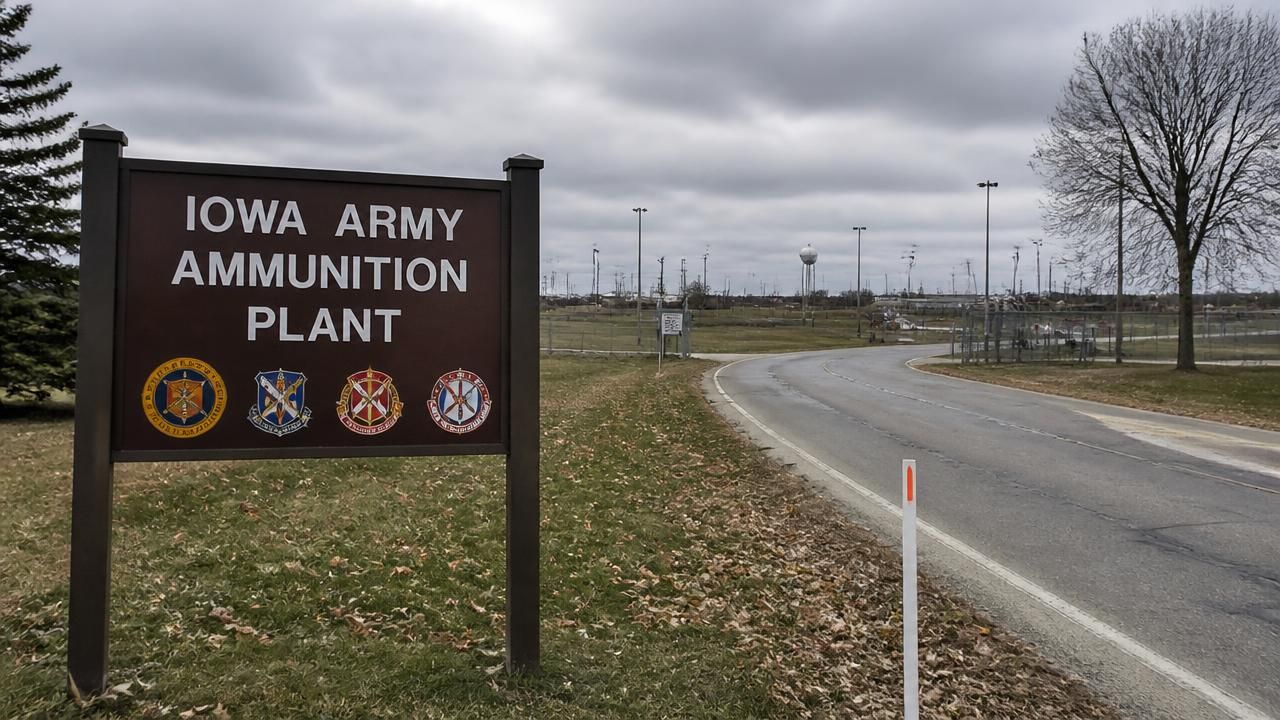
President Trump said Monday that he has ordered the U.S. military to halt its plan to detonate dozens of deteriorating barrels of lead azide at the Iowa Army Ammunition Plant in Middletown, Iowa, throwing the fate of one of the country's more unusual hazardous-waste standoffs to a federal court and to a governor who has not yet been sworn in.
The announcement, made in a post on social media Monday afternoon, capped a turbulent week in which the Army twice moved the date of a controlled detonation that residents and state officials say they learned about only days in advance. The operation had been scheduled for Nov. 20, was delayed Thursday amid public outcry and an emergency legal challenge from environmental groups, and had been reset for Nov. 25 before the president intervened.
What's in the barrels — and why it matters
At issue are 68 barrels of lead azide, a highly sensitive explosive compound used in detonators and primers that has degraded over years of storage. Reporting on the president's announcement described the stockpile as roughly 10,000 pounds of explosive material. According to earlier coverage, the Army's plan called for a controlled open detonation that would launch a plume of toxic gases and neurotoxic lead that could travel as far as 100 miles from the facility — a radius that would put parts of several states within reach of the fallout.
Army and other officials have disputed the outer edges of that estimate. One local report on the rescheduled Nov. 25 operation stated that the resulting plume would not reach Wisconsin, an assurance clearly aimed at residents along Iowa's northern border who had been alarmed by the 100-mile figure.
The Iowa Army Ammunition Plant, a sprawling government-owned, contractor-operated facility near Middletown in southeast Iowa, has manufactured and stored munitions for decades. Lead azide's instability — it is sensitive to heat, friction and shock — is precisely what makes both its storage and its disposal fraught. It is also what makes the disposal decision legally and politically complicated: the material cannot simply be left indefinitely, but every method of destroying it carries risk.
How the fight unfolded
The dispute escalated quickly last week. Residents and local officials said they were notified of the planned detonation only days beforehand, prompting an outcry that spanned county boards, state agencies and eventually the governor's office. Environmental groups, led by Earthjustice, filed an emergency court action arguing that the Army had not fully evaluated safer alternatives — such as controlled incineration, chemical neutralization or consolidated storage — before settling on open detonation.
"The fate of the unstable, highly explosive material is now in the hands of a federal court," the president wrote, adding that responsibility would also fall to Rob Sand, Iowa's governor-elect, who does not take office until January.
Trump's message carried an explicit warning: he said the incoming governor would bear the blame if the material were to detonate accidentally, and he invoked the prospect of "death or destruction." The framing drew immediate criticism from commentators who noted that the federal government — not a state official — controls the material and the facility, and that the president was effectively assigning risk to an officeholder who will not have authority over the site for weeks.
Differing frames across outlets
Coverage of the episode varied sharply by outlet, revealing how the same set of facts can be read as a technical dispute, a political maneuver or a local safety emergency.
- Technical and policy outlets focused on the chemistry and the procedural record, emphasizing that the Army had moved forward without a full public airing of alternatives — the core of Earthjustice's legal argument.
- Political coverage emphasized the back-and-forth between the White House and the governor-elect, casting the episode as a game of jurisdictional hot potato in which neither side wanted to own the outcome.
- Regional and local outlets led with the practical question on residents' minds: how far will the plume go, and will it cross state lines? The Nov. 25 notice that the detonation "won't reach Wisconsin" was, for those audiences, the headline.
- Aggregators and tabloid-style feeds amplified the president's most dramatic language, framing the story around a warning to the incoming governor rather than around the material itself.
What happens next
With the military ordered to stand down for now, the immediate question is what a federal court will do. The environmental groups are seeking a fuller review of disposal options before any detonation proceeds; the government has argued that delay itself carries risk, since the barrels are deteriorating and their stability cannot be guaranteed indefinitely. That tension — between the hazard of acting and the hazard of waiting — sits at the heart of the case.
The political dimension is unlikely to fade. Rob Sand will inherit a dispute he did not create and, under the president's framing, a share of the blame he cannot yet discharge. Federal officials have not said publicly whether they consider the barrels safe to hold through the winter, and the court has not indicated when it will rule. For the roughly 100-mile radius that has been cited in public discussion, the practical guidance remains what it has been for a week: uncertainty, a date that has already moved twice, and now a president who says the decision is no longer his.