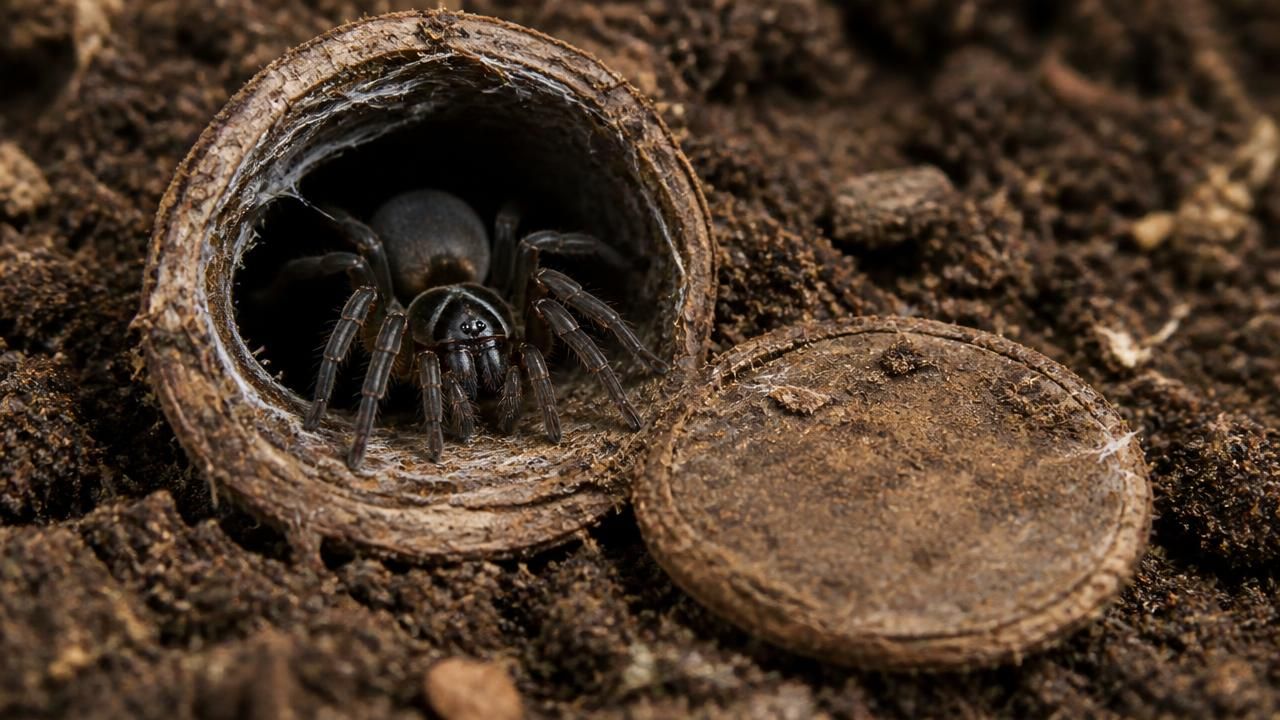
It is roughly the size of a quarter, lives underground in a silk-lined burrow in California, and was named after a late-night comedian. Yet the trapdoor spider Aptostichus stephencolberti turns out to carry one of the most unexpectedly bloated genetic instruction manuals in the animal kingdom: a genome roughly 50 percent larger than a human's, according to researchers at the University of California, Davis, and their collaborators.
The sequencing effort, reported by UC Davis, Science Daily, Mirage News and Phys.org, found that the spider's genome contains about 4.6 billion DNA base pairs packed into 52 chromosomes. By comparison, the human genome holds roughly 3.1 billion base pairs across 46 chromosomes — meaning this diminutive arachnid carries nearly twice as many chromosomes as a person and substantially more raw genetic material.
A spider with a famous name
The species was named in honor of Stephen Colbert, the comedian and television host, and the naming has long been one of the more colorful footnotes in arachnology. The spider is a trapdoor spider: it digs a burrow and lines the entrance with a hinged silken door, ambushing prey that wanders past. It belongs to the genus Aptostichus, a group of Californian trapdoor spiders that has attracted attention from taxonomists studying the state's hidden invertebrate diversity.
That such a small, unassuming animal could harbor such a large genome is the central surprise of the work — and a reminder that genome size has little to do with an organism's complexity. "It's a striking example of how little we can predict about genome size from an animal's size or appearance," the findings suggest, underscoring a long-standing puzzle in evolutionary biology.
Why genome size doesn't track complexity
Biologists have known for decades that genome size varies wildly across life, sometimes with no obvious relationship to an organism's complexity — a phenomenon historically dubbed the "C-value paradox." Lungfish and some salamanders have genomes many times larger than humans'. Many plants dwarf animal genomes entirely. The difference is often driven by transposable elements — mobile stretches of DNA that copy themselves throughout a genome — and by other repetitive sequences that accumulate or get purged over evolutionary time.
The Colbert spider's 4.6 billion base pairs fits that pattern. Sequencing a genome this repetitive is technically demanding, and assembling it into coherent chromosomes is one of the reasons the project is notable: it gives scientists a reference for a lineage that has been poorly represented in genomic databases. Spiders as a whole remain under-sampled genetically compared with insects or vertebrates, despite being among the most diverse and ecologically important predators on land.
"The genome is about 50% larger than a human's, and it has 52 chromosomes — surprising clues about spider evolution."
What the sequence can tell us
Researchers say the assembly opens several lines of inquiry. Among them:
- Genome architecture: How spiders tolerate and manage such large amounts of repetitive DNA, and whether chromosome number influences how genes are inherited and rearranged.
- Venom and silk genetics: Spiders are famous for both; a high-quality reference helps researchers trace the evolutionary origins of these protein cocktails across spider families.
- Sex determination and development: The unusually high chromosome count raises questions about how sex chromosomes and developmental genes are organized in the group.
- Conservation and biodiversity: Trapdoor spiders are cryptic, long-lived and highly localized. Genetic data can help identify distinct populations and species that are difficult to distinguish by eye.
The work also highlights a broader trend: as sequencing costs fall, researchers are turning to "weird" genomes precisely because they break assumptions. Assembling a highly repetitive arthropod genome requires long-read sequencing technologies and careful computational work, and each new reference genome improves the tools available for studying relatives.
How the story was framed
Coverage of the finding split along predictable lines. Science Daily and Mirage News led with the comparative hook — 50 percent larger than a human's — emphasizing the counterintuitive pairing of tiny body and gigantic genome. Outlets including Yahoo News emphasized the chromosome count, framing it as a head-turning factoid: the spider has more chromosomes than you do. UC Davis, where the research was based, presented the work as a scientific milestone, foregrounding the sequencing achievement and its implications for understanding spider evolution.
All framings point to the same underlying story: a celebrity-named arachnid from California has become an unlikely ambassador for the strange economics of genomes. And the discovery that a quarter-sized animal can carry 4.6 billion letters of DNA is a useful corrective to the intuition that size, complexity and genetic content march in step.
For now, the spider's genome stands as a reference point — a resource for arachnologists and a reminder that in biology, the smallest subjects sometimes carry the largest surprises.