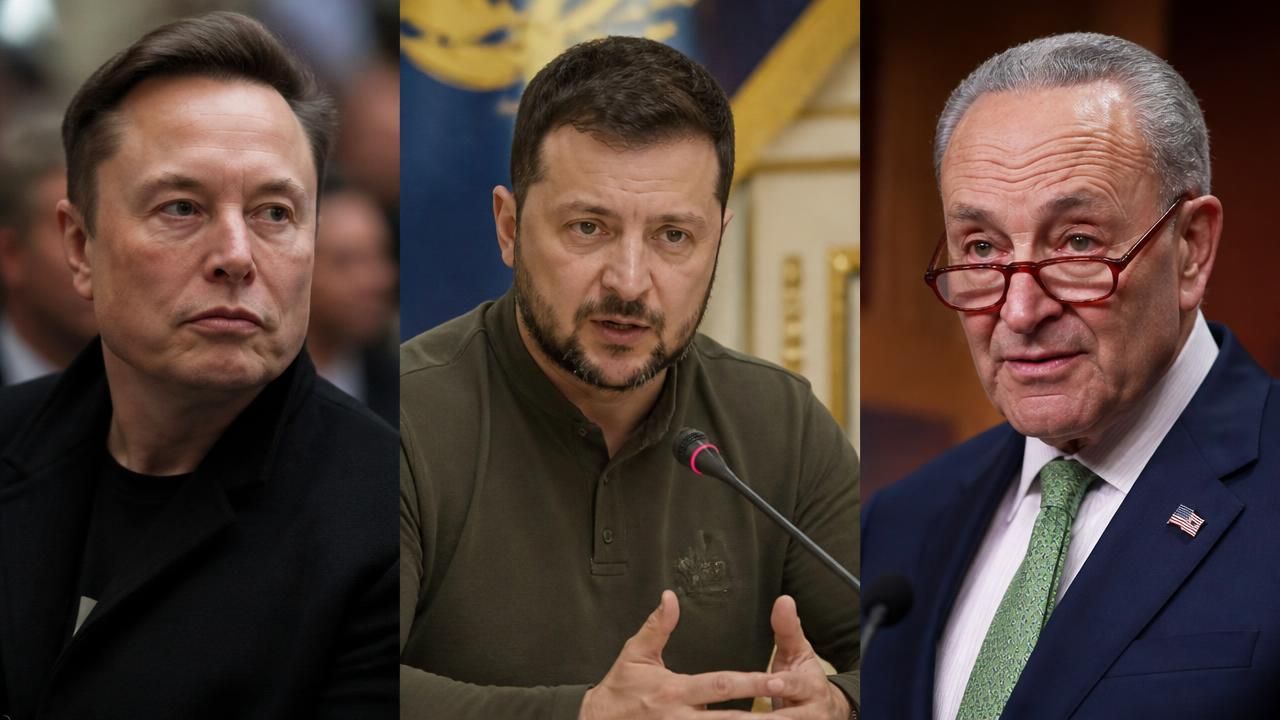
Renewed speed restrictions on SpaceX's Starshield satellite network in Ukraine have escalated from a battlefield annoyance into a full-blown political confrontation in Washington, pitting Kyiv against Elon Musk's company and casting doubt on the future of one of the U.S. government's most sensitive commercial partnerships.
Ukrainian President Volodymyr Zelenskyy said this week that Starshield — the military-grade sibling of the commercially available Starlink internet service — is once again operating under "systematic" speed limits over Ukrainian territory, describing the curbs as a direct threat to the country's drone operations and to energy infrastructure defenses as another winter of Russian strikes looms. According to Zelenskyy, the restrictions apply specifically to what he characterized as "occupied territories," though Ukrainian officials say the practical effect is felt along the front lines and in the airspace where reconnaissance and attack drones operate.
Musk responded bluntly, accusing Zelenskyy of lying about the restrictions. The public exchange marked a sharp deterioration in a relationship that has swung repeatedly between cooperation and conflict since the early days of Russia's full-scale invasion, when Starlink terminals became a lifeline for Ukrainian commanders.
A distinction with consequences: Starlink versus Starshield
The dispute turns in part on a technical distinction that has been blurred in public debate. Starlink is a commercial broadband service; Starshield is a separate, government-oriented product line built on similar satellite infrastructure but designed for national-security customers, with dedicated encryption and — crucially — U.S. government contracting terms attached. Analysts note that Starlink was never marketed as a weapon system, whereas Starshield was built explicitly for military and intelligence applications, making any throttling of the service a contract issue rather than a customer-service complaint.
Reporting from Reuters indicates that the United States has for years quietly asked Musk to alter Starlink coverage in Ukraine and the Middle East, suggesting that the boundaries of service in conflict zones have long been a subject of negotiation between SpaceX and federal agencies. That history complicates the company's framing of the current restrictions as a purely operational decision.
Congress threatens the purse strings
The most consequential development may be unfolding on Capitol Hill. Rep. Jim Himes (D-Conn.), the senior Democrat on the House Intelligence Committee who is expected to take the panel's gavel in January, sent a letter to Musk on Friday warning that SpaceX's conduct could imperil every contract it holds with the U.S. government.
"SpaceX's potentially unilateral modification of a U.S. Government contract, combined with its lack of responsiveness to congressional oversight, calls into question every contract the U.S. Government has with SpaceX," Himes wrote.
CNN, which first reported the letter, also reported that Himes sent a classified communication to Director of National Intelligence Jay Clayton conveying a similar message: that Congress would find it difficult to authorize funding for systems in which SpaceX is the primary vendor without satisfactory answers.
That is a significant threat. SpaceX is one of the Pentagon's most important suppliers, providing launch services for national-security satellites, and it is a pillar of the U.S. military's growing reliance on commercial space. A funding freeze or conditions on SpaceX contracts would ripple far beyond Ukraine.
An oversight vacuum
At the same time, the Pentagon's independent watchdog has declined a bipartisan request to investigate the Starshield slowdowns, according to CNN. The decision leaves lawmakers without an authoritative accounting of what changed, when, and at whose direction — precisely the gap that Himes and others say justifies their skepticism.
Coverage of the episode has diverged sharply by outlet. Conservative-leaning outlets such as the New York Post characterized the situation as a "blame game" between Musk and the White House that has since been resolved, reporting that Starlink capacity was restored to full power. Ukrainian and international outlets, by contrast, have emphasized Zelenskyy's contention that restrictions remain in place and that Kyiv is "still seeking clarity" from Washington. The competing narratives — restored versus restricted — have not been reconciled publicly, a reflection of how little verified information is available about Starshield's operational parameters.
A contract clock and a corporate pivot
Time pressure is mounting. A diplomat told Reuters that Ukraine's Starshield contract with the United States expires next year, raising the stakes for Kyiv as it seeks binding assurances about service continuity. Meanwhile, SpaceX is reportedly planning the retirement of its workhorse Falcon 9 rocket as it pivots toward Starship — a transition that will itself absorb regulatory and political attention in Washington.
The episode also carries implications for the broader commercial-space industry. The U.S. military has spent the past decade deliberately weaving private companies into its architecture, betting that commercial agility would outpace traditional procurement. The Starshield dispute exposes the vulnerability in that bet: when a single vendor's CEO is also a political actor with unilateral control over a service used in active combat, the line between commercial provider and sovereign decision-maker becomes uncomfortably thin.
For now, the key questions remain unanswered: What exactly changed in Starshield's configuration over Ukraine, who authorized it, and whether Congress will treat those answers as a precondition for future funding. What is clear is that a service once celebrated as a symbol of private-sector ingenuity in wartime has become a liability in the making — and that the fight over it is no longer confined to the battlefield.