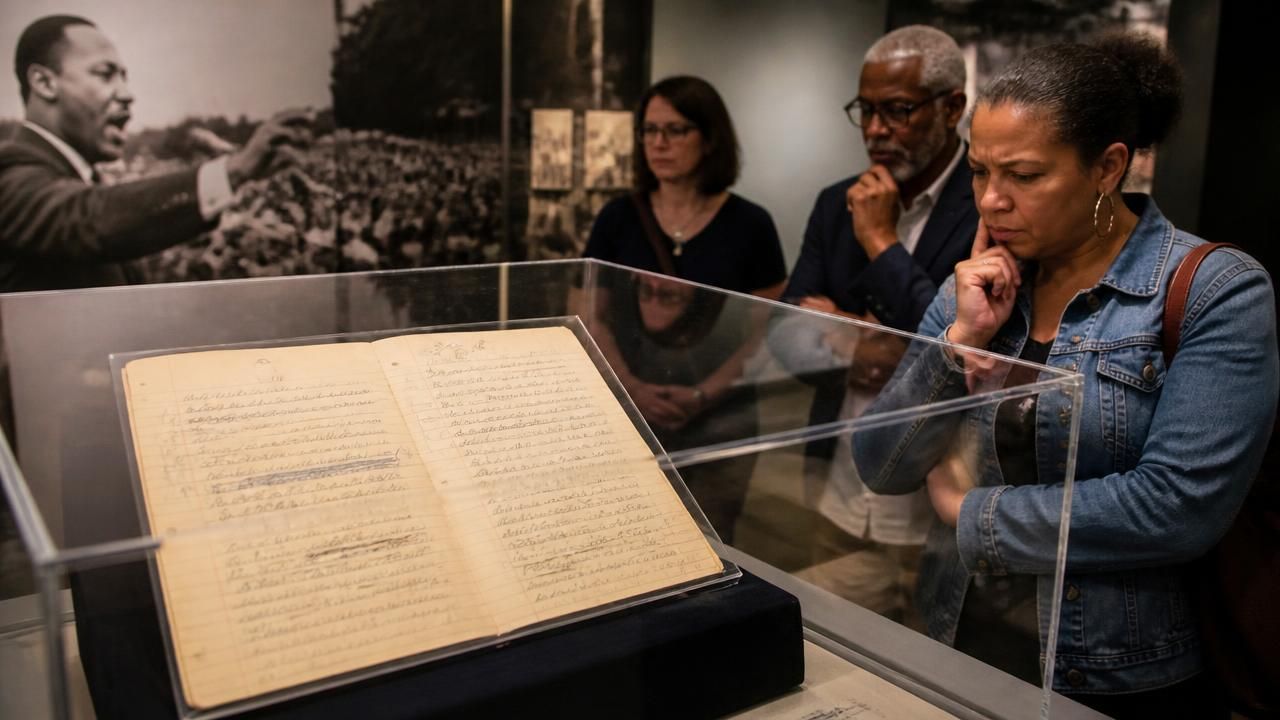
ATLANTA — It is the speech that defined a movement, but the words most Americans can recite from memory appear nowhere on the page. The only known handwritten final draft of the Rev. Martin Luther King Jr.'s “I Have a Dream” address has gone on public display in his hometown for the first time, offering visitors a close look at the working document behind one of the most consequential speeches of the 20th century.
The draft, which surfaced after decades in a desk drawer, is being exhibited in Atlanta before it heads to auction at Christie's, where it is expected to command as much as $10 million — a figure that would make it among the most valuable pieces of American civil-rights memorabilia ever sold.
A draft without the dream
The document's most striking feature is an absence. The phrase “I have a dream” — repeated eight times in the delivered speech and now inseparable from King's legacy — does not appear in the handwritten text. Nor does the closing crescendo drawn from the spiritual “Free at Last.”
What the pages do contain is the prepared argument King carried to the Lincoln Memorial on Aug. 28, 1963: the indictment of segregation, the call for voting rights, the appeal to the “promissory note” of the Constitution and the Declaration of Independence. King's edits, cross-outs and insertions are visible throughout — the handwriting of a preacher refining a sermon, not a speechwriter polishing a script.
That the draft omits the famous refrain is not an accident of editing but a matter of history. The “dream” language was largely improvised on the day, a fact that has long been part of the speech's mythology and that this document now documents in ink.
The improvisation that made history
King had used variations of the “I have a dream” refrain before — in Detroit that June and at earlier appearances in the South — but his prepared text for the March on Washington did not include it. As he neared the end of his remarks, gospel singer Mahalia Jackson, standing nearby, is said to have urged him to tell the crowd about the dream. King departed from his script, and the speech pivoted into the passage that would be anthologized, memorialized and taught in schools for generations.
“I have a dream that my four little children will one day live in a nation where they will not be judged by the color of their skin but by the content of their character.”
The March on Washington drew an estimated 250,000 people to the National Mall. Within years, the speech helped build the political pressure that produced the Civil Rights Act of 1964 and the Voting Rights Act of 1965.
From a desk drawer to a gallery wall
The manuscript was long presumed lost. According to reports, it spent decades in a desk drawer in Atlanta before being rediscovered — a provenance that has fueled intense interest from collectors and archivists alike. Outlets have framed the find differently: The New York Times and Smithsonian magazine have treated it as a literary and archival mystery, a “lost” text recovered; local Atlanta coverage has emphasized civic pride and the chance for residents to see a hometown artifact; broadcasters and wire services have focused on the logistics of the exhibition and the looming sale.
The public viewing marks the first time the draft has been shown to the general public. Visitors have described the experience as intimate and slightly uncanny — the mechanics of genius laid bare on paper, with the celebrated lines conspicuously missing.
A $10 million question
Christie's has estimated the draft could bring up to $10 million, a valuation that reflects both the scarcity of King material on the open market and the enduring global resonance of the speech. Comparable sales have reached into the millions: King's 1964 Nobel Peace Prize medal sold for roughly $3.7 million in 2014, and archival letters and documents bearing his hand have repeatedly set records for civil-rights ephemera.
Some historians and archivists have raised a different question: whether documents of this significance should be privately held at all. Public institutions, including the King Center and the National Archives, hold substantial collections, but budgets rarely compete with private bidders. The result is a recurring tension in the market for historic manuscripts — between the highest price and the widest access.
- What it is: The only known handwritten final draft of the “I Have a Dream” address, with King's own edits.
- Where: On public display in Atlanta, King's hometown, ahead of sale.
- The estimate: Up to $10 million at Christie's.
- The twist: The speech's most famous words were never written down.
Whatever the hammer price, the document's emergence has already altered how scholars understand the speech — less as a fixed text than as a live performance in which King, at the climactic moment, abandoned his manuscript. For visitors in Atlanta, the blank space where the dream should be may prove the most eloquent passage of all.