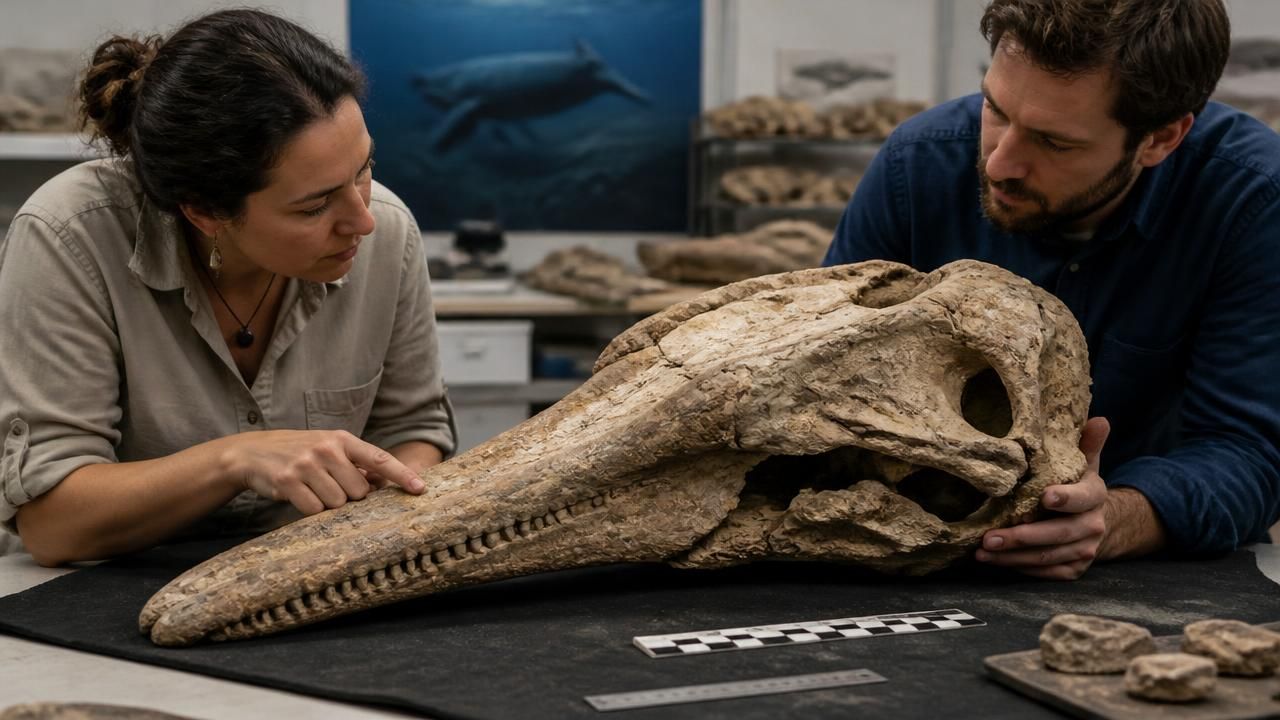
Paleontologists working on fossils from Peru have described what may be the most asymmetrical face of any mammal known to science: a small, extinct sperm whale that swam the eastern Pacific roughly six million years ago with a snout so dramatically down-curved and a skull so lopsided that the first researchers to study it assumed the specimen had simply been crushed after death.
The animal, Scaphokogia huachafo, was an extinct relative of today's pygmy and dwarf sperm whales. Its skull was not damaged. According to the team's analysis, the distortion was baked in by evolution — an extraordinary adaptation, in the words of the researchers, for hunting along the seafloor.
A skull that looked broken
The initial misreading is understandable. Fossil skulls are frequently flattened, sheared or twisted by millions of years of sediment pressure, and a paleontologist's first instinct on encountering a bent snout is to reach for the taphonomy textbook — the study of what happens to a body between death and discovery. Scaphokogia huachafo appeared to be a textbook case. Its rostrum curved sharply downward, its facial region was skewed, and its blowhole sat far off the midline.
But the deformation proved too consistent, too symmetrical in its asymmetry, to be the work of geology. Bone thickness, suture patterns and the internal anatomy of the nasal passages all pointed the same way: this was how the animal was built. As Science Daily put it in its summary of the work, the bizarre whale's anatomy looks damaged but instead reflects a genuine evolutionary specialization.
Its strange anatomy appears to have been an extraordinary evolutionary adaptation for hunting along the seafloor.
Both nostrils, one side
The most striking feature is the placement of the whale's nostrils. In most mammals the two nasal openings are broadly symmetrical. Even in dolphins and porpoises, whose blowholes have migrated to the top of the head, a midline position is the norm. In Scaphokogia, both nostrils had shifted to one side of the face — a configuration that headlines across outlets seized on. Discover framed the animal around exactly that detail, describing a "bizarre whale" that "swam ancient oceans with nostrils on one side of its face," while MSN's coverage split the emphasis between the "extraordinarily lopsided face" and the displaced nostrils, and Techlicious went informal, introducing readers to "huachafo, the ancient whale with a wildly crooked face."
The framing differences are telling. Science Desk and Discover led with the anatomical oddity; the aggregator coverage led with the image. But all converge on the same underlying fact: this was not a deformity, but a design.
Why asymmetry pays
Among toothed whales, cranial asymmetry is not unprecedented — it is a family tradition. Living sperm whales have massively skewed skulls, with the blowhole pushed to the front-left above an enormous spermaceti organ used to generate and focus sound. The pygmy and dwarf sperm whales of genus Kogia, the closest living analogues to Scaphokogia, also show a visibly off-centre blowhole.
In those animals, asymmetry is functionally linked to echolocation. Toothed whales produce clicks in the nasal passages and bounce them off the environment, reading the returning echoes to build a sonic picture of the dark ocean. Shifting the sound-generating apparatus off-centre changes the geometry of the beam — how wide it is, where it points, and how it interacts with the animal's jaw, which receives the returning sound.
For Scaphokogia, a skewed face combined with a long, down-turned snout suggests a whale scanning the sediment immediately below it rather than the open water ahead. Modern Kogia are suction feeders that hunt squid and fish in deep water; a whale with a snout angled toward the bottom would be well equipped to probe mud and sand for buried prey, using an echolocation beam aimed downward and slightly to one side.
Life in the ancient Pisco Sea
The fossil comes from Peru's celebrated coastal deposits, which preserve a remarkable window into the Pacific of the late Miocene and early Pliocene. Six million years ago, this was a highly productive sea, fed by upwelling currents that supported enormous populations of plankton, fish, seabirds and marine mammals. The region has yielded giant sharks, sea turtles, bizarre swimming sloths and an exceptional diversity of extinct whales and dolphins.
That richness provides context for Scaphokogia's odd anatomy. When many whale lineages share a habitat, dividing up the ocean — and the seafloor — becomes an evolutionary strategy. A whale that specializes in hunting on the bottom occupies a niche distinct from relatives working the midwater column, and the extreme skull shape is the fossil record's record of that division of labor.
What the fossil still has to say
The finding adds to a growing body of evidence that extreme asymmetry in odontocete skulls is not a quirk of one or two lineages but a recurring solution to the problem of sensing in the dark. Each new example helps researchers map when particular echolocation strategies evolved and how sound-production anatomy was reshaped along the way.
Researchers caution that a single skull, however well preserved, cannot fully reconstruct an extinct animal's behavior. Recovering more specimens, and studying the inner ear and jaw structures that receive sound, will be essential to testing the benthic-hunting hypothesis. But the headline result is already clear. Millions of years before anyone thought to call a face "crooked," evolution had already built one — and given it a purpose.