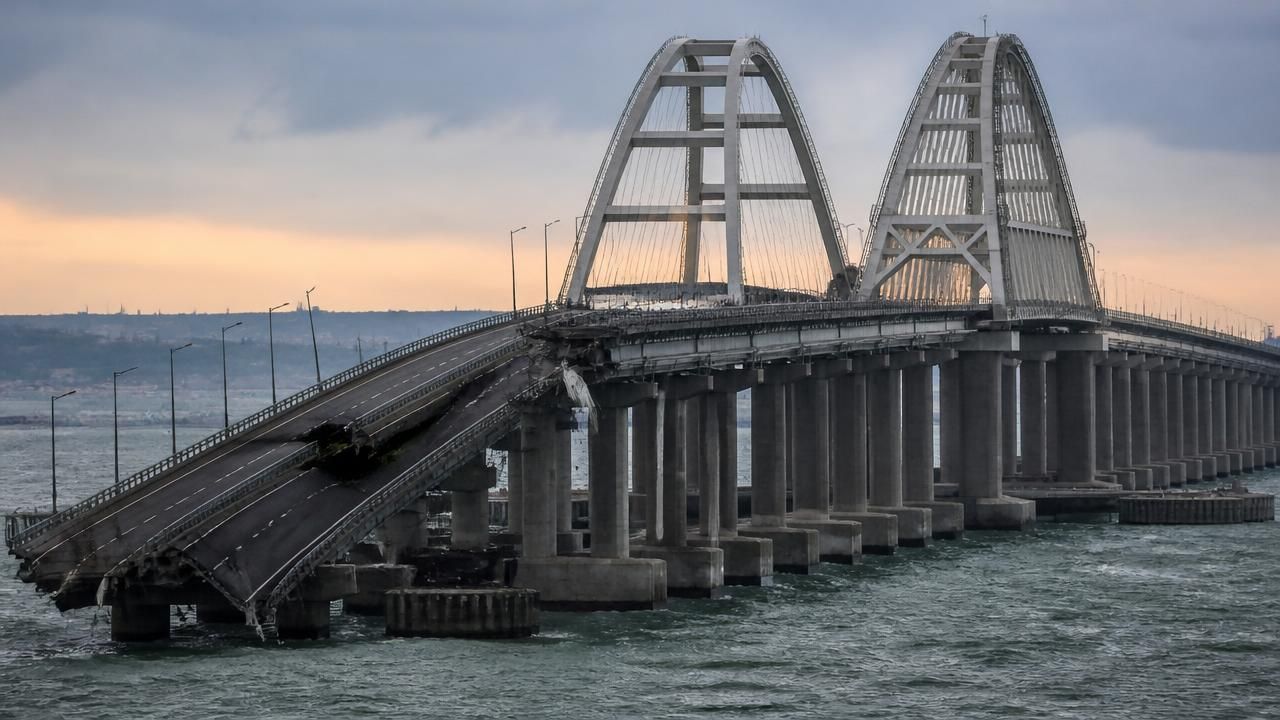
Ukrainian forces struck the Kerch Strait Bridge — the sprawling, multi-billion-dollar span that Russian President Vladimir Putin personally championed as a symbol of Crimea's attachment to Russia — collapsing a section of its roadway in what analysts are calling one of the most strategically and symbolically significant operations of the war.
According to an Institute for the Study of War update, coordinated waves of Ukrainian drones and missiles on the nights of November 15 and November 16 caused enough damage to bring down one of the two steel arches supporting the bridge's automobile roadway. The strike marks the deepest and most damaging Ukrainian attack yet on the crossing, which links the Russian mainland to the occupied Crimean peninsula.
How the Attack Unfolded
Russian military bloggers and unofficial sources describe a layered assault: several hundred Ukrainian drones launched in waves to saturate and overwhelm Russian air defenses, clearing a corridor for precision missile strikes aimed squarely at the bridge's structural supports. Among the weapons in that second wave, according to reporting, was Ukraine's domestically developed Flamingo cruise missile — a long-range system Kyiv has been eager to showcase as evidence of a maturing homegrown defense industry.
Russian sources claimed several hundred Ukrainian drones first overwhelmed Russian air defenses to pave the way for remote-controlled missile strikes focused on the bridge.
Outlets framed the operation along a spectrum. The New York Post emphasized scale, calling it the largest drone attack on Russia so far. USA Today stressed timing and political context, noting the strike landed just before Putin was due to meet with Chinese leader Xi Jinping and US President Donald Trump — a reminder that battlefield facts can reshape a negotiating table. MSN's coverage leaned on symbolism, describing the partial collapse of "Putin's prized bridge," while a companion analysis focused on the practical damage: the crossing is a primary logistics artery for supplying Russian forces in southern Ukraine and Crimea.
The Communications Breakthrough: Relay Drones Instead of Starlink
The most technically consequential detail, first reported by the Financial Times and highlighted by Ars Technica, is how Ukraine guided the strike without relying on the military-grade version of Elon Musk's Starlink satellite network — Starshield — which has been subject to usage restrictions over Russian-held territory.
Instead, Ukraine adapted a Russian battlefield innovation: drones equipped with mesh radios that fly together as an airborne communications network. Each drone in the formation acts as a relay node, chaining the signal from human operators to remotely piloted missiles and strike drones hundreds of kilometers away. Russia pioneered the technique to support its own long-range drone and missile attacks on Ukrainian cities; Ukraine has now turned it back on Moscow, using it to strike deep inside occupied territory where satellite links are unreliable or unavailable.
The implication is significant. Mesh-relay tactics make long-range precision strikes less dependent on any single commercial provider — and therefore less vulnerable to corporate policy decisions, jamming, or diplomatic pressure. It is, in effect, a hedge against the fragility of relying on a private satellite constellation in wartime.
Why the Bridge Matters
The Kerch Strait Bridge, opened in 2018, is the longest in Europe and carries both road and rail traffic. For the Kremlin it serves a dual purpose:
- Logistics: It is the primary overland supply route connecting Russia to Crimea and, by extension, to Russian forces in southern Ukraine. Rail capacity in particular is difficult to replace.
- Symbolism: Putin personally inaugurated the bridge, and it has been attacked repeatedly — a 2022 truck bombing, a 2023 strike, and now a partial structural collapse.
Damage to even one of the bridge's two arch-supported roadways forces Russia to reroute civilian and military traffic, impose weight and speed restrictions, and expend air-defense resources that are already stretched. Ukrainian officials have long argued the bridge is a legitimate military target precisely because of its supply role.
Retaliation and the Widening Exchange
The strike did not go unanswered. In the days that followed, critical bridges in both Crimea and the Kyiv region were reported damaged as Russia and Ukraine exchanged some of their largest-scale attacks of the conflict. The pattern reflects a broader escalation in long-range strike warfare: both sides are now fielding drone swarms, relay networks, and cruise missiles capable of reaching hundreds of kilometers into contested territory.
What to Watch
Several questions will determine the strike's lasting impact. First is engineering: whether Russia can repair the damaged arch quickly, or whether the crossing faces months of reduced capacity. Second is escalation: whether Moscow responds with a new wave of strikes on Ukrainian infrastructure, as it has after previous bridge attacks. Third is the diplomatic calendar — the strike's timing ahead of Putin's meetings with Xi and Trump gives Kyiv leverage, but also raises the risk that the bridge becomes a bargaining chip rather than a battlefield fact.
What is already clear is that Ukraine has demonstrated a capability it did not have a year ago: the ability to coordinate mass drone and missile strikes at long range, over heavily defended territory, without depending on Western satellite communications. That is a technological milestone — and, for Moscow, a durable strategic problem.