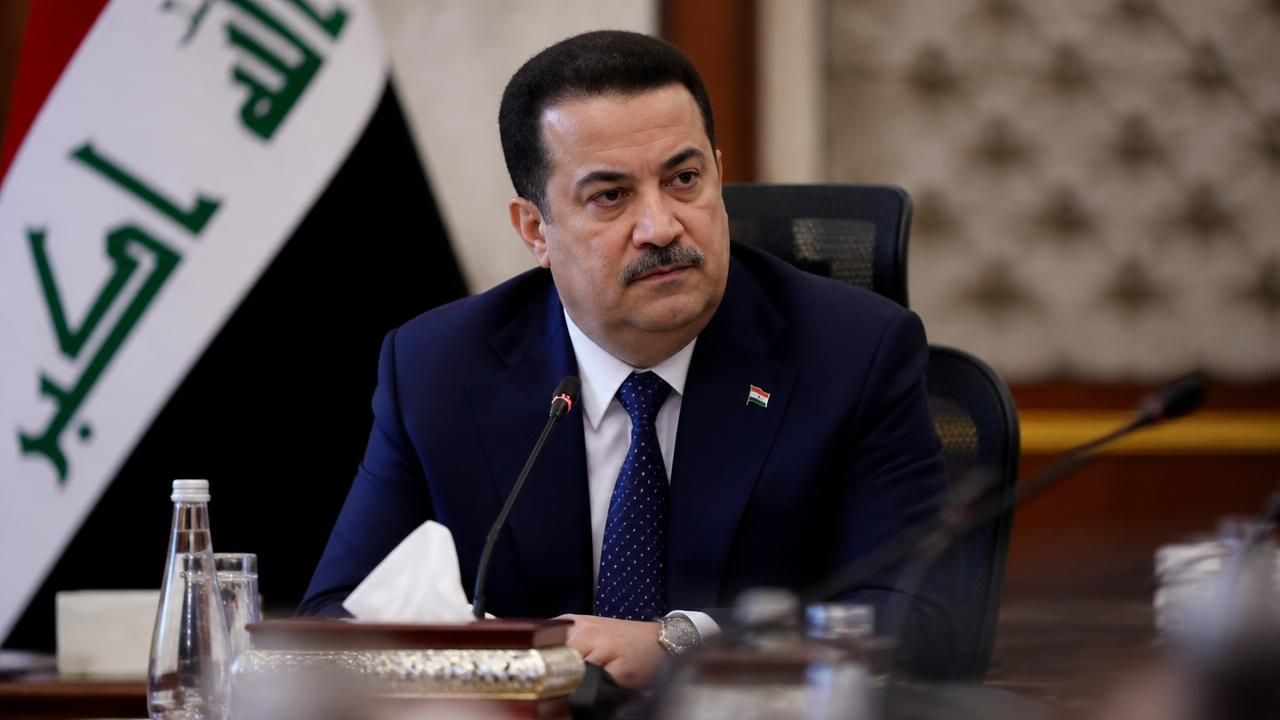
Iraqi Prime Minister Mohammed Shia al-Sudani is preparing the most consequential confrontation of his tenure: a planned crackdown on the Iran-aligned militias that have operated with near-impunity inside the country for two decades. The move, described by regional analysts as the riskiest gamble of his political career, comes as Washington signals impatience with the armed factions, reports circulate of a U.S. green light for Israeli strikes on militia positions in Iraq, and the militias themselves offer a conditional truce tied to the departure of American troops.
A Cabinet At Last — And A Point of Leverage
Sudani's government has moved to complete its cabinet, filling the remaining portfolios that had been left vacant since he took office in 2022. The long-delayed completion has been read in two opposite ways. Regional analysts, writing in Eurasia Review, note that the appointments deepen concerns about Iranian influence over Baghdad's institutions — several ministries have historically been controlled by parties and factions aligned with Tehran.
Yet the same analysis argues the completed cabinet gives Sudani something he previously lacked: a full institutional mandate and a broader coalition from which to bargain. With a unified government, the prime minister can present himself to both Washington and Tehran as the only figure capable of disciplining the militias without triggering civil collapse.
"Completing the cabinet raises Iranian influence concerns, but offers the prime minister a chance to curb the militias," the analysis concludes — a framing that captures the central paradox of Iraqi politics: every step toward institutional normalcy also redistributes power among armed actors.
Militias Set a Condition: U.S. Troops Out
The armed factions have made their own position explicit. In statements reported by WLRN and other outlets, Iraq's Iranian-backed militias said they would halt attacks once U.S. military forces withdraw from the country. The promise is conditional, open-ended and, critics note, entirely self-administered — the groups that have carried out rocket and drone strikes on bases housing American personnel would be the ones deciding when the condition has been met.
The offer fits a familiar pattern. Since the U.S. drawdown and the transition to an advisory mission, Iraqi factions have repeatedly linked violence to the American presence, framing attacks as resistance to occupation rather than as internal political coercion. The current U.S. force posture in Iraq numbers in the low thousands, officially on a train-and-advise mandate, and any further reduction would be read by militias as vindication.
A Reported Green Light, and Its Risks
Into this volatile mix has come a report, amplified by The Yeshiva World and circulating across regional media, that the United States has given Israel a green light to strike pro-Iranian militias in Iraq. The claim has not been confirmed by Washington or Jerusalem and should be treated with caution — but its circulation alone is consequential.
If accurate, such an understanding would represent a dramatic expansion of Israel's regional campaign, which has already struck targets in Lebanon, Syria and Yemen, into Iraqi territory. Baghdad has spent years trying to keep Iraq out of the direct line of fire between Israel and Iran, and Israeli operations on Iraqi soil would put Sudani in an impossible position: unable to defend Iraqi sovereignty, yet equally unable to retaliate without inviting ruin.
The leak also serves multiple audiences simultaneously. For Israel, it signals deterrence. For Iran, it signals escalation risk. For the militias, it offers a recruitment narrative. And for Sudani, it compresses the timeline for action — a crackdown he might have preferred to roll out gradually is now framed as a test of whether Baghdad or foreign powers set the rules.
The Human Cost of Impunity
Behind the diplomatic maneuvering lies the daily reality of militia power. NPR and WXXI News reported on an Iraqi environmentalist who was kidnapped and tortured by Iran-backed militias — and who has refused to abandon his mission to save the Mesopotamian marshes, a landscape and way of life stretching back to the dawn of recorded history.
His case illustrates what is at stake beyond geopolitics. The marshes of southern Iraq, drained under Saddam Hussein and partially restored after 2003, are now threatened by drought, upstream damming and mismanagement. Environmental advocates who challenge powerful interests — including armed groups profiting from land, water and smuggling — face detention and worse. The fact that he continues his work after being tortured is a testament to the resilience of Iraqi civil society, and a measure of how little protection the state currently provides it.
Why It Matters Now
Iraq sits at the intersection of three pressures: an American desire to reduce its footprint, an Iranian determination to preserve its network of allied factions, and an Israeli campaign that has already reshaped the region's security map. Sudani's crackdown is an attempt to prove that Baghdad, not Tehran or Washington, decides how armed groups behave inside Iraq.
- The upside: a successful, limited operation against the most violent factions could strengthen state authority, reassure foreign investors and unlock reconstruction financing.
- The downside: a heavy-handed or failed crackdown risks street confrontations, attacks on government facilities and a return to the sectarian violence that peaked in 2006-2007.
- The wild card: any Israeli strike inside Iraq — real or merely reported — could collapse the distinction between internal policing and external war.
For now, all sides appear to be testing thresholds rather than crossing them. The militias have paired their ceasefire offer with continued threats; Washington has paired pressure with ambiguity; and Sudani has paired a cabinet completion with a crackdown he cannot fully control. The months ahead will determine whether Iraq's prime minister can convert institutional completion into actual sovereignty — or whether the armed groups that tortured an environmentalist for defending a marsh will once again prove stronger than the state that is meant to protect him.