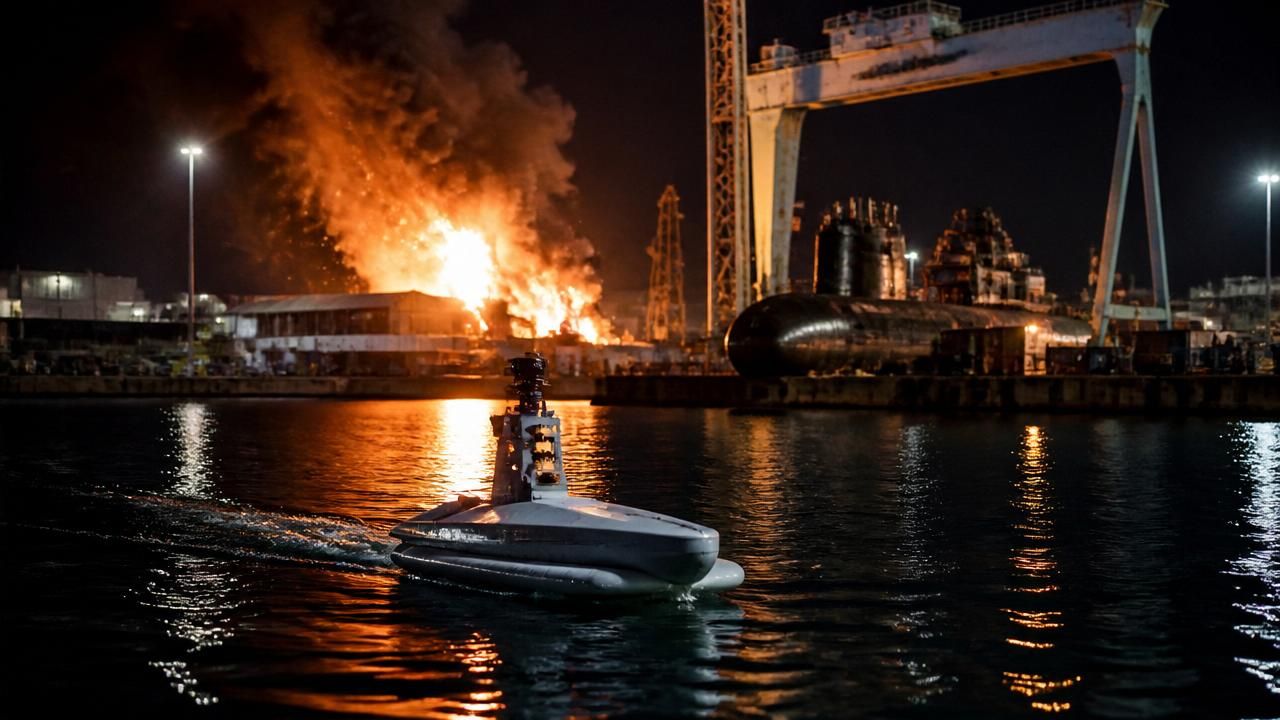
In a historic escalation of naval warfare, the United States military has deployed explosive-laden drone boats in combat for the first time, targeting an Iranian naval base and a midget submarine. The strikes, conducted on the night of July 12 at Iran's Bandar Abbas Naval Base, mark a new chapter in the use of unmanned systems in maritime conflict.
First Combat Use of US Sea Drones
US Central Command (CENTCOM) confirmed that American forces used 'one-way attack surface drones' to strike an Iranian Ghadir-class midget submarine and a ship maintenance facility. The drones, described as low-cost, high-impact weapons, were able to approach their targets at low speed without detection before detonating. According to USNI News, the submarine was out of the water, suspended from a gantry, making it a vulnerable target.
'This is the first time American forces have employed sea drones in combat operations,' CENTCOM stated in a social media post.
The development comes nearly a decade after Iranian and Houthi forces first demonstrated similar kamikaze drone boats in the region. The US military's adoption of this tactic reflects a broader shift toward unmanned warfare, as highlighted by a 2020 US Naval Institute article that explored how drones could 'mission kill' a US destroyer.
Broader Conflict Escalation
The drone strike is part of a wider confrontation between the US and Iran. Reports from multiple sources indicate a rapid escalation across the Middle East. According to Reuters, the US launched strikes in response to an attack on a cargo ship in the Strait of Hormuz. The Pentagon has ordered 2,500 Marines and an amphibious assault ship to the region, while President Trump reportedly mentioned an attack on Iran's Kharg Island, a major oil terminal.
Iran has retaliated with strikes on US military bases, and the conflict has spread to Lebanon and Kuwait, where a friendly-fire incident mistakenly downed US jets. Italy condemned a drone attack on a Gaza aid flotilla and deployed a frigate. Meanwhile, Iran's new supreme leader has vowed to keep the Strait of Hormuz closed, and Israeli Prime Minister Netanyahu issued threats against Tehran.
Kamikaze Drones in the Spotlight
The use of explosive drone boats is not limited to the US. Iran has also deployed similar weapons, striking a South Korean ship in the Strait of Hormuz with two explosions in one minute, as reported by Ynetnews. A suspected Ukrainian explosive sea drone was found to be made from recreational watercraft parts, according to USNI News. The New York Times highlighted how cheap drones are 'designed to wreak havoc' and are shaping the war with Iran.
ABC News reported that Iran used kamikaze drone boats for the first time in the Middle East war, attacking an oil tanker. The US Navy confirmed that an explosive drone attack killed two crew members on a merchant tanker. The UK and US jointly condemned Tehran for the attack.
Strategic Implications
The deployment of sea drones by the US represents a paradigm shift in naval tactics. As noted by the US Naval Institute, these weapons can 'mission kill' high-value assets like destroyers at a fraction of the cost. The US military's move to use such systems openly signals a willingness to embrace asymmetric warfare methods previously employed by adversaries.
Experts warn that the proliferation of drone technology could lead to an arms race in unmanned naval systems. The conflict also underscores the vulnerability of critical maritime chokepoints like the Strait of Hormuz, through which a significant portion of global oil supply transits.
Differing Perspectives
Media coverage reflects varying framings. US outlets like CBS News and CNN emphasize the technological milestone and the Pentagon's calculated escalation. Meanwhile, regional sources such as Saudi Gazette and France 24 focus on the broader regional instability and Iran's retaliatory capacity. Reuters and the New York Times provide detailed analysis of the weapons used and their implications for future warfare.
Some sources, like the Blue House (South Korea), have questioned the attack theory in a separate ship explosion, highlighting the fog of war. The diversity of reports illustrates the complexity of the conflict, with multiple actors and narratives at play.
Conclusion
The first combat use of US explosive drone boats marks a turning point in naval warfare, blending low-cost technology with high strategic impact. As tensions between the US and Iran continue to simmer, the world watches how this new era of unmanned maritime combat will unfold. With both sides now deploying kamikaze sea drones, the waters of the Middle East have become a testing ground for the future of conflict at sea.