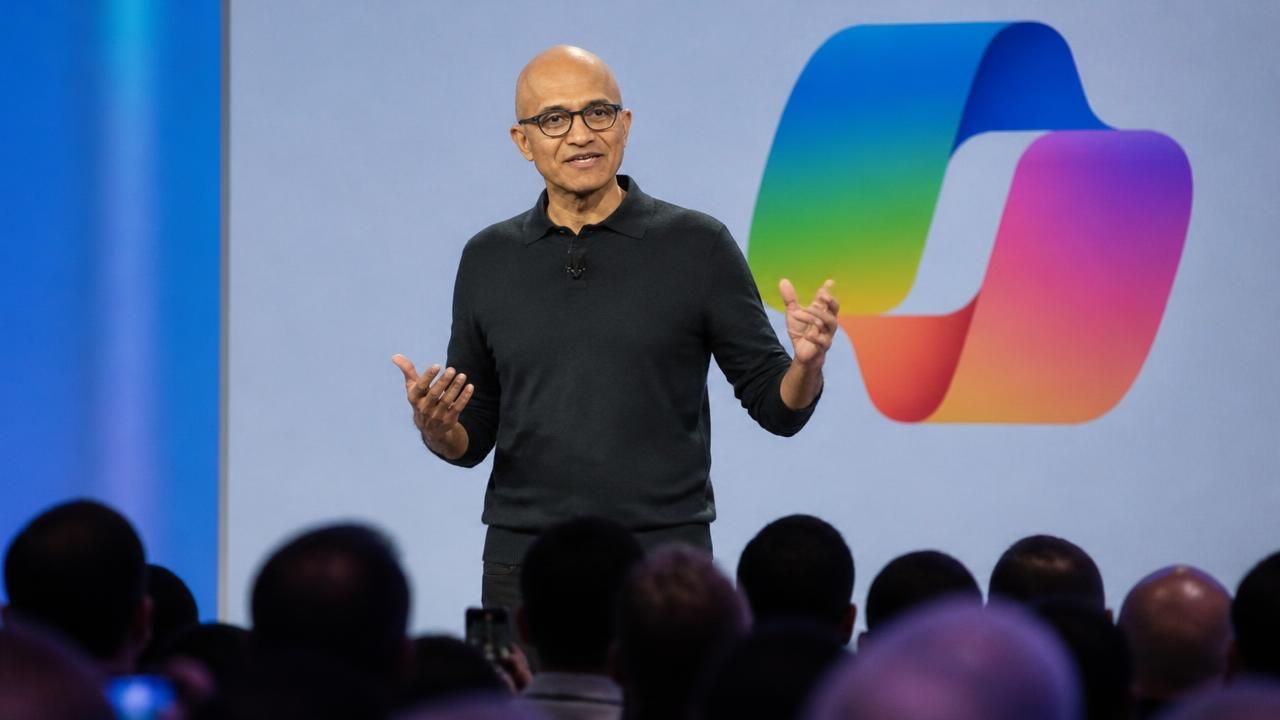
Microsoft used the opening keynote of its Ignite conference on Tuesday to make a sweeping claim about the future of white-collar software: the assistant is no longer the helper — it is the platform. Chief executive Satya Nadella announced the general availability of Word, Excel and PowerPoint inside Copilot, the company's AI assistant, and described the product as “the new OS for work.”
The company framed the rollout as the largest update to Copilot since its launch, introducing what Nadella called a “frontier ecosystem” of autonomous agents, coding tools and deep Office integration. Coverage of the announcement was remarkably uniform in its headline takeaway — Ars Technica, TechPowerUp, MSN and others all seized on the “OS for work” phrasing — but the substance behind the slogan is a fundamental reordering of how Microsoft thinks about applications.
An inversion of the app
For three decades, the Office suite has been the destination and the assistant a sideshow — a paperclip popping up to offer help with the document you were already writing. Microsoft now envisions the opposite. Agents will drive the work; the applications become plugin components that the agent calls upon as needed.
Under the new model, users can create documents, spreadsheets and presentations directly inside Copilot. Files produced there remain fully editable in their respective Office applications, so the traditional apps do not disappear — they become downstream destinations for work initiated by the agent.
What makes that possible, Microsoft says, is an organizational knowledge layer that draws context from a user's emails, meetings, calendars, chats and files. In effect, Copilot is being positioned less as a feature bolted onto Office than as a context-aware layer sitting above all of an organization's productivity data.
“Copilot is the new OS for work.”
What actually shipped
Beneath the keynote language, the announcement bundles several distinct capabilities:
- Office in Copilot: Generally available Word, Excel and PowerPoint creation inside the Copilot interface, with files exportable and editable in the standalone apps.
- Autonomous agents: A new class of agents that can carry out multi-step tasks with reduced human prompting, drawing on the organizational knowledge layer for context.
- An always-on Autopilot agent: As The Next Web reported, the new Copilot app adds a persistent agent mode that can operate continuously rather than waiting for a prompt.
- Coding capabilities: Developer-oriented features folded into Copilot, extending the assistant from documents into software work.
TechSpot characterized the strategy bluntly: Microsoft wants Copilot to become an “OS” that writes your documents and manages your work. That framing captures both the ambition and the friction — an operating system implies a platform others build upon, a claim Microsoft has not yet substantiated with third-party momentum.
The rethink behind the rebrand
The Verge, which examined the strategy as an internal “big Copilot rethink,” situates the Ignite push against a more complicated backdrop than the keynote suggested. Copilot has been rolled out across Windows, Office and consumer products over the past two years, but adoption has been uneven and the product's identity diffuse — at times a chatbot, at times a sidebar, at times a Windows feature. The new positioning appears designed to resolve that ambiguity by consolidating everything under a single agent-first brand.
The stakes are financial as well as strategic. Microsoft has invested tens of billions of dollars in AI infrastructure and has been under pressure from investors to show that spending translating into recurring revenue. An “OS for work” is a far easier story to sell to enterprises than a collection of features, because it implies seat-based ubiquity across an organization's entire knowledge workforce.
Project Aion and the OS ambition
The “OS” language may be more literal than metaphorical. BetaNews reported on a leaked internal effort known as Project Aion that would place Copilot at the center of the operating system itself, rather than layering it on top. Microsoft has not confirmed details of that project, and the Ignite keynote did not address it directly — but the direction of travel is consistent.
That ambition carries risk. Regulators in the United States and Europe have already scrutinized Microsoft's bundling practices, and embedding an AI agent at the OS level raises familiar questions about tying, default settings and competitive access. It also raises data-governance questions for enterprises, since an agent that reads email, calendars and chat inherits an unusually broad view of organizational activity.
Skepticism and the road ahead
The competitive context is unforgiving. Google has been embedding Gemini throughout Workspace, OpenAI and Anthropic continue to push agentic capabilities into the enterprise, and a wave of startups is building task-specific agents that do not require buying into an entire productivity stack.
Microsoft's advantage is distribution: hundreds of millions of Office users and a vast installed base of Windows machines. Its challenge is demonstrating that an agent-first interface is genuinely better than the applications it claims to supersede — and that “the new OS for work” is something customers will pay for, rather than a slogan that outruns the product.
For now, the message from Redmond is unambiguous: the app was the past, the agent is the platform, and Copilot is meant to be the place where work begins.