California regulators have ordered Waymo to stop operating its driverless robotaxis on freeways across the state, a sweeping suspension that took effect November 11 and that the company has effectively matched by pausing all highway rides nationwide in its home market.
The California Department of Motor Vehicles said the ban applies to freeway operations statewide and framed the decision in unusually blunt language, describing Waymo's highway service as an "imminent hazard to public safety." The order is indefinite, according to reporting by The Verge and business outlets tracking the company, and applies to the driverless freeway trips that had become a signature — and lucrative — part of Waymo's Bay Area service area.
What Triggered the Crackdown
The DMV's action followed two high-profile Bay Area incidents that circulated widely online and, in at least one case, went viral.
- The US-101 construction closure near Burlingame. A Waymo robotaxi drove into an active construction closure on the freeway, a scenario that regulators view as a worst-case test of whether autonomous systems can interpret temporary, human-managed traffic control that does not match map data.
- The I-280 encounter in San Francisco. A separate run-in involving California Highway Patrol vehicles on Interstate 280 drew intense attention on social media, with video of the episode spreading rapidly. Bay Area outlets, including SFist and the Silicon Valley Business Journal, tied the agency's decision directly to the viral nature of that footage.
In its statement, the DMV stressed that the freeway suspension was not an isolated response to a single bad day, but rather the culmination of a pattern it said raised systemic questions about how the company's vehicles handle anomalous road conditions at highway speeds.
"Imminent hazard to public safety." — California Department of Motor Vehicles, describing Waymo's freeway operations
Waymo's Response
Waymo has not publicly disputed the underlying facts of the two incidents, and the company moved quickly to pause highway rides entirely rather than fight the order in the short term, as WIRED reported. The practical effect is a significant rollback: freeway segments are what connect Waymo's dense urban service zones to airports and suburbs, and they represent the company's clearest path toward longer, higher-revenue trips.
The company has consistently argued that its safety record, measured per mile and against human drivers, remains substantially better than the human baseline, and that its vehicles are programmed to be conservative in ambiguous situations. Regulators, however, are focused less on aggregate statistics than on tail events — the rare cases where a vehicle misreads a work zone, a flare pattern, or an officer's hand signals at 65 miles per hour.
'Again': A Pattern, Not a First
Perhaps the most telling framing came from SFist, which headlined its coverage by noting that Waymos had been "kicked off California freeways again." The word matters. Waymo's expansion has proceeded in fits and starts, with each phase of growth — city streets, then highways, then airport corridors — requiring layered approvals from the DMV and the California Public Utilities Commission, and with each serious incident inviting a partial retreat.
That stop-start dynamic is now the defining rhythm of the robotaxi industry in the United States. Cruise's 2023 collapse in San Francisco, following a pedestrian-dragging incident and a subsequent permit suspension, established the template: a viral video, an aggressive regulatory response, and a company scrambling to contain reputational damage. Waymo has so far avoided that fate, but the freeway ban shows how quickly a single week of bad footage can reset a years-long rollout plan.
How Different Outlets Framed It
Coverage of the ban split along familiar lines. The Verge led with the regulatory hammer — a statewide ban, effective immediately, rooted in the DMV's legal authority — treating it as a technology-policy story about the limits of autonomous capability. Bay Area outlets such as SFist and KRON4 foregrounded the local texture: the specific freeways, the CHP, and the viral clip that made the I-280 episode a household topic in the region. Business coverage from the Silicon Valley Business Journal emphasized the "indefinitely" in the suspension, framing it as a commercial setback for a company that had been scaling aggressively. WIRED's headline captured the corporate consequence most directly: Waymo didn't merely accept a ban, it paused highway rides itself.
The common thread across all of them: this was not a technical glitch story, but a safety-perception story. No injuries were reported in either incident, yet the DMV's language was among the harshest it has used against an autonomous vehicle operator.
What Happens Next
For Waymo, the path back runs through the DMV: demonstrating that its perception and planning systems can reliably interpret temporary traffic control — construction zones, emergency scenes, officer directions — at freeway speeds. That is a harder engineering problem than most urban driving, because the cues are non-standard, often contradictory, and sometimes human improvisations rather than formal signage.
For the broader industry, the episode is a reminder that autonomous driving is as much a regulatory product as a technological one. Tesla's promised robotaxi ambitions, Zoox's testing, and a wave of Chinese and European entrants all depend on agencies willing to grant and preserve permits. California, the largest and most closely watched market in the United States, just demonstrated how fast those permits can be revisited.
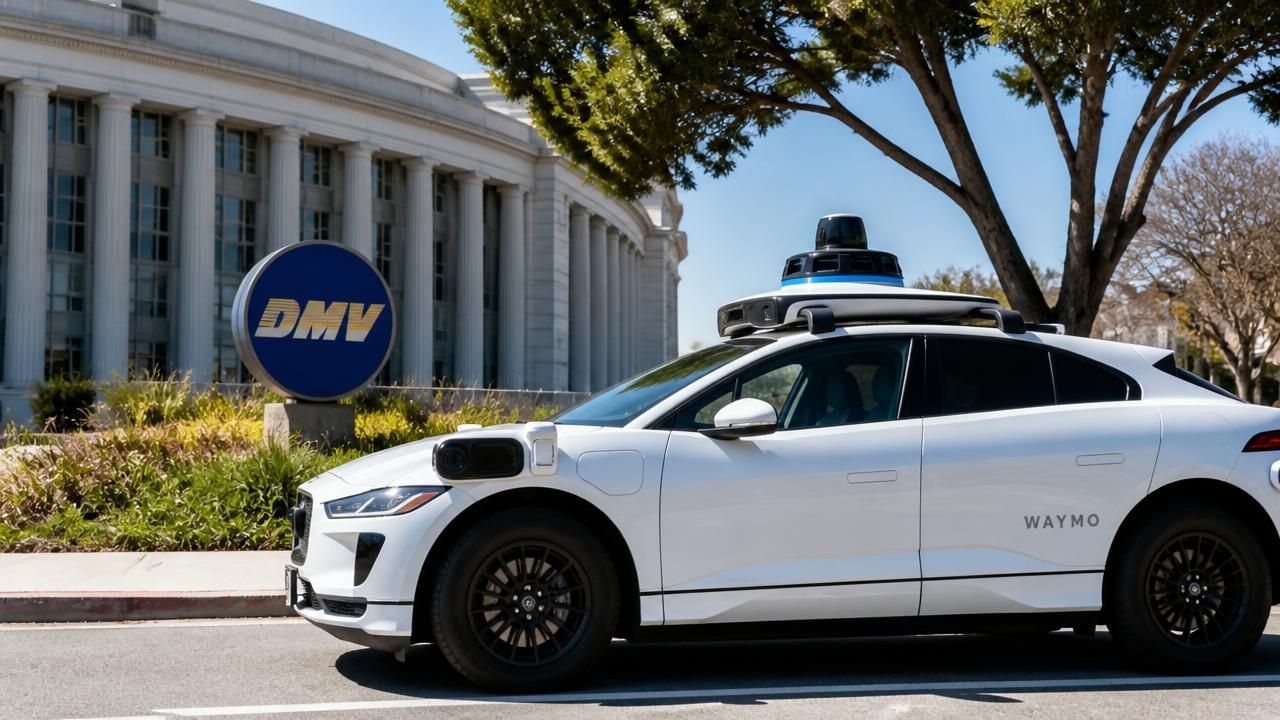
For California drivers, the immediate result is simpler: the white Jaguar I-PSUVs with the spinning sensor domes will stay on surface streets for now, and the freeway lanes they once navigated hands-free are, once again, off limits.