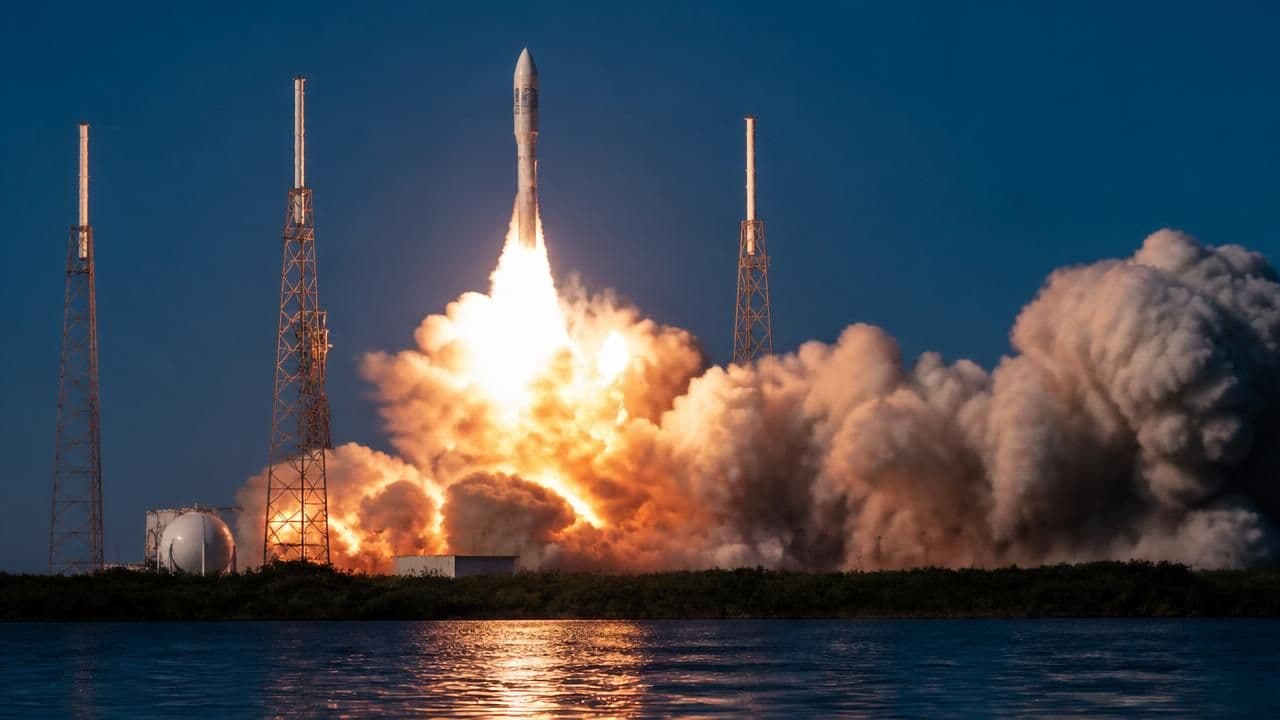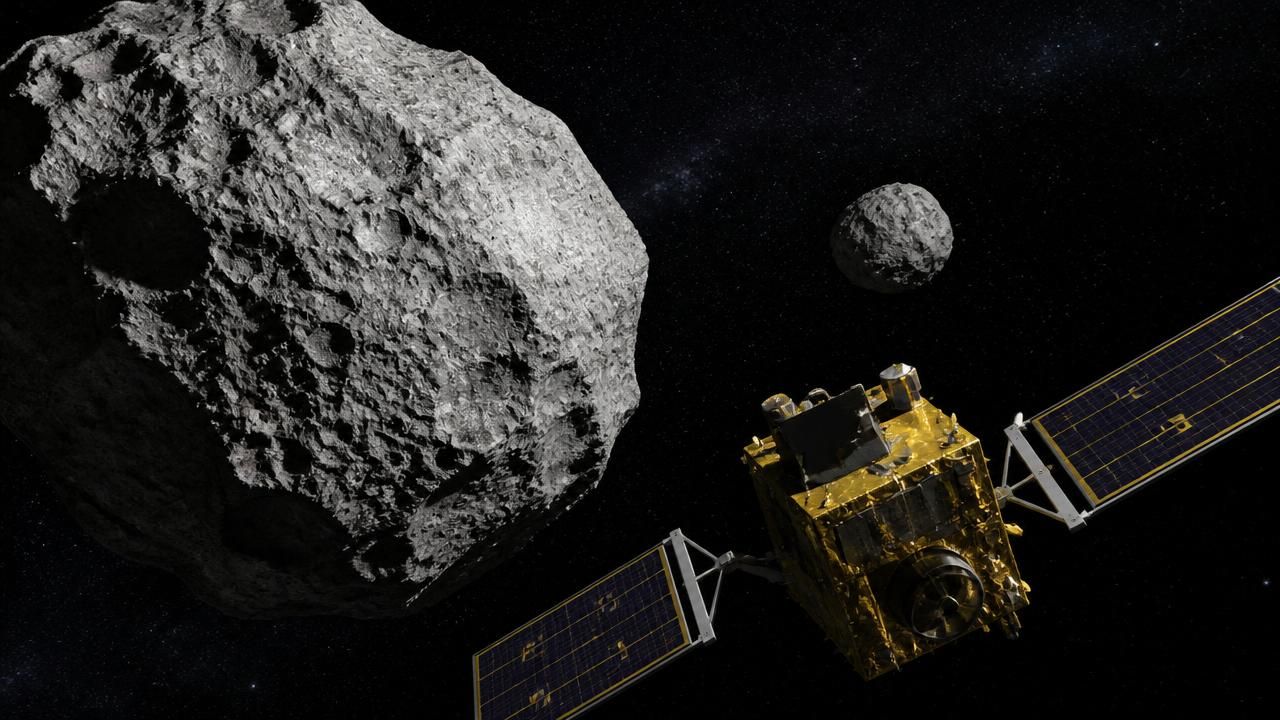
Two years after NASA deliberately slammed a spacecraft into a small asteroid, a European probe has arrived to survey the wreckage — and the first thing it found was a world stranger than mission planners expected.
The European Space Agency's Hera spacecraft has begun its close-up investigation of the Didymos–Dimorphos binary asteroid system, the target of NASA's Double Asteroid Redirection Test (DART). As Hera closed in, its cameras returned images of a crater-covered, previously unobserved face of Didymos, the larger of the two bodies — terrain no spacecraft had ever photographed, and a reminder that the system Hera is studying is a complex, battered relic rather than a simple pair of rocks.
The arrival is the second act of a story that began on 26 September 2022, when DART — a roughly 570-kilogram spacecraft roughly the size of a vending machine — struck the 160-meter moonlet Dimorphos at about 6.1 kilometres per second (some 22,500 km/h), some 11 million kilometres from Earth. The impact shortened Dimorphos's orbit around its 780-meter parent body by more than half an hour, from about 11 hours 55 minutes to roughly 11 hours 23 minutes. It was the first time humanity measurably changed the motion of a celestial body, and the first real-world test of a planetary defence technique.
A crash site, not just a crater
But a single impact experiment answers only part of the question. The DART team could measure how much the moonlet's orbit changed; what they could not directly measure was the mass of Dimorphos, and therefore how efficiently the spacecraft's momentum was transferred. That number — the momentum enhancement factor, known to engineers as beta — depends heavily on the debris blasted off the surface, which acted like a rocket exhaust and pushed Dimorphos further than the spacecraft alone could have.
Hera exists to pin down that number and the physics behind it. The mission is, in effect, a crime-scene investigation: rather than watching the collision, it will examine the aftermath in detail and reconstruct what happened. ESA and NASA coordinated the two missions under a joint programme called AIDA — the Asteroid Impact and Deflection Assessment — with DART as the hammer and Hera as the follow-up detective.
ESA frames Hera as detective work at an asteroid crime scene: the DART experiment proved a spacecraft can nudge a rock in space, but only a close-up survey can turn that one-off result into a repeatable, predictive technique.
Instruments built for forensics
Hera carries a suite designed explicitly for post-impact analysis: an asteroid framing camera, a thermal infrared imager to gauge surface properties, a hyperspectral imager and a laser altimeter to map shape and topography. The spacecraft also carries two shoebox-sized CubeSats, Juventas and Milani, which will venture closer than the parent craft dares.
- Juventas is expected to deploy and ultimately land, using low-frequency radar to sound the moonlet's interior — a crucial test of whether Dimorphos is a loose rubble pile or a more consolidated body, and therefore how broadly the DART result applies to other asteroids.
- Milani will study surface mineralogy and the dust environment, helping establish how much material was lofted and how it redistributed.
- Hera itself will measure the mass of Dimorphos by tracking how its gravity perturbs the spacecraft's trajectory, and will map the entire system at resolutions far beyond what DART's cameras glimpsed before impact.
Science, or survival?
Coverage of the arrival illustrates two distinct ways of framing the same event. ScienceDaily and other science-focused outlets lead with the discovery angle — a strange, cratered world, new clues about the collision, and the mechanics of an impact that reshaped a small body. Others, including aggregators such as MSN and syndicated outlets carrying the story internationally, foreground the existential question in their headlines: whether Earth can be saved from space rocks. Both framings are accurate, and Hera sits precisely at their intersection.
The planetary-defence case is straightforward. Astronomers have catalogued only a minority of near-Earth objects in the size range that could devastate a region — roughly 140 meters and larger — and none of the known ones poses a threat for the foreseeable future. A demonstrated, well-understood deflection technique is therefore insurance against the one that might. But deflection is only useful if engineers can predict the outcome; a technique that works on a rubble pile at an unknown mass is not yet a reliable tool.
There is a scientific dividend too. Didymos and Dimorphos belong to a class of binary near-Earth asteroids that are thought to form when a larger body spins so fast that material sloughs off its equator and coalesces into a moonlet. Hera's mapping will test that formation model, and the cratered face of Didymos already hints at a long, violent history of impacts and resurfacing.
What comes next
Over the coming months, Hera will tighten its orbit around the binary pair, releasing the CubeSats for their close passes and, if all goes to plan, attempting landings at the end of the mission. The data will let scientists model the DART impact in reverse: from the final shape of the crater, the distribution of ejected boulders and the moonlet's bulk density, back to the energy of the strike and the properties of the material it hit.
The stakes are as much diplomatic as technical. DART was an American mission, Hera a European one, and the data are being shared across an international planetary-defence community that includes Japan's Hayabusa2 and other asteroid missions. If the technique is ever needed in earnest, the decision to act will be made by many governments at once — which makes a shared, verified understanding of how deflection actually behaves the first prerequisite.
For now, the takeaway is simpler. The first attempt to move an asteroid worked, and the second mission to visit it is revealing just how much we still have to learn about the rock we hit.