Elephants are often held up as the animal kingdom's great survivors of social upheaval. Individuals die or disperse, calves are born, newcomers join the herd, and the wider community usually knits itself back together. Long-term studies of African savanna elephants have documented exactly this pattern: after poaching spikes or drought-driven die-offs, survivors tend to rebuild severed relationships over months and years.
But a new study of wild Asian elephants in Sri Lanka suggests that resilience is not unlimited. When deaths and departures steadily outpace births and arrivals, elephant society does not simply shrink. According to the research, it comes apart.
Twelve years in the field at Udawalawe
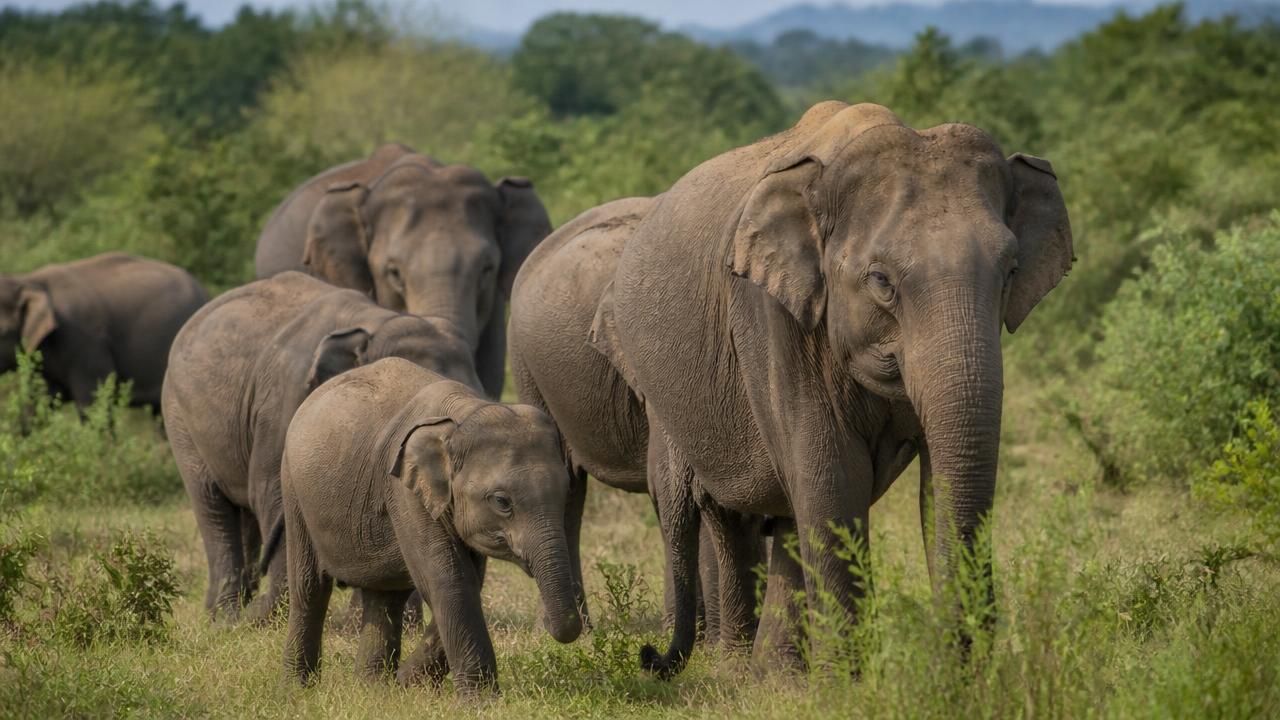
The findings come from Anastasia Madsen, a behavioral ecologist at the University of California, San Diego, and her colleagues, who analyzed 12 years of observations of wild Asian elephants in Udawalawe National Park in southern Sri Lanka. Shermin de Silva, an ecologist at UC San Diego and the study's senior author, founded the Udawalawe Elephant Research Project in 2006, building one of the longest continuous behavioral datasets for the species.
Udawalawe itself is a product of modern landscape change. The park was created in the 1970s around a reservoir on one of Sri Lanka's four major rivers. "Before that, it was basically a tropical deciduous forest," de Silva said—an accidental savanna carved out of forest, and one that now hosts a closely watched population of elephants whose movements, associations and family ties have been logged for well over a decade.
That longitudinal view is what makes the study distinctive. Rather than capturing a single dramatic die-off, the researchers tracked the slow arithmetic of attrition: who was lost, who arrived, and how the network of associations between individuals changed as the ledger tipped.
What 'fracture' looks like
The headline result is that once losses began to outpace newcomers, the community did not merely contract in the way conservationists might expect. The structure of the society changed—relationships that once linked different family groups thinned or broke, leaving a more fragmented population even where individual elephants survived.
"Once losses began to outpace newcomers, the elephants' society didn't just get smaller. It fractured."
For a long-lived, socially complex species, that distinction matters. Elephant calves learn foraging routes, water sources and social conventions from older relatives over years. If the adults who carry that knowledge disappear faster than new generations can absorb it, the loss compounds: a smaller population may also be a less knowledgeable one.
A resilience narrative under strain
The way the story has traveled illustrates how differently outlets frame the same science. Psychology Today foregrounded the notion of female elephants taking over for their mothers—a framing that emphasizes adaptation and continuity in matriarchal herds facing poaching pressure. Aggregator coverage on MSN leaned on a similar register, highlighting a baby elephant's "incredible resilience in the wild." Both framings are legible and not wrong: elephant societies genuinely do reorganize, and matriarchs and older females frequently step into leadership vacuums left by poaching.
But the Udawalawe findings complicate the uplift. Reorganization is not the same as restoration, and the study's authors point to a threshold beyond which the network loses cohesion rather than rerouting around loss. Resilience, in other words, is a capacity with limits—something conservation scientists across disciplines have argued for years, whether the pressure is ivory poaching, habitat fragmentation, or, in fisheries policy, the recurring debate over catch limits and whether reducing effort can outrun stock decline.
The Sri Lankan research also sits within a broader evidentiary picture. African savanna studies have shown recovery of social ties after poaching; the new work suggests that chronic, cumulative loss—as opposed to a discrete shock—may produce different, less reversible outcomes. That has direct implications for how managers measure the health of a population.
Why it matters for conservation
- Counting bodies is not enough. A population can hold its numbers while its social fabric degrades, with consequences for calf survival and knowledge transfer.
- Chronic loss behaves differently from catastrophe. Slow attrition may be harder for conservationists to detect and harder for elephants to absorb.
- Asian elephants face distinct pressures. Habitat conversion, human–elephant conflict and fragmentation dominate the threats to Elephas maximus, which is endangered, unlike the African savanna populations that dominate the resilience literature.
- Long-term field projects are the bottleneck. Twelve-year datasets are rare and fragile; the Udawalawe record exists because researchers stayed in place.
De Silva's project has long been one of the few sources of fine-grained social data on Asian elephants in the wild, and the new analysis extends its reach from behavior to conservation policy. The question it raises is uncomfortable: if the social architecture that makes elephants elephants erodes before the population itself collapses, what exactly are we measuring when we declare a herd stable?
For now, the answer from southern Sri Lanka is a caution. Communities can absorb shocks. Whether they can absorb a steady drip of losses, year after year, is a different question—and one that the next decade of data will be needed to answer.