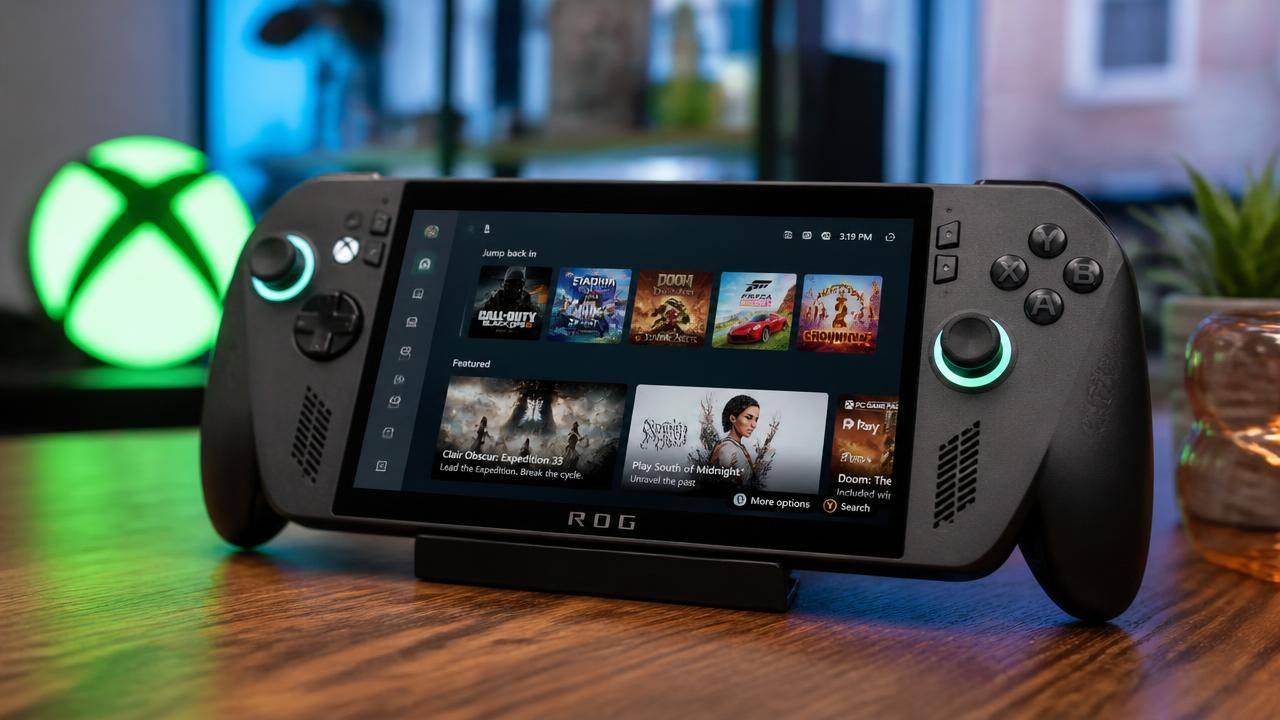
Microsoft's answer to Nvidia's DLSS is no longer a lab experiment. The company announced today that Automatic Super Resolution (Auto SR) is rolling out to the Xbox Ally X, the Xbox Ally X20 and select Windows Copilot Plus PCs — and, for the first time, the upscaler works while a handheld is running on battery in handheld mode rather than being tethered to a dock.
The news lands at a moment when the Windows handheld market is under unusual scrutiny, with devices like the ROG Xbox Ally X selling on the promise of console-like convenience and SteamOS-powered rivals eating into that pitch. Auto SR is Microsoft's attempt to claw back performance headroom in software — and, just as importantly, to make the case that Windows is the smarter place to play.
What Auto SR actually does
Auto SR is a machine-learning upscaler baked into Windows rather than into individual games. Where DLSS, AMD's FSR and Intel's XeSS generally require developers to integrate a specific SDK and ship a patch, Auto SR operates at the system level: the game renders at a lower internal resolution and the operating system reconstructs a sharper, higher-resolution frame on the fly.
That distinction is the whole pitch. Developers get better performance on supported hardware without doing any work, and players get a toggle that can meaningfully lift frame rates on hardware that was never going to hit native 1080p comfortably. The trade-off is control: because Microsoft isn't hand-tuning per title, image quality and compatibility can vary far more than they do with a developer-implemented upscaler.
What's new in the official release
Microsoft began testing Auto SR on the Xbox Ally X back in April, but the preview was limited — it only worked while the device was docked, effectively sidestepping the scenario handheld owners care about most. The full release changes that in three concrete ways:
- Handheld mode and battery power: Auto SR now functions undocked, running on the device's internal battery rather than requiring wall power.
- 1080p support: Games running at 1080p are now supported, expanding beyond the lower-resolution targets the preview handled.
- New features: Microsoft is shipping additional capabilities alongside the official launch, though The Verge notes those features have yet to be fully detailed.
There is a caveat baked into the announcement itself: Microsoft acknowledges that combining handheld play, battery power and a 1080p target can produce performance that falls short of what users might expect. Upscaling is not free — the reconstruction work costs GPU time, and on a power-limited handheld APU that cost is measured in watts that are no longer available to the game.
The numbers: roughly 30 percent in some titles
The most concrete performance figure circulating comes from TweakTown, which reports that Auto SR on the ROG Xbox Ally X improves performance by around 30 percent in several games when upscaling from 720p to 1080p. That is a substantial gain for a toggle that requires no developer involvement, and it maps onto the kind of uplift that makes the difference between a 40fps experience and something approaching 60fps.
Roughly 30 percent gains in several titles — but only in several titles, and only at specific resolution pairings.
The framing matters. "Several games" is doing real work in that sentence; the benefit is neither universal nor uniform, and titles with heavy CPU bottlenecks will see far less improvement than those that are GPU-limited.
Panther Lake changes the addressable market
Perhaps the more strategically significant detail is that Auto SR extends to Copilot Plus PCs — including machines built on Intel's new Panther Lake silicon. That takes Auto SR well beyond the handful of AMD-based Xbox-branded handhelds and into the broader laptop and handheld ecosystem, where integrated graphics have historically struggled with modern titles.
For Intel, this is a useful hedge. Its own XeSS upscaler requires developer adoption; a Windows-level upscaler that works on Panther Lake hardware regardless of what a studio has implemented gives those machines a baseline gaming story they wouldn't otherwise have.
The skeptical read
Not everyone is convinced the launch is a turning point. PCWorld's hands-on assessment is pointedly unenthusiastic, framing the technology as capable but far from transformative:
"Windows' DLSS rival isn't ready to save handheld gaming." — PCWorld's headline verdict
That skepticism reflects a broader truth about the category. Upscaling solves a rendering problem; it doesn't solve a software-experience problem. Handheld owners complain about sleep-and-resume quirks, launcher friction and touch-unfriendly UI at least as often as they complain about frame rates. A 30 percent boost in a subset of titles is a genuine win, but it doesn't address why so many players drift toward SteamOS.
Why handhelds are the real battleground
That context explains the parallel conversation around Windows handhelds this week. Coverage of Winhanced — a community utility for tuning Windows 11 on handheld hardware — notes that the tool is genuinely improving, yet its author still prefers booting into Xbox mode on a Windows handheld. The takeaway is telling: Microsoft's full-screen, controller-first Xbox shell may be doing more for the handheld experience than any rendering feature.
Auto SR and the Xbox-mode interface are two halves of the same strategy. One buys frames; the other buys the console feel that makes a Windows device legible to people who have never opened a settings menu. Microsoft needs both to hold the line against SteamOS and against its own OEM partners' inconsistent hardware.
The bottom line
Auto SR's expansion is a real milestone: driver-level, developer-free upscaling that now works where handheld players actually play — undocked, on battery, at 1080p — with roughly 30 percent gains in a meaningful set of titles and support reaching Intel's Panther Lake Copilot Plus machines. But the honest framing, echoed across outlets, is that this is an enabling technology rather than a rescue. It raises the ceiling on Windows handheld performance; it does not fix the floor of the Windows handheld experience. Whether that's enough will be decided over the next year of hardware, not in a single driver update.