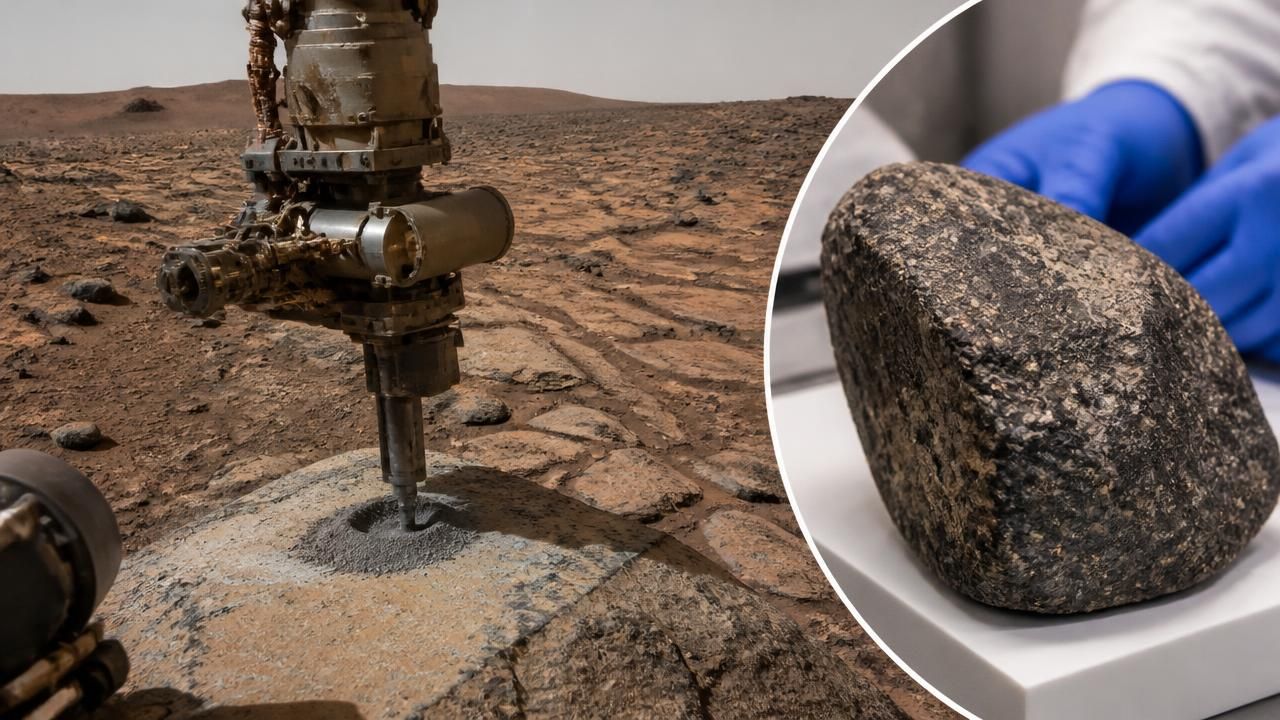
NASA's Mars Perseverance rover has done something its science team had been chasing for months: it drilled and sealed a sample of gabbro, a coarse-grained igneous rock that is a key witness to the earliest chapters of Martian history. The milestone, detailed in a mission update published Nov. 1, 2026, arrives in the same news cycle as an Earthbound discovery — a Martian meteorite dated to roughly 4.1 billion years, identified with help from a University of Maine scientist and described by outlets including MSN and Yahoo News as one of the oldest pieces of Mars ever recovered on this planet.
Two rocks, two planets, one question: what was the Martian crust like before the world lost its atmosphere, its surface water, and most of its geological memory?
A gabbro at last, after a rock that refused to be drilled
The Perseverance story began with a frustration. An earlier abrasion patch nicknamed “Badger Peak” turned out to be a gabbro — exactly the kind of igneous rock the team wanted in its sample library — but it was too hard to core. Gabbro, made mostly of calcium-rich plagioclase feldspar and pyroxene crystals, is the intrusive cousin of basalt: it forms when magma cools slowly underground, giving crystals time to grow large. That slow cooling makes it both scientifically valuable and mechanically stubborn.
Rather than abandon the target, the rover drove about 100 meters (330 feet) to a different patch of light-toned rocks. There, it abraded a surface dubbed “Pumbe,” which bore what NASA described as a striking resemblance to Badger Peak. Visual and chemical data from the new workspace convinced the team it had found another gabbroic candidate — and this time the coring bit came back full. The sample, named “Singita,” was imaged inside the bit by the rover's left Mastcam-Z camera on Oct. 24, 2026 (Sol 2018) at a local mean solar time of 12:56:57, shortly after the coring operation.
“The team felt strongly that it was worth the effort to add a gabbro … to Perseverance's sample collection,” wrote Tasha Coelho, a Mastcam-Z student collaborator at Arizona State University, in the NASA feature.
That single sentence captures a broader strategy. Perseverance's sample tubes are not being filled at random; each core is a vote for a particular hypothesis about Jezero Crater's past. Igneous rocks like gabbro act as clocks — their crystals can be dated radiometrically — and as archives of the magma from which the earliest crust was built.
The 4.1-billion-year-old messenger
Meanwhile, in laboratories on Earth, a different kind of Martian rock was making headlines. A meteorite dated to about 4.1 billion years — blasted off Mars by an ancient impact and eventually landing on our planet — has been characterized as one of the oldest Martian meteorites known. A University of Maine scientist was part of the team that helped identify and classify it, according to regional coverage aggregated by Yahoo News, while MSN framed the find more starkly: a 4.1-billion-year-old rock, among the oldest pieces of Mars ever discovered on Earth.
The framing difference is instructive. NASA's own account is written from the rover's perspective — sol numbers, camera timestamps, abrasion patches, drilling logistics — and treats the sample as an operational triumph. The meteorite coverage is written from the laboratory outward, emphasizing provenance, age, and the rarity of surviving ancient Martian material in terrestrial collections. Both, however, are describing the same lost interval: the Noachian period, when Mars was volcanically vigorous, likely wetter, and far more Earth-like than the cold desert Perseverance now rolls across.
Why gabbro punches above its weight
Most Martian meteorites — the shergottites, nakhlites, and chassignites — are comparatively young, clustering in the last 1.3 billion years or so. Ancient crustal material is rare because billions of years of impacts, weathering, and resurfacing have recycled it. That scarcity is precisely why a 4.1-billion-year-old specimen in a museum drawer and a fresh gabbro core in a titanium tube on Mars are complementary prizes.
- On Mars: Perseverance can document a sample's original context — which outcrop, which layer, which chemistry — something no meteorite can provide.
- On Earth: Laboratories can apply instruments far too massive to fly, from high-precision mass spectrometry to detailed isotopic mapping.
- Together: A dated ancient meteorite calibrates the crater-counting chronologies used to assign ages to Martian surfaces, including the terrain Perseverance is sampling.
The gabbro connection is not incidental. Slow-cooled igneous rocks are among the best candidates for precise radiometric dating, which is why the team was willing to spend a drive on a second attempt after Badger Peak refused to cooperate.
The long road to a laboratory
None of this will be resolved quickly. Singita joins a growing collection of sealed tubes that will sit on the Martian surface until a proposed Mars Sample Return campaign can retrieve them — a program whose architecture and budget remain unsettled. The NASA update was also syndicated by outlets such as Mirage News, a reminder of how mission dispatches now travel: the same paragraphs appearing in a government science blog and a general-interest news feed, with little added context about why a gabbro matters.
What the two stories share is a corrective to the idea that Mars is a dead subject. A rock that crystallized beneath an ancient volcano, whether it is now sitting in a rover's bit or on a laboratory bench after a billion-year journey through space, is a document. Perseverance has just added a new page, and the meteorite researchers have offered a translation key.