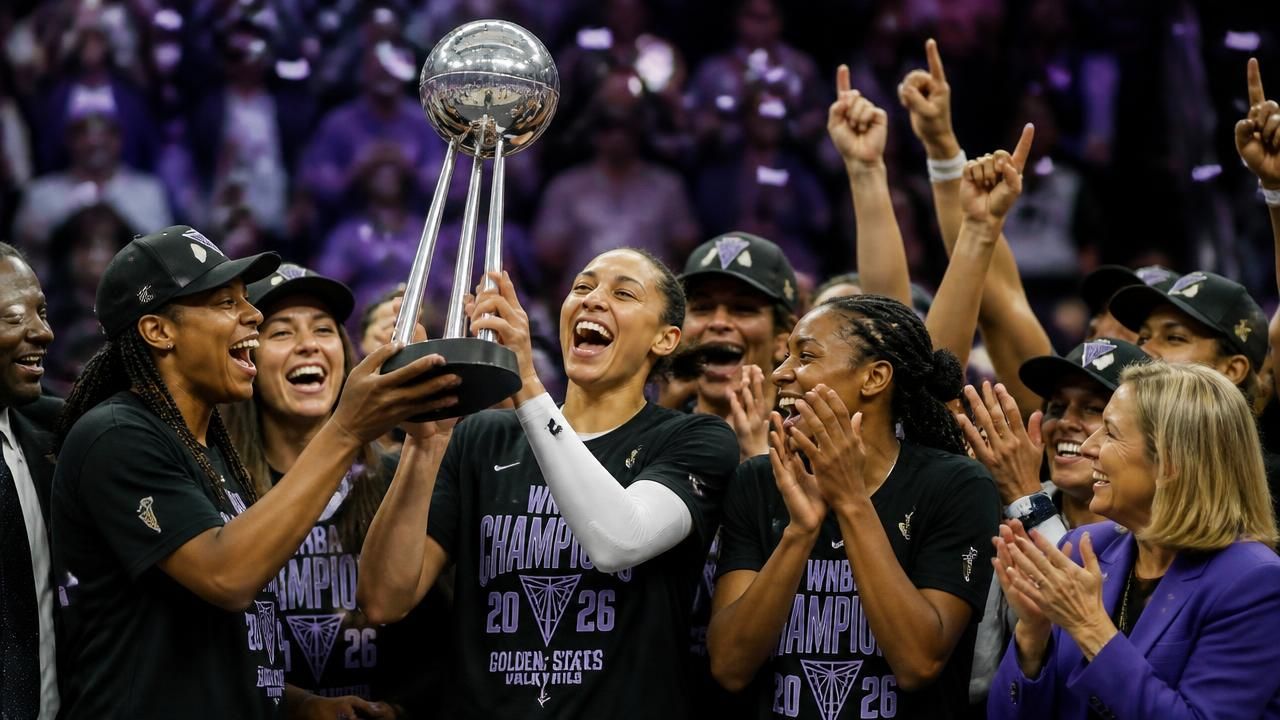
The Golden State Valkyries won the 2026 WNBA championship, defeating the Atlanta Dream 68-63 in Game 7 of the Finals and completing one of the fastest rises in league history. The title comes in only the franchise’s second year of existence—a run that moved from expansion curiosity to Bay Area phenomenon to champion. Her Campus put the outcome plainly in its headline: “The Golden State Valkyries Are the 2026 WNBA Champions.”
The Valkyries entered the league as the WNBA’s first expansion team in 17 years, and expectations were modest. But as The New York Times noted in a feature on the club, they quickly became a local sensation.
“Expectations were low for the Golden State Valkyries ... but they captivated Bay Area sports fans and surprised the league by securing a playoff spot in their first season.”That first-year playoff berth was a warning. By Year 2, Golden State had reached the Finals and then finished the job in a decisive Game 7.
A final decided by star power and defense
The Guardian’s live coverage recorded the final score as Atlanta Dream 63, Golden State Valkyries 68, capturing a tense, low-scoring Game 7 that fit the defensive themes previewed before the series. The New York Times’ Finals preview had framed the matchup around two questions: whether the Valkyries or Dream held the defensive edge, and whether Gray would be back. The answers arrived in a final that demanded stops as much as shot-making.
Golden State’s breakthrough was powered by Gabby Williams, the player the franchise chose to run its offense. The New York Times described how the Valkyries “gave Gabby Williams the keys” and how she turned an expansion team into a Bay Area phenomenon. In the Finals, MSN reported, Williams “summoned an all-time heater” to lift Golden State to the Game 7 victory. Her performance became the defining individual story of a series that otherwise belonged to team defense and timely role-player contributions.
Williams, UConn ties and the Kiah Stokes bet
The Hartford Courant observed that Golden State was loaded with former UConn stars, but that one player had become the center of attention—a nod to the program’s influence on the roster and to Williams’s rise as the face of the franchise. The Press Democrat’s Kurtenbach took a sharper view, arguing that the Valkyries “mocked WNBA convention” in how they built the team, and that Kiah Stokes has proved the approach right. That framing captures a larger truth about this champion: Golden State did not follow a traditional expansion script. It bet on a distinctive mix of established veterans, unconventional role players and a lead guard who could make the whole thing cohere.
Atlanta’s challenge and the Reese factor
Atlanta did not arrive as a mere foil. The Mercury News warned before the Finals that Golden State “will have their hands full” with Angel Reese, the Dream’s centerpiece and a player capable of controlling a series through rebounding, defense and physicality. Reese’s presence gave the Finals a star-vs-star subplot and forced the Valkyries to solve a problem they had not faced in the same way during their first-year playoff run.
The tactical chess match began early. The Arizona Republic noted after Game 1 that the Valkyries had “found a way” and needed to repeat it. ESPN’s Finals guide promised predictions and a path to victory for each team, while local coverage in the Mercury News and East Bay Times emphasized how rare Golden State’s ascent was. The Mercury News called the run “ahead of schedule” and unlike any other in league history; the East Bay Times described the Finals berth as “so unimaginable but so realistic.”
Why this title matters
The Valkyries’ championship is a business story as much as a basketball one. The New York Times framed Golden State as “the most valuable team in women’s sports,” and the club’s on-court success has reinforced its off-court appeal in one of the country’s largest and most competitive sports markets. A second-year champion in the Bay Area gives the WNBA a powerful marketing asset and a test case for expansion: can a new team build a winning identity quickly without inheriting a traditional roster?
It is also a story about how quickly expectations can shift. In Year 1, a playoff spot was a surprise. In Year 2, anything short of a title would have felt like a disappointment. The Valkyries bridged that gap with Williams’s shot-making, a defense-first identity and a willingness to ignore conventional expansion wisdom. The result is a championship that will be remembered less as a Cinderella story than as a blueprint—one that other expansion franchises will study, and one that the Bay Area has already embraced.
For Atlanta, the loss closes a Finals run built around Reese’s force and a defense that made Golden State work for every possession. For the Valkyries, the confetti is only the beginning of a new set of questions: how to defend a title, how to keep a young fan base engaged, and how to turn a two-year rise into a lasting dynasty. For now, the answer is simple: Golden State is no longer an expansion experiment. It is a WNBA champion.