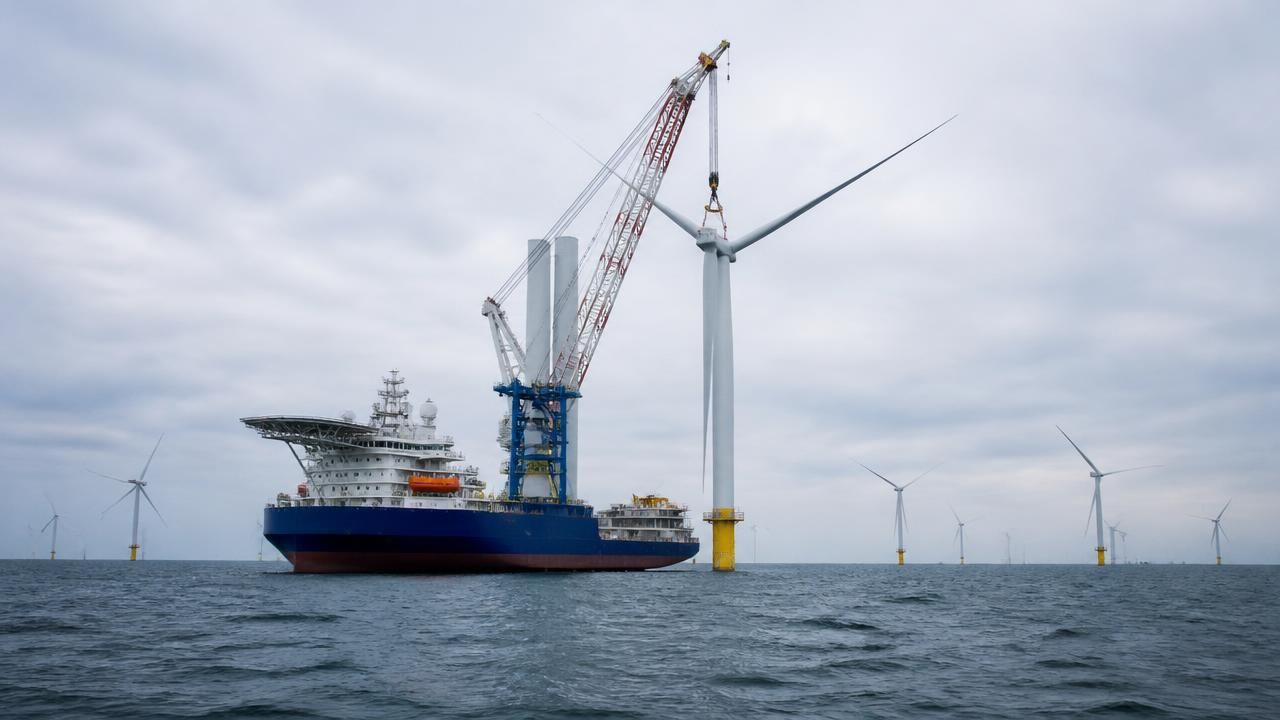
Orsted A/S has installed the final turbine at its Revolution Wind project off the Rhode Island coast, completing construction of the 704-megawatt farm that has become the central battleground in the Trump administration's campaign against the nascent American offshore wind industry. The last of the project's 65 Siemens Gamesa machines was set in place in recent days, and the developer expects the wind farm to reach full commercial operation later this year.
Once fully energized, Revolution Wind will send power to Rhode Island and Connecticut — enough electricity for roughly 350,000 homes — from a site about 15 miles south of the Rhode Island coastline, making it one of the largest offshore wind facilities in US waters. Shares of the Copenhagen-listed developer rose on the news, a modest relief rally for a stock that has been battered by the sector's cost crisis and by the political risk now attached to anything with a blade in American waters.
A project that became a political lightning rod
Revolution Wind was never a purely commercial story. It was the first utility-scale offshore wind farm to begin construction under the current administration's shadow, and it quickly became the test case for President Donald Trump's long-standing hostility to the technology. Trump has called turbines ugly, expensive and lethal to birds, and in his first days back in office he declared that his government would not support the industry.
"We're not going to do the wind thing," Trump said in remarks widely reported at the start of his term, arguing that turbines spoil landscapes and cost more than fossil alternatives.
That rhetoric hardened into policy. A day-one executive order paused new offshore wind leasing on the Outer Continental Shelf and directed agencies to review existing approvals, while Interior Secretary Doug Burgum issued a secretarial order requiring a fresh audit of wind permits already granted. In late August, the Bureau of Ocean Energy Management ordered Orsted to halt construction at Revolution Wind, citing unspecified national-security concerns including potential interference with radar systems.
The legal back-and-forth
The stop-work order did not survive contact with the courts. A federal judge in Washington allowed construction to resume within weeks, finding that the government had offered little more than assertion to justify yanking an approval that had already survived years of environmental review. Orsted's crews went back to work, and the project kept grinding toward completion.
But the administration has not accepted that outcome. According to reports, the Interior Department has moved to formally reconsider — and potentially rescind — the project's approved construction and operations plan, reopening a permitting fight that developers had assumed was settled. Industry lawyers describe the maneuver as an attempt to relitigate through administrative procedure what the government lost in court, and it has renewed uncertainty across a sector that has already written off tens of billions of dollars of planned investment.
The framing differs sharply by outlet. Bloomberg cast the turbine milestone as a completed project the president tried and failed to stop. Trade and market outlets such as ad-hoc-news read the same event through a share-price lens, emphasizing the relief for Orsted. The Boston Herald and The Hill framed the moment as the opening of a new round in the fight, with Washington reviving its effort to halt a farm that is nearly finished. The underlying facts are identical; the emphasis is not.
Markets, costs and the price of uncertainty
For Orsted, the completion is a hard-won operational win after a punishing stretch. The company booked billions of kroner in impairments tied to its US portfolio, scrapped two New Jersey projects outright, cut its dividend and replaced its chief executive. Rising interest rates, snarled supply chains and turbine quality problems have squeezed every developer in the sector. Political risk is now a fourth variable, and one that cannot be modeled with a discount rate.
- Revolution Wind: 704 MW, 65 turbines, serving Rhode Island and Connecticut.
- Orsted now owns the project outright after buying out its utility partner's stake.
- The 2025 stop-work order froze construction for weeks before a federal judge intervened.
- Other US projects, including Vineyard Wind off Massachusetts, have faced similar suspensions and litigation.
The deeper problem is credibility. Offshore wind is a decade-long, multi-billion-dollar bet on a stable permitting regime. When a completed approval can be reopened on national-security grounds, lenders price that risk into every future deal — and states in the Northeast, which have legislated mandates for offshore power, find themselves exposed.
Congress looks for a legislative fix
Lawmakers have begun exploring whether to write protections into statute, according to reports from Washington. The emerging effort would require the Interior Department to show documented cause before suspending or revoking an approved offshore wind permit, and would give developers a defined administrative appeal path rather than forcing them into emergency litigation. Supporters argue the measure would restore predictability without stripping the executive branch of legitimate safety or security authority; critics say it is an attempt to tie the president's hands after he lost in court.
Whether such a bill can pass a divided Congress — and survive a likely veto — is far from clear. More immediate is the question of whether the administration can halt a wind farm whose turbines are already standing in the water.
What happens next
Orsted's near-term task is commissioning: testing the array, energizing the export cable and moving toward full output while the legal clock runs. A final adverse ruling could complicate operations even if it cannot un-build the project. For the wider industry, Revolution Wind is now both a template and a warning — proof that US offshore wind can be finished, and proof of how much it costs to get there.