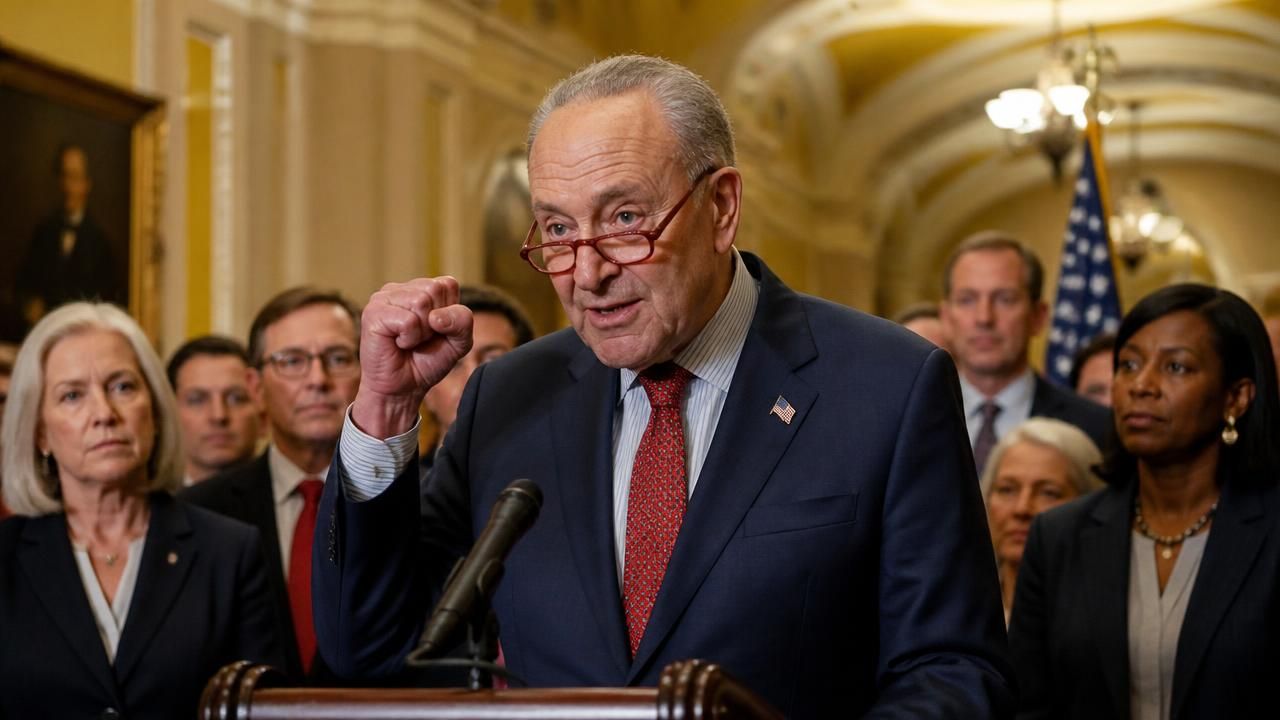
WASHINGTON — Democrats have won control of the U.S. Senate in the 2026 midterm elections, a result Senate Minority Leader Chuck Schumer described as a “generational remake” of the chamber and the political map. Speaking the day after his party flipped control of Congress, Schumer said voters had spoken clearly about their priorities and that Democrats now must deliver. The remarks were carried live by PBS News and reported by NPR Politics and its local affiliate WFDD, which framed the moment around Schumer’s claim of a historic shift.
NPR’s headline was direct: “Chuck Schumer heralds Democrats’ ‘generational remake’ of Senate.” The story emphasized that Schumer, the Senate minority leader, was already looking past the result to the governing challenge ahead. “We have seen a generational remake of the Senate map,” Schumer said, according to Yahoo and MSN syndicated versions of the story. Another MSN headline captured the leader’s mood more bluntly: “Schumer exults over Democratic Senate: ‘Wow, wow, wow.’”
A wave, and a redrawn map
The Democratic win was described across outlets as a wave election, but the coverage did not settle on a single meaning. MSN also published a cautionary headline: “The political map is anyone’s guess after a Democratic wave in the midterm elections.” That tension—between Schumer’s triumphal language and the uncertainty of a newly drawn map—ran through the day’s reporting. For NPR and WFDD, the story was about a party leader claiming a mandate and promising to convert it into legislation. For MSN’s syndicated feed, the same event was sometimes a victory lap and sometimes a reminder that waves can recede.
“We have seen a generational remake of the Senate map.” — Sen. Chuck Schumer
The phrase “generational remake” is politically loaded. It suggests not just a one-cycle gain but a durable shift in which states and constituencies are competitive. The available reports did not specify the exact size of the Democratic majority or the seat-by-seat results, but the outcome was enough for Schumer to claim that voters had rejected the previous balance of power. It also gives Democrats control of the Senate floor, committee gavels and the confirmation process—levers that shape judicial nominations, executive appointments and oversight.
Razor wire and relief
Where NPR stressed Schumer’s call to deliver, CBS News stressed confrontation. Its headline said Schumer “vows ‘legislative razor wire’ against Trump” after Democrats won Senate control. The phrase signals a strategy of procedural resistance and aggressive floor management: using Senate rules, amendments and oversight to block or shape Trump-backed priorities while forcing Republicans to take difficult votes. It is a message aimed at the Democratic base, which has demanded that the party not squander a midterm win.
The official transcript from Senate Democrats offered a softer, more reassuring frame. Under the title “After Historic Gains & With A New Senate Majority, Leader Schumer Tells Americans ‘Relief Is On The Way,’” the party sought to present the victory as a deliverable, not merely a defeat for the other side. Schumer’s public remarks, carried by PBS, mixed those notes: relief for voters who want action, and razor wire for a president who wants to set the agenda.
“Relief is on the way.” — Senate Democrats’ transcript of Schumer’s remarks
A leadership test inside the caucus
The triumph was not entirely frictionless. MSN reported that Schumer “has votes for majority leader despite some Democratic dissent.” The report did not detail the source of that dissent, but the headline alone signaled that the new majority will have to manage an internal coalition as well as a Republican opposition. In the Senate, where a single member can slow or reshape legislation, such friction can matter as much as the party’s nominal majority. Schumer’s challenge is to keep his caucus united while negotiating with Republicans and defending Democratic priorities.
The leadership vote also complicates the story of a clean mandate. A wave election can strengthen a leader’s hand, but it can also embolden competing factions that believe they contributed to the win. Schumer’s allies will point to the map and the majority; his critics will point to the dissent and ask whether the party’s message is sharp enough. The public remarks were designed to settle that argument by projecting confidence.
What comes next
With control of the Senate, Democrats can set the floor agenda, launch investigations and act as a check on Trump. But the majority’s power is not unlimited. The Senate’s sixty-vote cloture rule, the need to protect vulnerable incumbents and the prospect of divided government will shape what Schumer can actually pass. His “razor wire” language suggests he will prioritize blocking over bargaining when the two conflict, while the “relief is on the way” message suggests he wants voters to see tangible results before the next election.
The 2026 result also resets the political map for both parties. Democrats will try to recruit candidates in states that now look more competitive; Republicans will try to argue the wave was a one-off. MSN’s “anyone’s guess” framing may prove the most durable: the Senate majority is real, but the meaning of the wave will be fought over in the months ahead. For now, Schumer has the votes, the gavel and a phrase—“generational remake”—that his party hopes will define the new era.