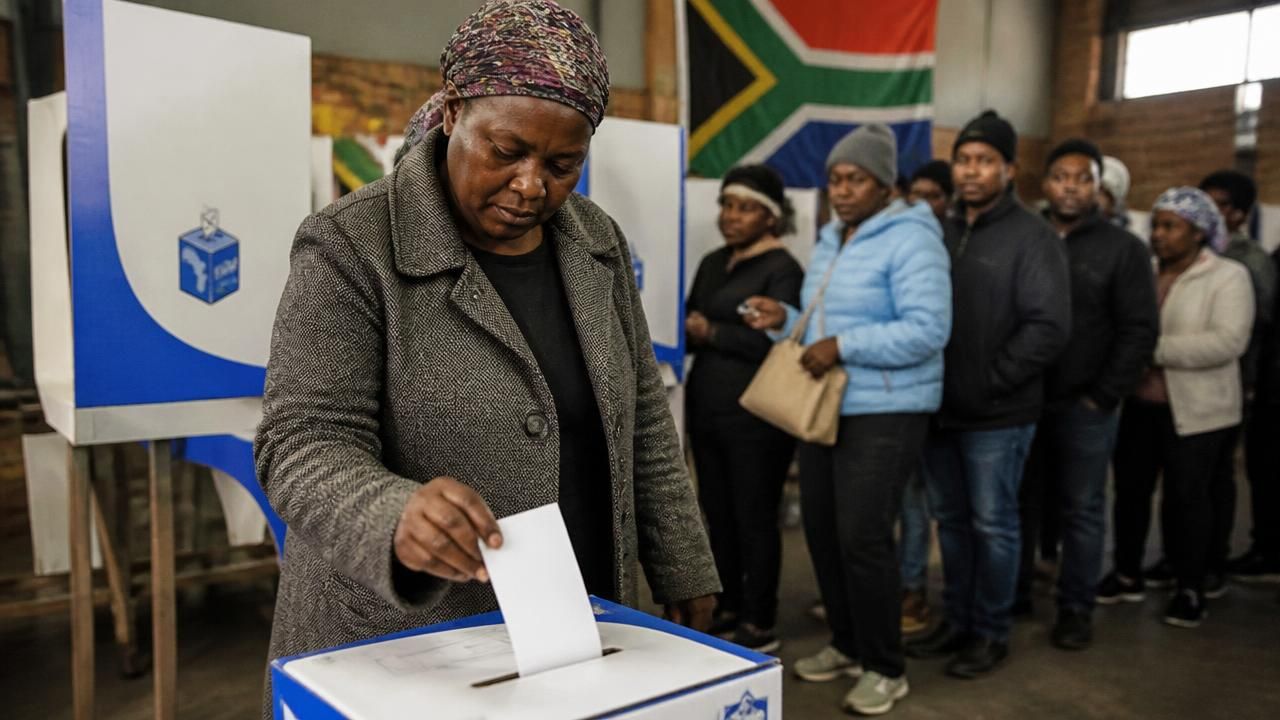
South Africans went to the polls on Wednesday in municipal elections widely seen as the toughest test yet for the African National Congress, the liberation movement that has governed since Nelson Mandela's historic 1994 victory ended apartheid. Across the country's metros and rural municipalities, voters cast ballots amid deep frustration over water outages, rolling power cuts, sewage spills and crumbling roads — grievances that polls suggest could push the ANC to its weakest result since democracy began.
The party is still expected to emerge as the largest single force, but surveys point to it winning less than a third of the vote — a striking fall from the 45.6% it secured in the 2021 municipal elections and the 40.2% it took in the 2024 national poll. If the projections hold, the result would confirm a steady, accelerating erosion of the ANC's hegemony and further complicate its efforts to hold together fragile coalition governments in key cities.
A liberation movement under siege
The contest is being reported internationally less as a routine local ballot than as a referendum on the ANC itself. Britain's Financial Times framed the campaign around the everyday failures of the state — "dry taps, sewage spills, power cuts and bad roads" — while the Guardian described a party "on course for a bruising result" as voters punish it for poor service delivery. Newsday called the vote "a tough test for the ruling ANC," and MSN's coverage struck a similar note, describing a party "under pressure to reverse South Africa's decline."
Reuters, meanwhile, emphasised a different but related grievance: anger at corruption, which it said has dented public faith in both the party and the presidency ahead of the ballot. Together the framings converge on a single narrative — that the ANC's electoral arithmetic is now being shaped less by its liberation credentials than by the lived experience of the people it governs.
Water, power and the politics of neglect
The most potent symbols of that experience are mundane and daily. Residents in several provinces report taps that run dry for days, substations that fail under load-shedding, and wastewater treatment works that discharge into rivers and streets. Municipalities — which are constitutionally responsible for water reticulation, electricity distribution, sanitation and local roads — have become the frontline of public anger, and the audit failures of many councils have become a campaign issue in their own right.
The economic backdrop sharpens the frustration. Official unemployment remains among the highest in the world, with youth joblessness far higher, and household budgets are squeezed by high food and fuel prices. For many voters, local government was supposed to be the most tangible tier of the democratic dividend; instead, it has become the most visible evidence of state decay.
Corruption and the presidency
The ANC's difficulties are compounded by the standing of President Cyril Ramaphosa, whose reformist promise has been tested by repeated corruption scandals, factional warfare inside the party and the constraints of governing in coalition with rival parties. Reuters reported that anger over graft has sapped confidence in the president and his party before the poll — a warning sign in urban wards where the ANC once enjoyed overwhelming loyalty.
The party's internal divisions have also spilled into candidate selection, with disputes over lists and wards producing independent and splinter candidacies that could further fragment its vote, particularly in Gauteng and KwaZulu-Natal.
The 'born free' generation
Analysts point to a generational shift as one of the structural forces behind the decline. South Africans born after 1994 — the so-called "born free" cohort — have no personal memory of apartheid and increasingly judge the ANC on delivery rather than history. Reporting from Digital Journal captured a mood of "anger, determination" among these voters, many of whom are considering opposition parties or simply staying home.
"No electricity, no vote."
That slogan, reported by Nigeria's Punch, encapsulates a threat the ANC has heard before but rarely at this volume: that service failure translates directly into abstention or defection. Low turnout would be a double blow, weakening the legitimacy of councils at the very moment they need credibility to attract investment and fix infrastructure.
What is at stake
The results will determine control of South Africa's metropolitan giants, including Johannesburg, Tshwane, Ekurhuleni, eThekwini and Nelson Mandela Bay — cities that generate the bulk of national economic output. Several are already run by unstable coalitions that have churned through mayors and executives, hampering budget execution and capital projects.
- Coalition arithmetic: a weaker ANC will have to negotiate with more partners, raising the risk of further municipal instability.
- National signal: the vote is being read as an early indicator for the 2029 general election.
- Service delivery: voters are demanding measurable improvements in water, power and sanitation rather than new promises.
- Party reform: a poor showing will intensify internal pressure on the ANC's leadership to renew or be replaced.
The ANC can still point to its role in building a constitutional democracy, expanding social grants and extending electricity and water to millions who lacked them under apartheid. Reuters' reporting from poor communities, however, suggests that for many households the party now feels like an institution that has "passed them by" — a sentiment that no amount of historical credit can offset at the ballot box.
Whatever the final tally, the election looks set to mark another milestone in South Africa's slow transition from liberation politics to competitive, accountability-driven politics. The question for the ANC is whether it can reinvent itself as a party judged on service delivery before the voters finish the job of redefining it.