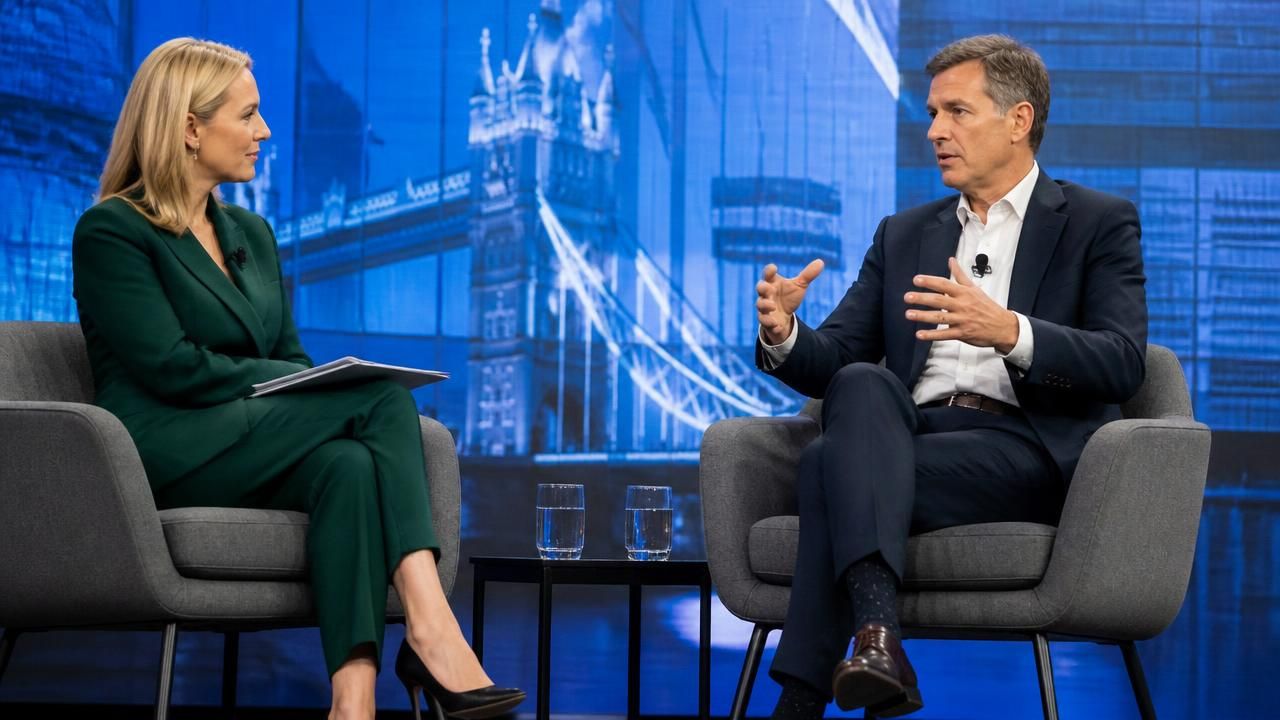
Schneider Electric and Bloomberg New Economy have launched an Energy Technology Coalition aimed at unlocking what the two organizations call the future of "smart demand," a push to reshape how electricity is generated, distributed and consumed as artificial intelligence workloads strain power systems worldwide. The initiative was unveiled alongside Schneider's appearance at Bloomberg Tech 2026 in London, where the company's executive vice-president for energy management, Frédéric Godemel, sat down with Bloomberg's Dana Perkins to discuss the energy systems and infrastructure required to sustain AI-driven growth.
The announcement circulated quickly through financial media, with the headline — "Schneider Electric and Bloomberg New Economy Launch Energy Technology Coalition to Unlock the Future of 'Smart Demand'" — carried by aggregators including Yahoo Finance and Ad-hoc-News. Bloomberg's own coverage centered less on the press release than on the substance behind it: a wide-ranging on-stage conversation about whether the world's grids can physically absorb the electricity demand that the AI boom is creating.
What the coalition is meant to do
Details of the coalition's membership, governance and funding were not fully spelled out in the initial materials, but its framing is deliberate. The phrase "smart demand" signals a shift away from the industry's traditional reflex — build more generation — toward managing consumption itself: shifting flexible loads to hours when renewable power is abundant and grids are less congested, and using software to coordinate thousands of industrial, commercial and residential endpoints in near real time.
Schneider Electric and Bloomberg New Economy launch Energy Technology Coalition to "unlock the future of smart demand."
For Schneider, a French multinational with deep positions in electrical distribution, industrial automation and data-center power, the coalition extends an existing strategic bet: that the electrification and digitization of energy are the same business. The company has spent years repositioning its portfolio around grid software, microgrids and data-center cooling and power architecture, all categories that become more valuable as AI clusters multiply.
Why now: the AI power crunch
The timing reflects a genuine inflection point. Hyperscale data centers have grown from marginal electricity consumers to some of the largest single loads on regional grids in the United States, Ireland, Singapore and beyond. Grid interconnection queues in major markets stretch years, transformer and switchgear lead times have extended sharply, and utilities in several regions have revised demand forecasts upward for the first time in a generation.
That collision between AI capital expenditure and physical infrastructure is now a boardroom issue on both sides of the Atlantic. Technology companies increasingly find that their growth plans are gated not by chips or capital but by whether a substation can be energized on schedule. Schneider's argument — that the answer lies as much in flexibility and efficiency as in new megawatts — is one that utilities, regulators and large power buyers are all being forced to evaluate.
How outlets framed it
The story landed differently depending on the outlet. Bloomberg treated it as a technology-and-infrastructure conversation, using the Godemel interview to examine the physical buildout behind AI. Syndicated financial coverage, by contrast, led with the corporate partnership itself — a coalition announcement framed as a market-moving collaboration between a European industrials giant and a Bloomberg editorial franchise. The gap between those two framings is itself revealing: the press release sells a partnership, while the underlying question is whether demand-side technology can scale fast enough to matter.
The open questions
- Scope: Whether the coalition will function as a research body, a standards-setting forum, or a lobbying vehicle for favorable treatment of demand-flexibility technologies.
- Membership: Whether utilities, hyperscalers and regulators will join — or whether it remains primarily a vendor-led effort.
- Metrics: What "success" looks like, and whether the group will publish measurable targets for load shifting, grid utilization or emissions.
- Geography: Whether the effort is global or focused on the U.S. and European markets where grid constraints are most acute.
Industry analysts have broadly welcomed demand-side approaches while cautioning that flexibility cannot substitute for physical infrastructure. Efficiency and load management can compress the capacity gap at the margin, but transmission lines, transformers and dispatchable generation still take years to permit, finance and build. The risk, critics note, is that a well-publicized coalition creates a perception of progress without accelerating a single interconnection.
What to watch
Schneider's next moves will be instructive. The company is expected to use the platform to push its grid software and data-center power offerings to an audience of utilities and large energy buyers, and to argue that AI's power problem is as much an engineering and software opportunity as a constraint. Whether Bloomberg New Economy's convening power can translate a coalition launch into concrete commitments — from hyperscalers, utilities and governments — is the test that will determine whether "smart demand" becomes a durable part of the AI infrastructure conversation or simply another conference headline.
For now, the message from London is clear: the AI economy's bottleneck is increasingly measured in megawatts, and the companies that can move them — or avoid needing them — stand to gain.