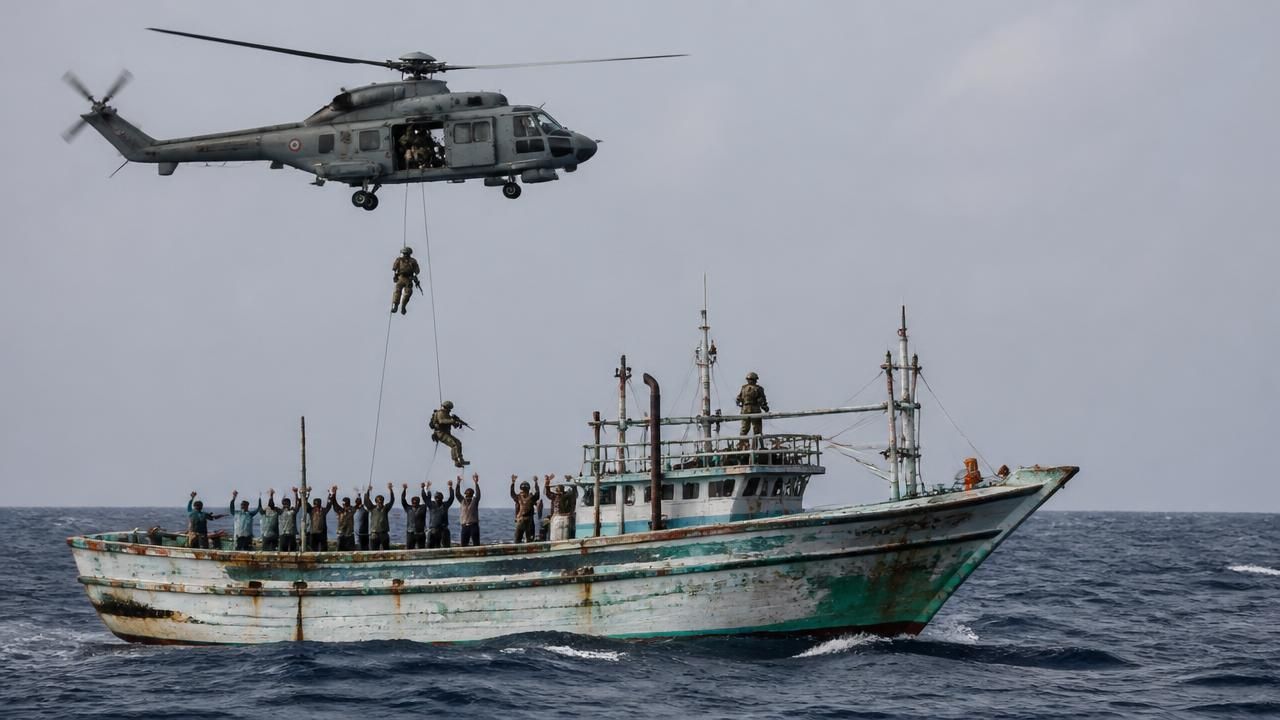
The Indian Navy has rescued 20 crew members from an Iranian fishing vessel hijacked by Somali pirates off the coast of Somalia, according to multiple reports, ending a dramatic 48-hour operation that involved a warship, a maritime surveillance aircraft and marine commandos. The vessel was named in several accounts as the Azini. The rescue underscores a renewed threat from Somali piracy in the Gulf of Aden and the western Indian Ocean, a waterway critical to global shipping.
Reports differed on some details. Most outlets, including NPR, Cleveland.com and MSN aggregations, said the navy rescued 20 crew from the Iranian fishing boat. Several accounts described the crew as Iranian. Hindustan Times, however, reported that the Indian Navy foiled “another piracy attempt” off Somalia and rescued 11 Iranian and eight Pakistani nationals—19 people in total. The discrepancy may reflect separate incidents, evolving information or confusion in early reporting. What is clear is that Indian naval forces intercepted a hijacked vessel and freed its crew after a prolonged operation.
A daring airborne insertion
According to the accounts, the operation unfolded over roughly 48 hours. The Indian Navy deployed a warship and a maritime surveillance aircraft to locate and monitor the hijacked fishing vessel. Marine commandos then parachuted onto the ship, a tactic that allows forces to retake a vessel quickly before pirates can harm hostages or escape. The combination of air surveillance, naval presence and specialized commando teams is central to modern counter-piracy operations.
- Warship: provided command, control and boarding capability.
- Maritime surveillance aircraft: helped track the vessel.
- Marine commandos: parachuted onto the hijacked ship to retake it.
- Duration: about 48 hours from hijack to rescue.
The hijacking followed a resurgence of Somali piracy across the Gulf of Aden and western Indian Ocean.
Why Somali piracy is back in the headlines
Somali piracy surged between 2008 and 2012, prompting international naval patrols, armed guards on merchant ships and better onboard security. Attacks fell sharply. But recent years have seen a resurgence, with pirates exploiting gaps in patrol coverage and targeting smaller vessels, including fishing boats, that lack robust defenses. The Gulf of Aden and western Indian Ocean remain among the world’s most important maritime corridors, carrying a significant share of global trade and energy shipments.
The hijacking of the Azini fits a pattern: pirates seize a smaller vessel, use it as a mother ship or hold crew for ransom, and challenge naval forces to respond quickly. India has been an active participant in anti-piracy patrols, deploying warships and aircraft to protect shipping lanes and rescue crews. The latest operation demonstrates both the capability and the limits of naval power: while commandos can retake a ship, persistent patrols and intelligence-sharing are needed to deter attacks.
Different outlets, different emphasis
Coverage of the rescue varied by outlet. NPR emphasized the multi-asset operation—warship, surveillance aircraft and marine commandos—and placed it in the context of a piracy resurgence. MSN and other aggregators focused on the dramatic 48-hour timeline and the number of crew freed. Malay Mail highlighted the parachute insertion by commandos. Hindustan Times, meanwhile, framed the news as “another piracy attempt” and reported a different crew breakdown, with 11 Iranian and eight Pakistani nationals. That variation illustrates how breaking news can produce competing snapshots before official details are fully consolidated.
For regional governments, the incident is a reminder that Somali piracy did not disappear. It also highlights Iran’s exposure: Iranian fishing vessels operate in the same waters, and Tehran has occasionally deployed its own naval assets to protect shipping. The involvement of Pakistani nationals, as reported by Hindustan Times, would add another layer of regional complexity if confirmed.
What happens next
The immediate outcome—20 crew rescued after a 48-hour operation—is a success for the Indian Navy. But the broader challenge remains. Counter-piracy requires sustained naval presence, intelligence cooperation and better security practices on vulnerable vessels. Fishing boats are especially at risk because they often travel without armed guards or hardened bridges. Without continued patrols, pirates may continue to exploit the vast expanse of the western Indian Ocean.
The rescue also raises questions about reporting accuracy in fast-moving maritime incidents. Crew numbers and nationalities can change as officials verify identities and accounts. The Indian Navy has not, in the sources reviewed, provided a full statement reconciling the 20-crew and 11-Iranian/eight-Pakistani figures. Until it does, the episode will be remembered for the dramatic image of commandos parachuting onto a hijacked ship—and for the reminder that piracy, like the sea itself, is difficult to contain.